Two runners can run the same distance each week and get very different results. The difference is often the schedule: which days are hard, which are easy, and where the rest days sit. A good schedule lets you recover between key runs, so each one counts.
The short answer
A good running schedule has mostly easy runs, one or two harder sessions, one long run and enough rest, arranged so that hard days are never back to back; 3 to 5 days a week suits most recreational runners.
The building blocks
| Run | What it does | How often |
|---|---|---|
| Easy run | Builds your aerobic base, helps recovery | Most of your runs |
| Long run | Builds endurance | Once a week |
| Workout | Tempo, intervals or hills: builds speed and threshold | 1 to 2 a week |
| Recovery run | Very easy, short, after a hard day | Optional, for 5+ days |
| Rest day | Recovery and adaptation | 1 to 4 a week |
Learn more about each: easy runs, long runs, tempo runs and intervals.
Weekly templates
3 days a week
Great for beginners and busy runners. Tuesday easy, Thursday workout (or easy for beginners), Saturday long run. Rest on the other days, or add walking or cycling.
4 days a week
Tuesday workout, Wednesday easy, Friday easy, Saturday long run. Rest Monday, Thursday and Sunday. This is the sweet spot for many recreational runners.
5 days a week
Tuesday workout, Wednesday easy, Thursday easy or second workout, Saturday long run, Sunday recovery run. Rest Monday and Friday.
6 days a week
Tuesday workout, Wednesday easy, Thursday workout or steady run, Friday easy, Saturday long run, Sunday recovery run. Rest Monday. Suits experienced runners building towards a half or full marathon.
| Days | Mon | Tue | Wed | Thu | Fri | Sat | Sun |
|---|---|---|---|---|---|---|---|
| 3 | – | E | – | W | – | L | – |
| 4 | – | W | E | – | E | L | – |
| 5 | – | W | E | E | – | L | R |
| 6 | – | W | E | W | E | L | R |
How to build your own schedule, step by step
- Count your realistic days. Pick the number you can keep for months, not the number you wish for.
- Place the long run on the day you have the most time, often Saturday or Sunday.
- Place one workout 2 to 3 days before or after the long run.
- Fill the rest with easy runs and put rest days after hard days.
- Check the rule: no two hard days in a row.
- Every 3 to 4 weeks, make one week easier (about 70 to 80% of normal).
Getting the balance right
Aim for about 80% of your running time at an easy, conversational pace and about 20% harder, as described in 80/20 running. The long run is usually 20 to 30% of the week. Most runners do not need more than two hard sessions a week; one is enough for many.
Adjusting for your goal
Fitting running into real life
- Short on time on weekdays? Keep weekday runs at 30 to 40 minutes and do the long run at the weekend.
- Shift work or travel? Plan by the number of runs per week, not fixed days.
- Family commitments? Early morning runs and a weekly long run with a set start time help it stick.
- Hot climate? Put key sessions in the cool early morning or evening.
Example: one runner's week, step by step
Sam works office hours, has two children and wants to run a 10K faster. Sam can run four times a week: two weekday mornings before work, Thursday evening and Saturday morning. Saturday has the most time, so it becomes the long run (60 to 75 minutes). Tuesday morning is the workout (intervals or tempo), three days away from the long run. Thursday evening and one more weekday morning are easy runs of 30 to 40 minutes. Monday, Wednesday and Sunday are rest days for family time. The week has one workout, one long run, two easy runs and no hard days back to back: simple, and easy to keep for months.
When to change the schedule
A schedule is a guide, not a contract. Swap a hard day for an easy one when you slept badly, feel ill or your legs are still heavy from the last session. Move the long run if the weather is dangerous. And every few months, review it: as your fitness grows, you may add a day, lengthen the long run or add a second workout.
Common mistakes
- Every run medium hard, so there are no truly easy or truly hard days.
- Hard workout the day after the long run.
- Copying an elite schedule with twice your usual distance.
- Never changing the schedule when you feel ill or very tired.
Plan your week in Windlace
- Open My Weekly Schedule and set the days you usually run and what you do on each day.
- Set a goal with Break the PR: the plan is built around your weekly schedule.
- Set a weekly mileage goal: it shows as a dashed line on your weekly mileage chart.
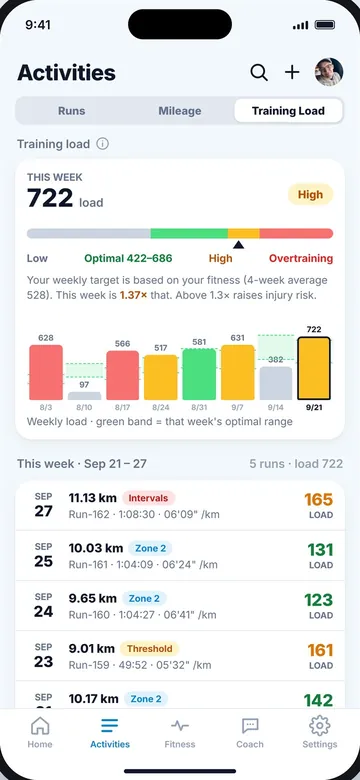
- Check recovery and training load to know when to swap a hard day for an easy one.
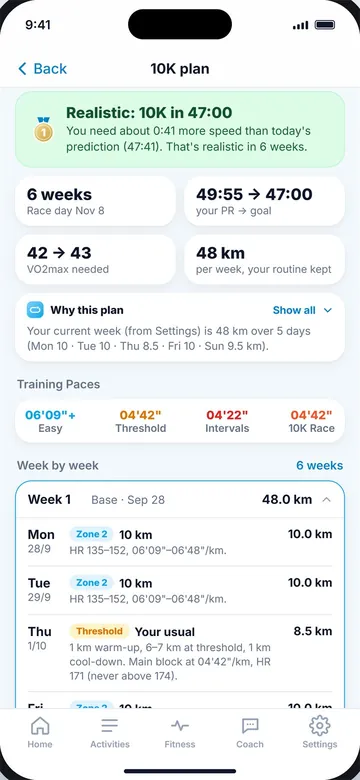
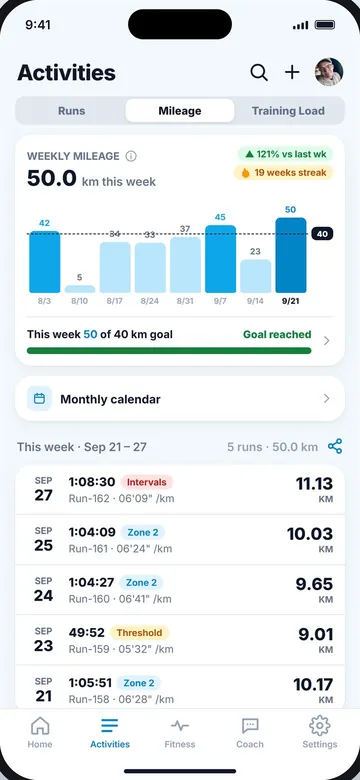
A plan built around your week (left) and weekly mileage with your goal (right).
Key takeaways
- A good schedule mixes easy runs, one or two workouts, one long run and rest.
- Never put two hard days in a row; place rest or easy days between them.
- 3 to 5 running days a week suits most recreational runners.
- Keep about 80% of your running easy, and make every 3rd or 4th week easier.
- Skip a missed run rather than doubling up.
Frequently asked questions
How many days a week should I run?
3 to 5 days suits most recreational runners. Beginners can start with 3, experienced runners may run 6.
What is a good weekly running schedule?
For 4 days: a workout, two easy runs and a long run, with rest days in between.
Should I run on back-to-back days?
Yes, if one of the days is easy. Avoid two hard days in a row.
What day should my long run be?
Usually the day you have the most time, often Saturday or Sunday, with an easy or rest day after.
How many hard runs a week?
One or two. Most of your running should be easy.

Keep reading
 Training80/20 running: why slow training makes you fasterWhere 80/20 running comes from, why it works, how to measure it, and a simple 80/20 week.9 min read
 RecoveryRest days for runners: how many do you need?How many rest days you need by level, what to do on them, and the signs you need a day off.9 min read
 TrainingHow much should you run per week?Typical weekly distance for 5K to marathon, how to build it safely, and signs you are doing too much.9 min read