If there is one number that predicts endurance race results better than any other, it is how much you run, week after week, over months. Not one big week. Not one heroic long run. Consistent weekly distance. But the right amount is very personal, and building it too fast is one of the most common causes of running injuries.
The short answer
Most recreational runners do well on about 15 to 30 km a week for a 5K, 25 to 45 km for a 10K, 30 to 55 km for a half marathon and 40 to 70 km for a marathon; the best weekly distance is the most you can run consistently without getting hurt or exhausted.
Typical weekly distance by race
| Race | Beginner | Intermediate | Experienced |
|---|---|---|---|
| 5K | 15 to 20 km | 20 to 35 km | 35 to 60 km |
| 10K | 20 to 30 km | 30 to 45 km | 45 to 70 km |
| Half marathon | 25 to 35 km | 35 to 55 km | 55 to 80 km |
| Marathon | 35 to 50 km | 50 to 70 km | 70 to 110 km |
In miles, divide by 1.6: 40 km is about 25 miles; 65 km is about 40 miles.
Why weekly distance matters so much
Large studies of marathon runners have found that higher training volume is linked to faster finish times, though the link weakens at very high volumes and the risk of injury rises. More is better only up to the point you can absorb it.
How to build your weekly distance safely, step by step
- Start from your average of the last 4 weeks, not your biggest week.
- Add a little: about 5 to 10% a week, or 2 to 5 km, whichever is smaller for you. See The 10% rule.
- Build for 2 to 3 weeks, then ease back for 1 week to about 70 to 80%. This lets your body catch up.
- Hold a new level for a few weeks before building again.
- Add mostly easy running. Do not increase distance and intensity in the same week.
- Add a run before making runs longer, when you can. Four 8 km runs are gentler than two 16 km runs.
How many days a week?
Spreading your distance over more days makes each run shorter and gentler. A rough guide:
- 3 days: fine up to about 25 to 30 km a week.
- 4 days: comfortable up to about 40 km.
- 5 days: up to about 55 to 60 km.
- 6 or more days: for higher distances, usually with some very short recovery runs.
What the week should look like
Most of your weekly distance should be easy, about 75 to 85%. A typical mix: one long run (about 20 to 30% of the week), one quality session such as a tempo run or intervals, and easy runs for the rest. Your long run should grow together with your week; read How long should your long run be?
Time or distance?
Distance is easy to track, but time on your feet is fairer between runners. A runner at 7:00 per km spends 40% longer running 40 km than a runner at 5:00 per km. If you are slower, consider planning by hours a week. Training load, which combines time and intensity, is even better: see What is training load?
Consistency beats big weeks
A runner who runs 35 km every week for a year will almost always be fitter than one who swings between 60 km weeks and weeks off with injury. Your body adapts to what you do regularly, not to your best week. That is why steady building, easier weeks and enough sleep matter more than any single number. If life gets busy, keep a smaller week rather than stopping completely: even two or three short runs hold most of your fitness for a few weeks.
Coming back after a break
After two weeks or more off, do not jump back to your old distance. A common approach is to start at about half of your previous weekly distance and build back over 3 to 6 weeks, depending on how long the break was. After an injury, follow the advice of your physio or doctor, and build even more slowly. Your heart and lungs come back quickly; tendons and bones take longer.
Signs you are doing too much
- Easy runs feel hard and your easy pace slows at the same heart rate.
- Resting heart rate is raised for several days, or HRV is clearly lower.
- Niggles that do not go away after a day or two, especially in shins, Achilles or knees.
- Poor sleep, low mood or no motivation to run.
- Workouts get worse, not better, over 2 to 3 weeks.
If you notice two or more, take an easier week at about 60 to 70% of your normal distance, then build again more slowly.
Weekly distance in Windlace
- Check your weekly distance on the Home tab, and your weeks over time on the Fitness tab.
- Watch your training load and the balance between recent and longer-term load, to spot sudden jumps.
- Check your recovery after hard days before adding more.
- Ask the AI coach how much to run next week. It suggests; you decide.
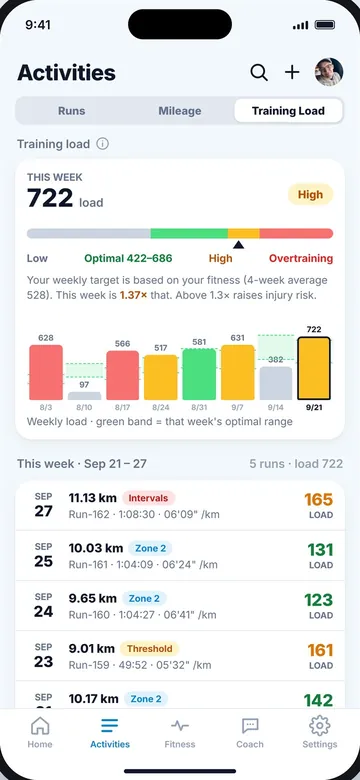
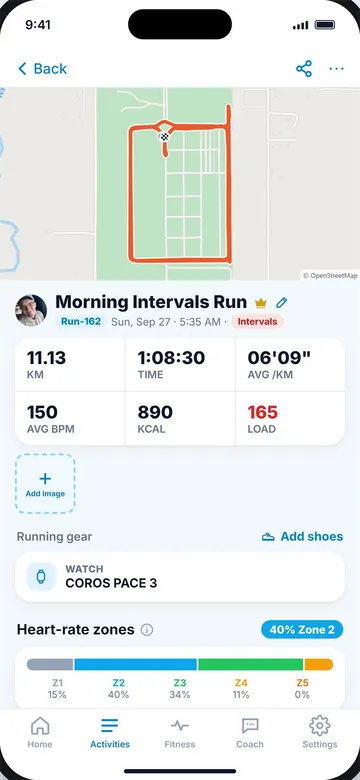
Training load over time (left) and a run summary (right).
Key takeaways
- Typical peaks: 15 to 30 km a week for 5K, 30 to 55 km for a half, 40 to 70 km for a marathon.
- The best weekly distance is the most you can run consistently without injury or exhaustion.
- Build about 5 to 10% a week for 2 to 3 weeks, then ease back for 1 week.
- Keep 75 to 85% of the week easy, and do not raise distance and intensity together.
- Easy runs feeling hard, a raised resting heart rate and lingering niggles mean back off.
Frequently asked questions
How many km a week should I run?
It depends on your goal and experience. Many recreational runners do 20 to 50 km a week; marathon runners often 40 to 70 km at their peak.
How many miles a week for a marathon?
Most recreational marathoners peak at about 25 to 45 miles (40 to 70 km) a week.
How fast can I increase my mileage?
About 5 to 10% a week, with an easier week every 3 to 4 weeks. Build more slowly after a break or injury.
Is running more always better?
Only up to the amount you can recover from. Beyond that, injury and fatigue cancel out the benefit.
Should I count time or distance?
Either works. Time is fairer for slower runners; training load, which includes intensity, is even better.

Keep reading
TrainingThe 10% rule in running: does it really work?What research says about the 10% rule, when it is too fast or too slow, and a smarter way to build.9 min read
 TrainingHow long should your long run be?Simple long run rules by race distance and weekly mileage, the right pace, and how fast to build up.9 min read
TrainingWhat is training load, and how much is too much?How hard your running really was: how training load is worked out, your optimal range, and how to build up safely.10 min read