Almost every runner has heard it: do not increase your weekly distance by more than 10% from one week to the next. It is simple, easy to remember and better than no rule at all. But it was never based on strong science, and following it blindly can be both too fast and too slow, depending on who you are.
What the 10% rule says
The 10% rule says you should not increase your weekly running distance (or time) by more than 10% compared with the week before, to give your body time to adapt and lower the risk of injury.
Example: if you ran 30 km this week, run no more than 33 km next week. Some runners apply it to their long run too.
What the research says
The rule has been tested. In a well-known Dutch study (Buist and colleagues, 2008), novice runners were split into two groups: one followed a slow, 10%-style build-up over 13 weeks, the other a faster 8-week build. About 20% of runners in both groups got injured. Following the 10% rule alone did not protect them.
A later large Danish study of novice runners (Nielsen and colleagues, 2014) found something more useful: runners who increased their weekly distance by more than about 30% over two weeks had a clearly higher risk of certain injuries than those who increased more slowly. Big jumps matter more than small, steady steps.
Research in team sports on the "acute to chronic workload ratio" points the same way: injury risk rises when the last week is much bigger than your average of the last 4 weeks. It is not one number that hurts you; it is a sudden spike.
Where the rule breaks down
A smarter way to build, step by step
- Use your 4-week average, not last week, as your base.
- Add a little: roughly 5 to 10%, or 2 to 5 km, whichever fits your level.
- Build for 2 to 3 weeks, then ease back to about 70 to 80% for one week.
- Hold new levels for a few weeks before the next step up.
- Change one thing at a time: distance or intensity, not both in the same week.
- Listen to warning signs: niggles that last more than 2 days, unusual tiredness or a raised resting heart rate mean hold or back off.
Example: 20 km to 40 km in 12 weeks
| Block | Weeks 1 to 3 | Week 4 (easier) |
|---|---|---|
| Block 1 | 22, 24, 26 km | 20 km |
| Block 2 | 27, 30, 32 km | 25 km |
| Block 3 | 33, 36, 39 km | 30 km |
Twelve weeks later, the runner can comfortably run around 40 km a week. The growth is steady, and no single week is a big jump from the month before.
Who should build more slowly
- New runners: heart and lungs adapt in weeks, but bones and tendons take months.
- Runners coming back from injury, especially bone stress injuries or Achilles problems.
- Older runners, who often need a little more recovery between bigger weeks.
- Anyone adding hills, speed work or a new surface at the same time.
What about the long run?
Many injuries come from one run that is much longer than usual, not from the weekly total. A sensible companion rule: keep your long run to about 20 to 30% of your week, and add no more than 1 to 2 km (or 10 to 15 minutes) to it at a time. If your longest run in the last month was 12 km, jumping to 18 km is a bigger risk than adding a few kilometres spread across the week.
Why training load beats distance
Distance only tells half the story. A 10 km tempo run is much harder than a 10 km easy jog. Training load combines how long you ran with how hard you ran, so it catches spikes that distance misses. Comparing this week's load with your usual 4-week load is the modern version of the 10% rule. Read What is training load? to learn how it works, and How much should you run per week? for target distances.
How Windlace keeps your build-up safe
- See your weekly mileage on the Activities tab, week by week, with your goal as a dashed line.
- Open training load on the Fitness tab. Your optimal range comes from your usual training (4-week average).
- Watch the colour: Low, Optimal, High or Overtraining. High means plan easy days; Overtraining means injury risk is going up.
- Check recovery after big days before adding more.
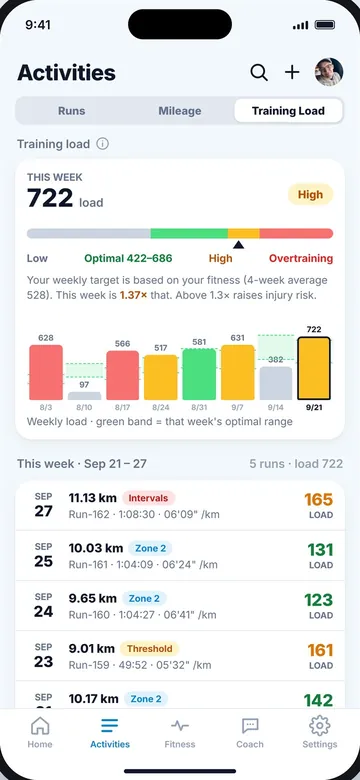
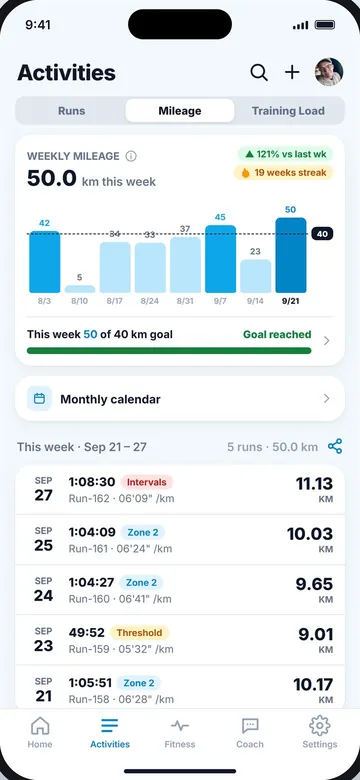
Training load and optimal range (left) and weekly mileage (right).
Key takeaways
- The 10% rule: do not add more than 10% to your weekly distance from one week to the next.
- Studies show it does not prevent injury on its own; sudden big jumps are the real risk.
- Increases of more than about 30% over two weeks were linked to more injuries in new runners.
- Build for 2 to 3 weeks, then ease back for 1, and change distance or intensity, not both.
- Comparing this week's training load with your 4-week average catches spikes that distance misses.
Frequently asked questions
Is the 10% rule good for runners?
It is a reasonable starting point but not proven to prevent injury. Avoiding sudden big jumps and taking easier weeks matters more.
How fast can I increase my running mileage?
About 5 to 10% a week for 2 to 3 weeks, then an easier week. Beginners at low distances can often add a short run safely.
Does the 10% rule apply to the long run?
Many runners use it for long runs too. Adding 1 to 2 km a week to the long run is a common, safe pace.
What if I missed a week of running?
Restart at about the level before the break, not at the level you had planned. Do not double up.
What is the acute to chronic workload ratio?
It compares your last week of training with your average of the last 4 weeks. A much bigger recent week means a higher injury risk.

Keep reading
TrainingHow much should you run per week?Typical weekly distance for 5K to marathon, how to build it safely, and signs you are doing too much.9 min read
TrainingWhat is training load, and how much is too much?How hard your running really was: how training load is worked out, your optimal range, and how to build up safely.10 min read
RecoverySigns of overtraining in runners (and what to do)The early warning signs, how to check your data for them, how to recover and how to avoid it.10 min read