Almost every training plan, from beginner 5K to elite marathon, has one run a week that is longer than the rest. That long run builds the endurance you need to finish strong. Getting its length right is one of the simplest ways to train better.
The short answer
A long run should usually be about 20 to 30% of your weekly distance and no more than about 2.5 to 3 hours, run at an easy, conversational pace; for most runners that means 8 to 12 km for a 5K or 10K, 16 to 20 km for a half marathon and 26 to 32 km for a marathon.
Why the long run matters
Long run length by race
| Race | Peak long run | Peak time |
|---|---|---|
| 5K | 8 to 12 km | 50 to 75 min |
| 10K | 12 to 16 km | 70 to 100 min |
| Half marathon | 16 to 21 km | 1:40 to 2:15 |
| Marathon | 26 to 32 km | 2:30 to 3:00 |
You do not need to run the full race distance before a half marathon or marathon. The adrenaline of race day, the taper and good pacing cover the rest. For marathoners, many coaches cap long runs at around 3 hours, because beyond that the extra fatigue outweighs the benefit, especially for slower runners.
The 20 to 30% rule
A common guideline is that your long run should be about 20 to 30% of your weekly distance. If one run makes up half your week, the jump from your normal runs is too big and the injury risk climbs.
Long run ≈ weekly distance × 0.25 to 0.30
Example: 40 km a week × 0.25 to 0.30 = 10 to 12 km. To run a 20 km long run comfortably, build your week towards about 65 to 80 km over time, or accept that the long run will be a bigger share in peak weeks.
Runners on 3 to 4 days a week often run long runs closer to 30 to 35% of their weekly distance in a marathon build. That can work, but build it slowly. See Weekly mileage for how to grow your week safely.
Long run pace
Most long runs should be easy: about 60 to 90 seconds per km slower than your goal marathon pace, or at your normal easy pace. You should be able to talk the whole way. Heart rate will slowly drift up in the second half, which is normal; read heart rate drift for why.
Once you have a solid base, you can add some faster running to some long runs (not all):
- Fast finish: the last 15 to 20 minutes at marathon or half marathon pace.
- Race-pace blocks: 2 to 3 × 15 to 20 minutes at marathon pace within the run.
- Progression: start easy and speed up by a few seconds per km each third of the run.
How to build up your long run, step by step
- Start from your current long run, not from what a plan says you should be doing.
- Add about 1 to 2 km (or 10 to 15 minutes) each week.
- Step back every third or fourth week to about 70 to 80% of the previous long run.
- Peak 3 weeks before a marathon or 2 weeks before a half, then shorten the long runs as you taper.
- Recover after: the day after a long run should be easy or a rest day.
Fuel and water
For runs under about 75 minutes, most runners need only water, if that. For longer runs, start taking carbohydrate (gels, chews or sports drink) after about 45 to 60 minutes, roughly 30 to 60 grams per hour, and drink to thirst. Long runs are the place to practise your race-day fuelling, so you know what your stomach handles before the big day.
After the long run
What you do in the hours after a long run decides how much you gain from it. Eat a meal or snack with carbohydrate and protein within about an hour, drink to replace what you sweated, and keep moving gently later in the day. The next day should be a rest day or a short, very easy run. Some soreness is normal after a new longest run; sharp or one-sided pain is not, and is a reason to rest and check it before your next run. Read what to eat after a run for simple meal ideas.
Time or distance?
Many coaches prefer to set long runs by time rather than distance, especially for slower runners. A 4-hour marathoner running 32 km might be on their feet for over 3.5 hours, much longer than a faster runner covering the same distance. Setting a time cap, such as 2.5 to 3 hours, keeps the load fair for everyone. On hot or hilly days, time-based long runs also stop you chasing a distance that is too hard for the conditions.
Long runs in Windlace
- Record or sync your long run from your phone or watch. Windlace tags it as a Long run.
- Check your weekly distance on the Home and Fitness tabs to keep the long run in proportion.
- Open the run to see pace and heart rate across the run, splits and time in each zone.
- Check your recovery the next day before planning another hard session.
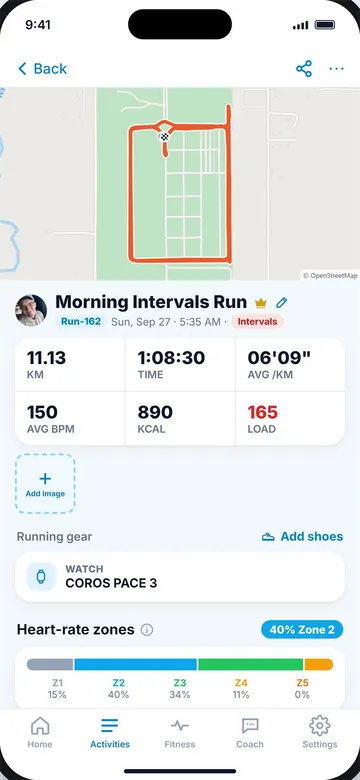
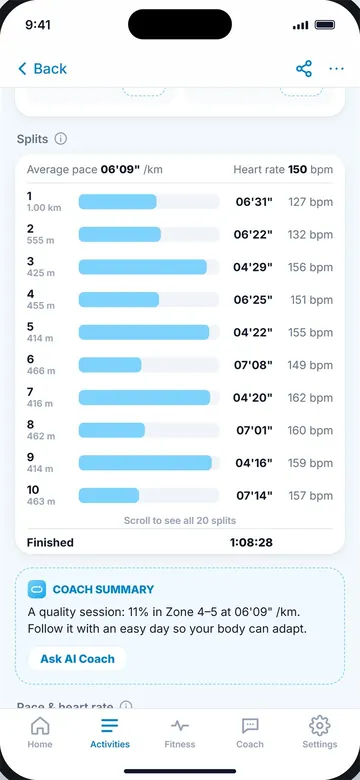
A long run summary (left) and its splits (right).
Key takeaways
- A long run is usually 20 to 30% of your weekly distance, capped around 2.5 to 3 hours.
- Typical peaks: 8 to 12 km for 5K, 16 to 21 km for a half, 26 to 32 km for a marathon.
- Run most long runs at an easy, conversational pace.
- Add 1 to 2 km a week, step back every third or fourth week, and peak 2 to 3 weeks before the race.
- Practise fuelling on runs longer than about 75 minutes.
Frequently asked questions
How long should my long run be for a half marathon?
Most runners peak at 16 to 21 km, about 1:40 to 2:15 of running, two weeks before the race.
Do I need to run 42 km before a marathon?
No. Most plans peak at 30 to 32 km, or about 3 hours. The taper and race day cover the rest.
How fast should my long run be?
Easy: about 60 to 90 seconds per km slower than marathon pace, at a pace where you can talk.
Is it OK to walk during a long run?
Yes. Short walk breaks, especially on hills or at water stops, keep the effort easy and can help you cover more distance safely.
How often should I do a long run?
Once a week for most runners. Some marathoners alternate a full long run with a shorter one every other week.
What should I eat during a long run?
For runs over 75 minutes, take about 30 to 60 grams of carbohydrate per hour from gels, chews or sports drink, starting after 45 to 60 minutes.

Keep reading
TrainingHow slow should an easy run be?Four simple ways to find your easy run pace, and why running slowly most days makes you faster.9 min read
Heart rateWhat is heart rate drift, and should you worry about it?Why heart rate climbs at a steady pace, how to measure drift with aerobic decoupling, and how to reduce it.9 min read
TrainingInterval training for runners: a simple guideWhat intervals are, the right pace and rest, six classic workouts and how often to do them safely.10 min read