Ask a group of runners what their biggest training mistake was, and many will say the same thing: running their easy days too hard. It feels productive to finish every run tired. But easy runs have a different job, and they only do it when they are truly easy.
The short answer
An easy run should be slow enough that you can talk in full sentences; for most runners that is about 60 to 120 seconds per km slower than 5K race pace, or roughly 13 to 29% slower than threshold pace, with heart rate in Zone 2.
If that sounds very slow, you are not alone. Many runners are surprised, and many find their easy pace speeds up within a few months of running it properly.
Why easy runs should be slow
Studies of elite endurance athletes, notably by Stephen Seiler, found that they do around 80% of their training at low intensity. That pattern is the basis of 80/20 running.
Four ways to find your easy pace
1. The talk test
The simplest and most reliable. On an easy run you should be able to speak in full sentences without gasping. If you can only manage a few words, slow down. If you could sing, you might be going a little too easy, which is fine for recovery runs.
2. Heart rate
Keep your heart rate in Zone 2. With the Karvonen method, that starts at about 60% of your heart rate reserve (the range between your resting and max heart rate) and goes up to about 70%.
3. From a race time
Use a recent 5K or 10K. Your easy pace is about 1 to 2 minutes per km slower than 5K pace. A 25-minute 5K (5:00 per km) gives an easy pace of roughly 6:00 to 7:00 per km.
4. From threshold pace
If you know your threshold pace, multiply it (in seconds) by about 1.135 and 1.29. That is how Joe Friel-style pace zones place the easy, endurance zone.
Easy pace ≈ threshold pace × 1.135 to 1.29
Example: threshold 5:00 per km = 300 s. 300 × 1.135 = 341 s (5:41). 300 × 1.29 = 387 s (6:27). Easy range: 5:41 to 6:27 per km.
Easy pace by race time
| 5K time | 5K pace | Easy pace |
|---|---|---|
| 35:00 | 7:00 | 8:10 to 9:40 |
| 30:40 | 6:08 | 7:19 to 8:42 |
| 26:58 | 5:23 | 6:30 to 7:44 |
| 24:06 | 4:49 | 5:50 to 6:59 |
| 21:48 | 4:21 | 5:19 to 6:22 |
| 19:56 | 3:59 | 4:53 to 5:51 |
The "grey zone" trap
Between easy pace and threshold pace sits a middle zone that feels "comfortably tough". Runners love it: it feels like good work, and the pace looks respectable on social media. The problem is that running there every day is too hard to recover from properly, yet not hard enough to give the specific benefits of real workouts. Over weeks, it leaves you tired, stuck at the same race times, and more likely to get injured.
The fix is simple: make easy days easier, so your hard days can be harder.
How to slow down, step by step
- Set a ceiling, not a target: a top heart rate or slowest-allowed pace you stay under.
- Start slower than you think. The first 10 minutes should feel almost too easy.
- Hide pace on your watch for easy runs and show heart rate or time instead.
- Run with someone slower, or chat the whole way with a friend.
- Walk the hills if your heart rate shoots up. It is still an easy run.
- Be patient for 6 to 8 weeks. Most runners see their easy pace get faster at the same heart rate.
How much of your running should be easy?
For most runners, about 75 to 85% of weekly time running. If you run four times a week, that means three easy runs and one workout, or a long run plus two easy runs and one workout where the long run is mostly easy too. New runners can run almost everything easy for the first few months and still improve fast.
Will running slowly make me slow?
No. Easy pace is not the pace you race at; it is the pace that lets you train often and recover. Your race speed comes from the combination of a big aerobic base (built by easy running) and a smaller amount of faster work (tempo runs and intervals). Runners who switch to properly easy days usually find their workouts get better within a few weeks, because they arrive at them fresh.
Common mistakes
- Racing your easy runs against your own past times or other runners on social apps.
- Speeding up at the end of every easy run "to finish strong". Save it for planned workouts.
- Using a pace from a cool day on a hot one.
- Feeling embarrassed by the pace. Elite runners run their easy days surprisingly slowly too.
How to check your easy pace in Windlace
- Open the Fitness tab. Your Endurance pace zone (easy and long runs) is worked out from your threshold pace, from your fastest efforts.
- Open an easy run and look at the pace zones and heart rate zones: most of the bars should be in the easy zones.
- Watch your average Zone 2 pace on the Fitness tab. Faster at the same heart rate means your base is growing.
- Ask the AI coach whether your last week had enough easy running. It suggests; you decide.
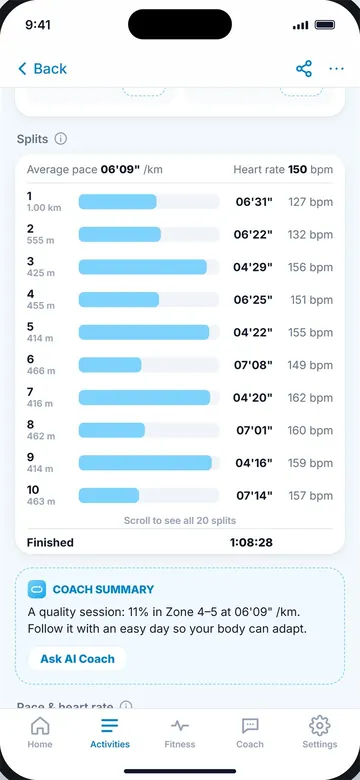
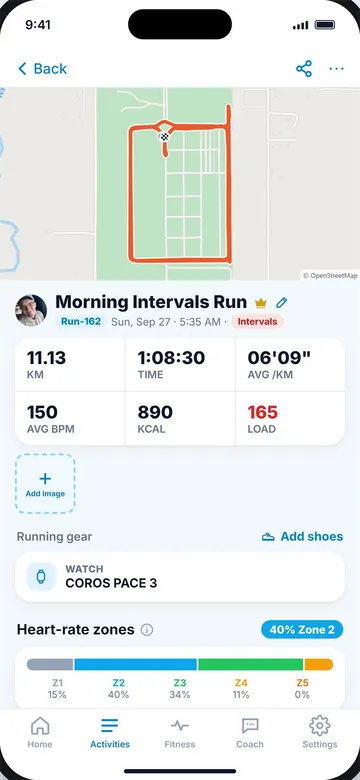
Zones for one run (left) and the run summary (right).
Key takeaways
- Easy runs should let you talk in full sentences: usually 1 to 2 minutes per km slower than 5K pace.
- From threshold pace, easy is roughly 1.135 to 1.29 times slower (in seconds per km).
- Easy running builds your aerobic engine and lets you recover for hard workouts.
- Avoid the "grey zone" between easy and threshold on easy days.
- About 75 to 85% of your weekly running should be easy.
Frequently asked questions
How slow should an easy run be?
Slow enough to talk in full sentences. For most runners that is 60 to 120 seconds per km slower than 5K race pace.
Why is my easy pace so slow?
A slow easy pace is normal when your aerobic base is still building, or in heat and on hills. With weeks of consistent easy running it usually gets faster.
What heart rate is an easy run?
Zone 2: about 60 to 70% of your heart rate reserve, or roughly 65 to 75% of max heart rate for many runners.
Can I run too slowly on easy days?
It is hard to run too slowly. As long as you are running, slower easy runs still build fitness and help recovery.
How many easy runs should I do per week?
Most of them. With four runs a week, two or three should be easy, and the long run mostly easy too.

Keep reading
Heart rateWhat is Zone 2 running, and why does everyone talk about it?Why slow running makes you faster, how to find your Zone 2 heart rate and pace, and how to use it every week.10 min read
TrainingHow long should your long run be?Simple long run rules by race distance and weekly mileage, the right pace, and how fast to build up.9 min read
TrainingInterval training for runners: a simple guideWhat intervals are, the right pace and rest, six classic workouts and how often to do them safely.10 min read