Most training advice says "run this at tempo" or "run that easy". The problem is knowing how fast that actually is for you. The answer starts with one number: your threshold pace.
Once you know it, every other training pace falls into place, from easy runs to intervals. Here is how it works.
What threshold pace means
Threshold pace is the fastest pace you can hold steadily for about an hour. It is the running speed that matches your lactate threshold: run slower and you can keep going for a long time; run faster and fatigue builds quickly.
You will see it under a few names. Coach Jack Daniels calls it T pace. Others call it tempo pace, functional threshold pace, or critical speed. They all point to roughly the same effort: comfortably hard, about 7 to 8 out of 10, where you can only say a few words at a time.
Why threshold pace matters
- It sets your training paces. Easy, tempo, interval and recovery paces can all be worked out from it, so every run has a clear purpose.
- It is the pace of your tempo runs. Running tempo sessions at the right speed is the best way to make threshold pace faster.
- It tells you how fit you are. A faster threshold pace means faster 10K, half marathon and marathon times.
- It helps you pace races. Your 10K pace is a little faster than threshold; your half marathon pace is a little slower.
Where it sits next to your race paces
Threshold pace sits between your 10K pace and your half marathon pace. This table shows the full picture for runners at four fitness levels, all per kilometre:
| 5K time | 5K pace | 10K pace | Threshold pace | Half marathon pace | Marathon pace |
|---|---|---|---|---|---|
| 24:08 | 4:50 | 5:00 | 5:06 | 5:16 | 5:27 |
| 21:50 | 4:22 | 4:32 | 4:38 | 4:45 | 4:56 |
| 19:57 | 3:59 | 4:08 | 4:15 | 4:20 | 4:31 |
| 18:22 | 3:40 | 3:49 | 3:56 | 4:00 | 4:10 |
The pattern is the same at every level: threshold pace is about 6 to 7 seconds per km slower than 10K pace and about 5 to 10 seconds per km faster than half marathon pace.
How to find your threshold pace
1. From a recent race (quickest)
Use a 10K or half marathon you ran in the last two months, on a mostly flat course:
- Work out your race pace per km: your finish time divided by the distance.
- From a 10K: add about 6 seconds per km. A 50:00 10K (5:00 /km) gives about 5:06 /km.
- From a half marathon: take off about 5 to 10 seconds per km. A 1:51 half (5:16 /km) gives about 5:06 /km.
2. A 30-minute solo test
No recent race? Run a test. Warm up for 10 to 15 minutes, then run 30 minutes as hard as you can hold steadily, on your own, on a flat route. Note your average pace for the 30 minutes.
Threshold pace ≈ your 30-minute test pace × 1.04
You can run a little faster for 30 minutes than for an hour, so slow it by about 4%. Example: a test at 5:00 /km gives 5:00 × 1.04 = about 5:12 /km. This uses Riegel's race formula, so treat it as a close guide.
3. From your fastest efforts (what Windlace does)
Sports scientists use an idea called critical speed. Your best paces over a few different times, such as your fastest 3, 5, 10 and 20 minutes, form a curve. From that curve you can work out the pace you could hold for much longer. The more good efforts in your recent runs, the more accurate it gets, and you never have to run a test.
4. By feel
If you have nothing else, use effort. Threshold pace feels comfortably hard: you breathe hard but steadily, you can say a few words but not chat, and you feel you could keep going for a while longer. Use this to check the other methods too.
How to use threshold pace in training
Many coaches split running into zones built from threshold pace. Windlace uses six pace zones, each with its own job:
| Zone | Name | How it feels and what it is for |
|---|---|---|
| Z1 | Recovery | Very easy jogging. Warm-up, cool-down, recovery. |
| Z2 | Aerobic base | Easy, you can talk. Most of your running. |
| Z3 | Tempo | Comfortably hard. Steady longer efforts. |
| Z4 | Threshold | Hard but steady, about your 1-hour race pace. |
| Z5 | VO2max | Very hard, like 3 to 5 minute repeats. |
| Z6 | Anaerobic | Faster than VO2max pace: short, all-out reps. |
Threshold workouts to try
One threshold session a week is enough for most runners. Keep the rest of your running easy.
Common mistakes
How to track your threshold pace in Windlace
Windlace finds your threshold pace for you, with no test needed. It scans every run for your fastest 3, 5, 10 and 20-minute stretches from the last 120 days and works out the pace you could hold for about an hour.
- Add your runs. Record with your phone's GPS, link your COROS watch once, or upload .fit, .tcx or .gpx files.
- Open the Fitness tab. See your lactate threshold as a pace and a heart rate, for example "5:06 /km @ 168 bpm".
- Use your pace zones. All six zones are built from your threshold pace, so your tempo and easy paces are always up to date.
- Check each run. Every run shows how long you spent in each pace zone, and its pace effort, which adjusts your pace for hills.
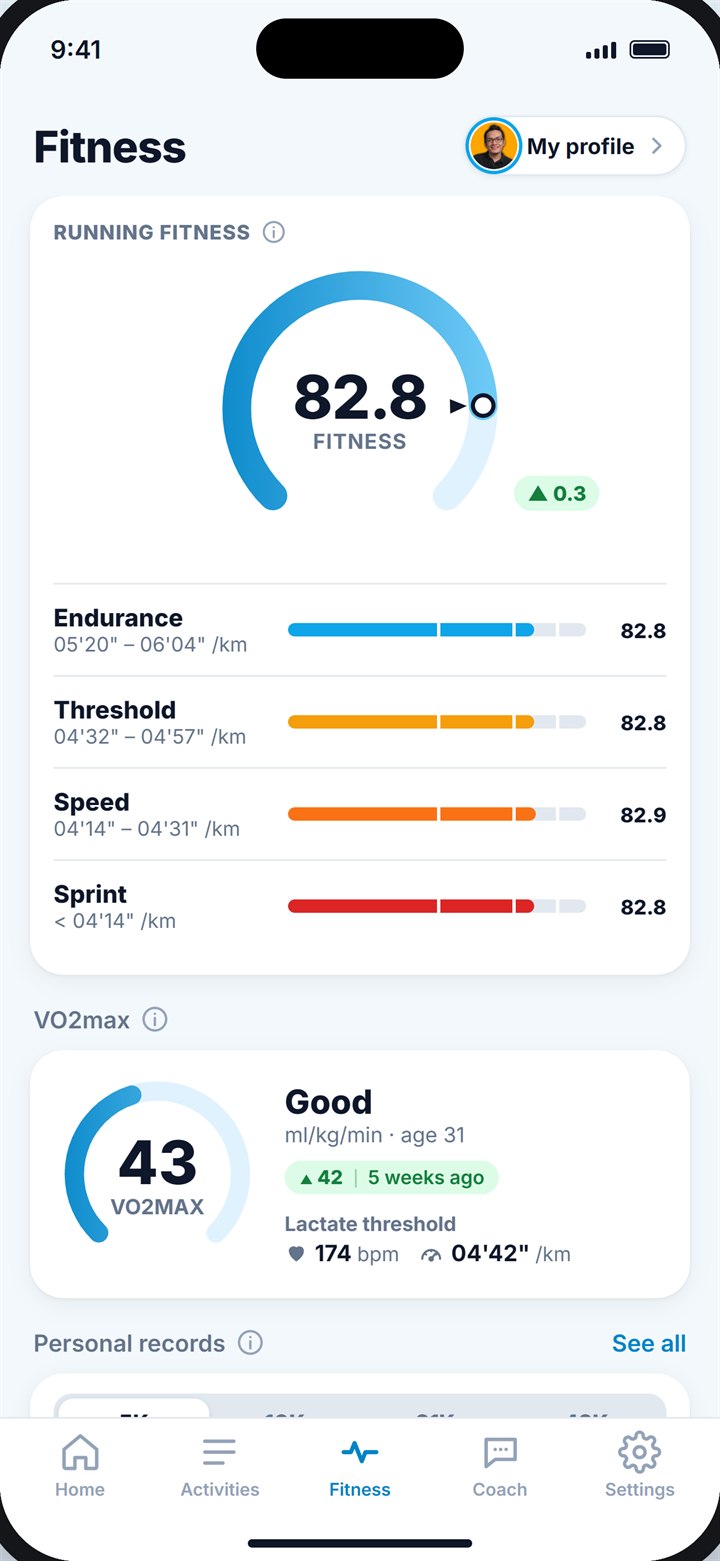
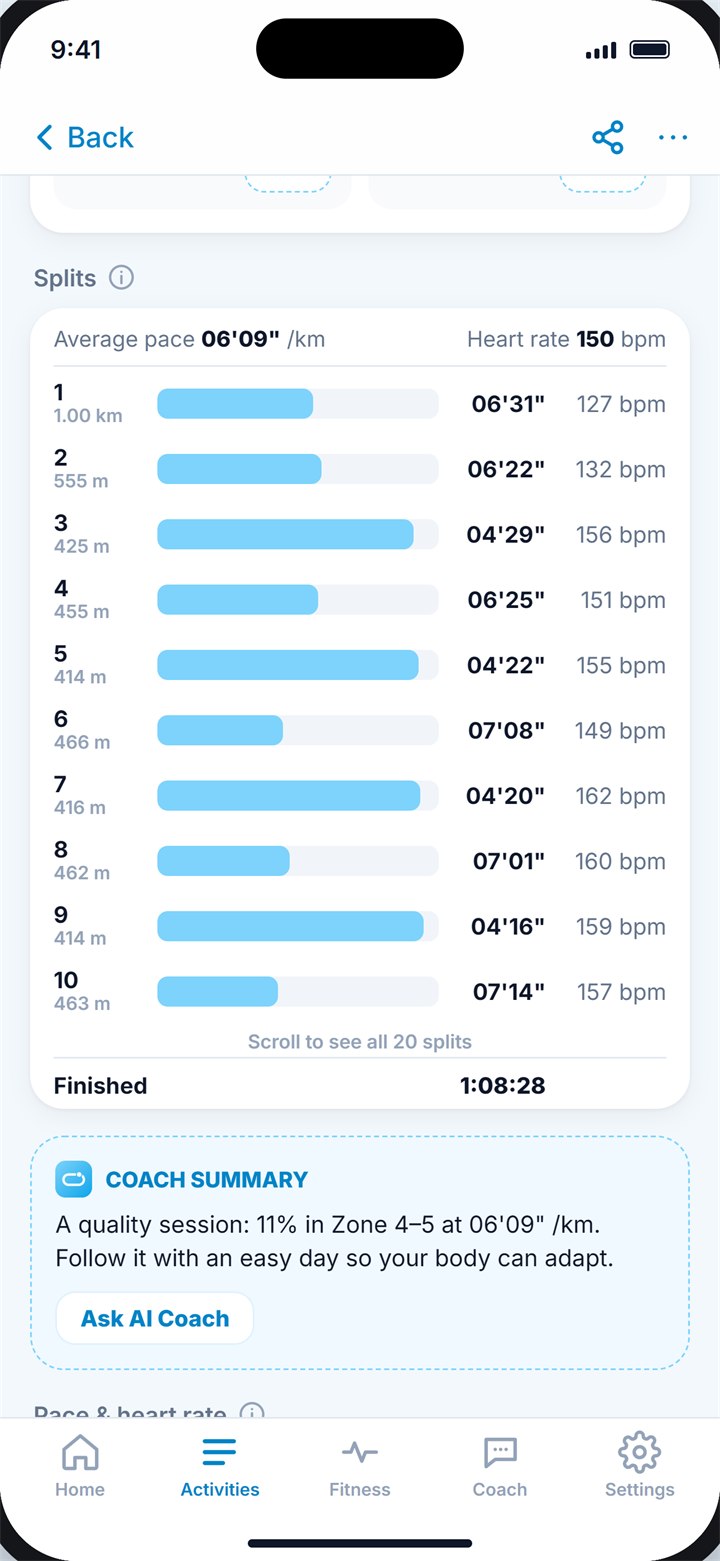
Your threshold pace and zones on the Fitness tab (left), and a run's splits (right).
Key takeaways
- Threshold pace is the fastest pace you can hold steadily for about an hour.
- It sits about 6 to 7 seconds per km slower than 10K pace and a little faster than half marathon pace.
- Find it from a recent race, a 30-minute test (× 1.04), your fastest efforts, or by feel.
- Use it for tempo runs and cruise intervals, and to set all your other training paces.
- Update it every 6 to 8 weeks, and go by effort in heat or on hills.
Frequently asked questions
Is threshold pace the same as tempo pace?
Mostly, yes. Many coaches use the words for the same comfortably hard effort. Some use "tempo" for a slightly slower, steadier pace (Zone 3) and "threshold" for the 1-hour pace (Zone 4).
How do I calculate my threshold pace from a 5K?
Use a table like the one above. For example, a 24:08 5K points to a threshold pace of about 5:06 per km, and a 19:57 5K to about 4:15 per km.
How long can I run at threshold pace?
About an hour in a race. In training, keep it to 20 to 40 minutes in total, in one block or a few.
How often should I update my threshold pace?
Every 6 to 8 weeks, or after a race or a training block. Apps that work it out from your runs, like Windlace, update it on their own.
Why is my threshold pace slower in hot weather?
Heat makes your heart work harder at the same pace, so the effort that matches your threshold comes at a slower speed. Run by effort or heart rate on hot days.

Keep reading
FitnessWhat is lactate threshold, and why does it matter?The pace you can hold for about an hour: what it means, how it feels, how to find yours, and the workouts that make it faster.11 min read
FitnessWhat is VO2max, and how do you track it?The complete runner's guide: what the number means, what a good VO2max is for your age, how to test it, and the workouts that raise it.12 min read
TrainingHow to improve your VO2maxThe workouts that raise VO2max, how often to do them, a sample week, and how long it takes to see results.10 min read