Ask a running coach which number matters most for races from 10K to the marathon, and many will not say VO2max. They will say lactate threshold. It is the line between running that you can keep up for a long time and running that wears you out in minutes.
The good news: lactate threshold responds to training faster than almost anything else. Here is what it is, how to find yours, and how to raise it.
What lactate threshold means
Lactate threshold is the running intensity where lactate starts to build up in your blood faster than your body can clear it. Below it, you can run steadily for a long time. Above it, fatigue builds quickly and you have to slow down.
Your muscles always make some lactate, even at rest. When you run easily, your body uses it as fuel as fast as it is made, so the level in your blood stays low and flat. As you run faster, you make more. At some pace, production overtakes clearance and the level starts to climb. That turning point is your lactate threshold.
For runners, the most useful way to think about it is simple: your lactate threshold pace is roughly the fastest pace you can hold for about an hour. Read more in What is threshold pace?
The two thresholds: LT1 and LT2
Scientists actually talk about two turning points. You will see both names in training plans and watch apps, so it helps to know the difference:
| LT1 (aerobic threshold) | LT2 (lactate threshold) | |
|---|---|---|
| What happens | Lactate first rises above your resting level | Lactate climbs fast and keeps rising |
| Blood lactate | About 2 mmol/L | About 4 mmol/L |
| How it feels | Steady; you can talk in sentences | Comfortably hard; a few words at a time |
| How long you can hold it | Several hours | About an hour |
| Close to | Top of your easy running | Your 10K to half marathon race effort |
When runners and coaches say "lactate threshold" or "threshold pace" without a number, they almost always mean LT2. That is the one this guide is about.
Why lactate threshold matters for runners
VO2max tells you the size of your engine. Lactate threshold tells you how much of that engine you can use for a long time. Two runners with the same VO2max can race very differently, and the one with the higher threshold will usually win anything longer than a few kilometres.
- It predicts endurance races. Your 10K, half marathon and marathon times depend heavily on how fast you can run before lactate climbs.
- It improves faster than VO2max. Even experienced runners can keep raising their threshold for years with steady training.
- It sets your training paces. Many coaches and apps build heart-rate and pace zones from your threshold, so every run is at the right effort.
As a share of VO2max, beginners often reach their threshold at around 50 to 60% of it. Well-trained runners can reach 75 to 90%. That gap is a big part of what training does.
How fast it is and how it feels
Lactate threshold is easy to recognise once you know what to look for:
Threshold pace by fitness level
This table shows roughly where threshold pace sits for runners at different 5K levels:
| 5K race time | Threshold pace per km | Threshold pace per mile |
|---|---|---|
| 30:40 | 6:24 | 10:18 |
| 27:00 | 5:40 | 9:07 |
| 24:08 | 5:06 | 8:12 |
| 21:50 | 4:38 | 7:27 |
| 19:57 | 4:15 | 6:51 |
| 18:22 | 3:56 | 6:20 |
| 17:03 | 3:40 | 5:54 |
How to find your lactate threshold
1. Lab test (most accurate)
You run on a treadmill while the speed goes up every few minutes. After each step, a tester takes a drop of blood from your finger or ear and measures the lactate. The pace where lactate starts to climb steeply is your threshold. It is very precise, but it costs money and you need a sports lab.
2. The 30-minute solo test (free)
This field test, made popular by coach Joe Friel, finds your threshold heart rate with nothing but a heart-rate monitor:
- Warm up for 10 to 15 minutes of easy running, with a few short pickups.
- Run 30 minutes as hard as you can hold steadily, on your own, on a flat route or a track. Pace it like a race: even, not a sprint start.
- Press lap at 10 minutes. Keep going for the last 20 minutes.
- Take the average heart rate of the last 20 minutes. That is your lactate threshold heart rate.
- Cool down with 10 minutes of easy jogging.
Threshold heart rate ≈ average heart rate of the last 20 minutes
Example: if your average for minutes 10 to 30 is 172 bpm, your threshold heart rate is about 172 bpm. Your threshold pace is a little slower than your average pace for the test, because a test you do alone is shorter than an hour.
3. From a recent race
If you raced a 10K or half marathon in the last couple of months, you already have a good guide. Your threshold pace is usually about 5 to 10 seconds per km slower than your 10K race pace, and a little faster than your half marathon pace. Example: a 50:00 10K (5:00 /km) puts threshold pace at about 5:06 /km.
4. Your watch or app (easiest)
Many running watches and apps estimate your threshold pace and heart rate from your normal runs, especially your fastest efforts. It updates as you get fitter, with no special test needed.
How to improve your lactate threshold
The best way to raise your threshold is to spend time running at or just around it, on top of plenty of easy running. Threshold work should feel controlled. If you finish gasping, it was too fast.
Pick one threshold session a week
Keep the rest of the week easy
Most of your weekly running should still be easy. A common guide from Jack Daniels is to keep threshold running to about 10% of your weekly distance. More easy kilometres build the base that lets your threshold keep rising.
Give it time
Many runners notice their threshold pace getting faster within 4 to 8 weeks of regular threshold sessions. Keep going: unlike VO2max, threshold can keep improving for years.
Lactate threshold vs VO2max
The two numbers go together, but they tell you different things:
| Lactate threshold | VO2max | |
|---|---|---|
| What it measures | The fastest pace you can keep up for about an hour | The most oxygen your body can use at all-out effort |
| Shown as | A pace (min/km) and a heart rate (bpm) | ml/kg/min |
| Best for predicting | 10K, half marathon and marathon | Your overall aerobic potential |
| How you train it | Tempo runs and cruise intervals | Hard intervals of 2 to 5 minutes |
| How it changes | Keeps improving for years | Rises quickly at first, then levels off |
Want the full picture on the other number? Read What is VO2max, and how do you track it?
How to track your lactate threshold in Windlace
Windlace works out your threshold for you. It looks at your fastest 3, 5, 10 and 20-minute stretches from the last 120 days and finds the pace you could hold for about an hour. Your threshold heart rate comes from your runs too. No special test needed.
- Add your runs. Record with your phone's GPS, link your COROS watch once, or upload .fit, .tcx or .gpx files.
- Open the Fitness tab. See your lactate threshold as a pace and a heart rate, for example "4:45 /km @ 172 bpm".
- Use your training paces. Your pace zones, including your Threshold pace, are built from it, so you know exactly how fast to run a tempo.
- Check every run. Each run shows how long you spent in each heart-rate and pace zone, so you can see if your tempo was really at threshold.
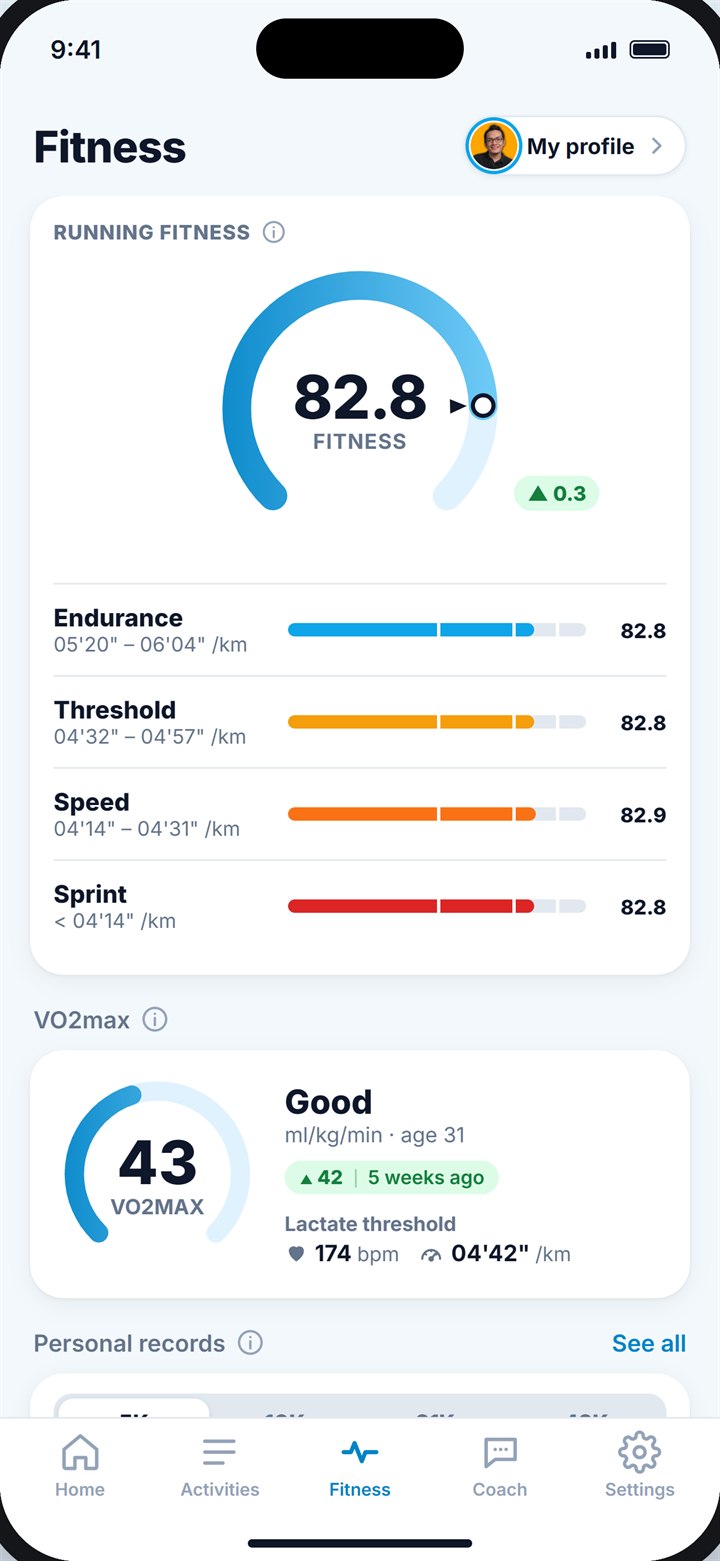
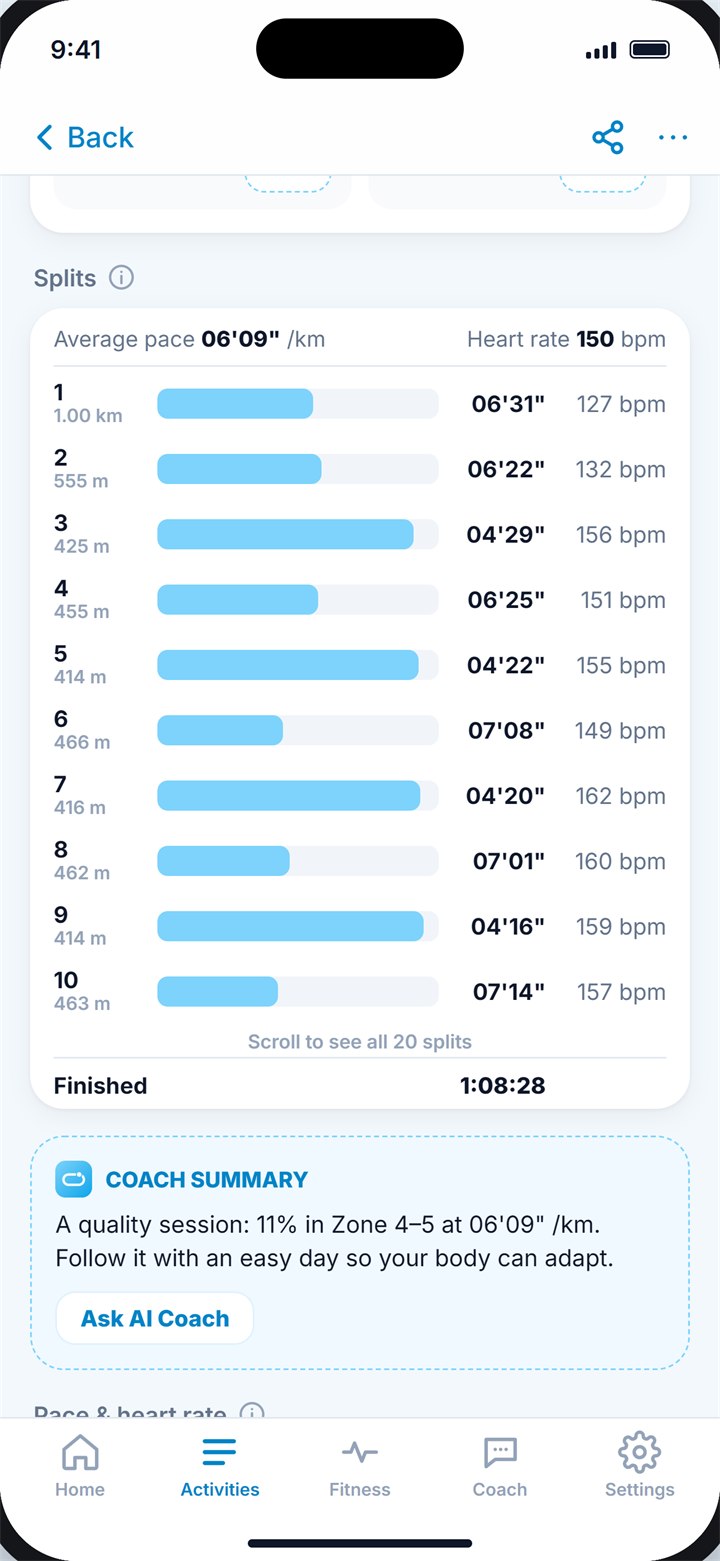
The Fitness tab (left) and a run's splits and zones (right).
Key takeaways
- Lactate threshold is the effort where lactate builds up faster than your body clears it.
- Threshold pace is roughly the fastest pace you can hold for about an hour.
- It feels comfortably hard: about 7 to 8 out of 10, a few words at a time.
- Find it with a lab test, a 30-minute solo test, a recent race, or your watch or app.
- Raise it with one tempo or cruise-interval session a week, plus mostly easy running.
Frequently asked questions
What is a good lactate threshold for a runner?
There is no single good number, because threshold is a pace and a heart rate that depend on your fitness. A useful sign of good fitness is how close your threshold pace is to your 10K pace, and how high it sits as a share of your VO2max: beginners often reach it at 50 to 60% of VO2max, well-trained runners at 75 to 90%.
Is lactate threshold the same as anaerobic threshold?
People often use the names for the same thing: the second threshold (LT2), where lactate rises quickly. The aerobic threshold (LT1) is a different, lower point where lactate first starts to rise.
What heart rate is lactate threshold?
For most runners it is around 85 to 92% of maximum heart rate. The most reliable way to find yours is a 30-minute solo test: your threshold heart rate is about the average heart rate of the last 20 minutes.
How long can you run at lactate threshold?
About an hour when you are fresh and racing. In training, keep threshold efforts to 20 to 40 minutes in total, often split into blocks.
How often should I do threshold runs?
Once a week is enough for most runners; experienced runners sometimes do two. Keep threshold running to about 10% of your weekly distance and run the rest easy.
Does lactate cause muscle soreness?
No. Lactate is cleared from your blood within about an hour after hard running. The soreness you feel a day or two later comes from small muscle damage, not lactate.

Keep reading
PaceWhat is threshold pace, and how do you find yours?The pace you can hold for about an hour: where it sits next to your race paces, four ways to find it, and how to train with it.10 min read
FitnessWhat is VO2max, and how do you track it?The complete runner's guide: what the number means, what a good VO2max is for your age, how to test it, and the workouts that raise it.12 min read
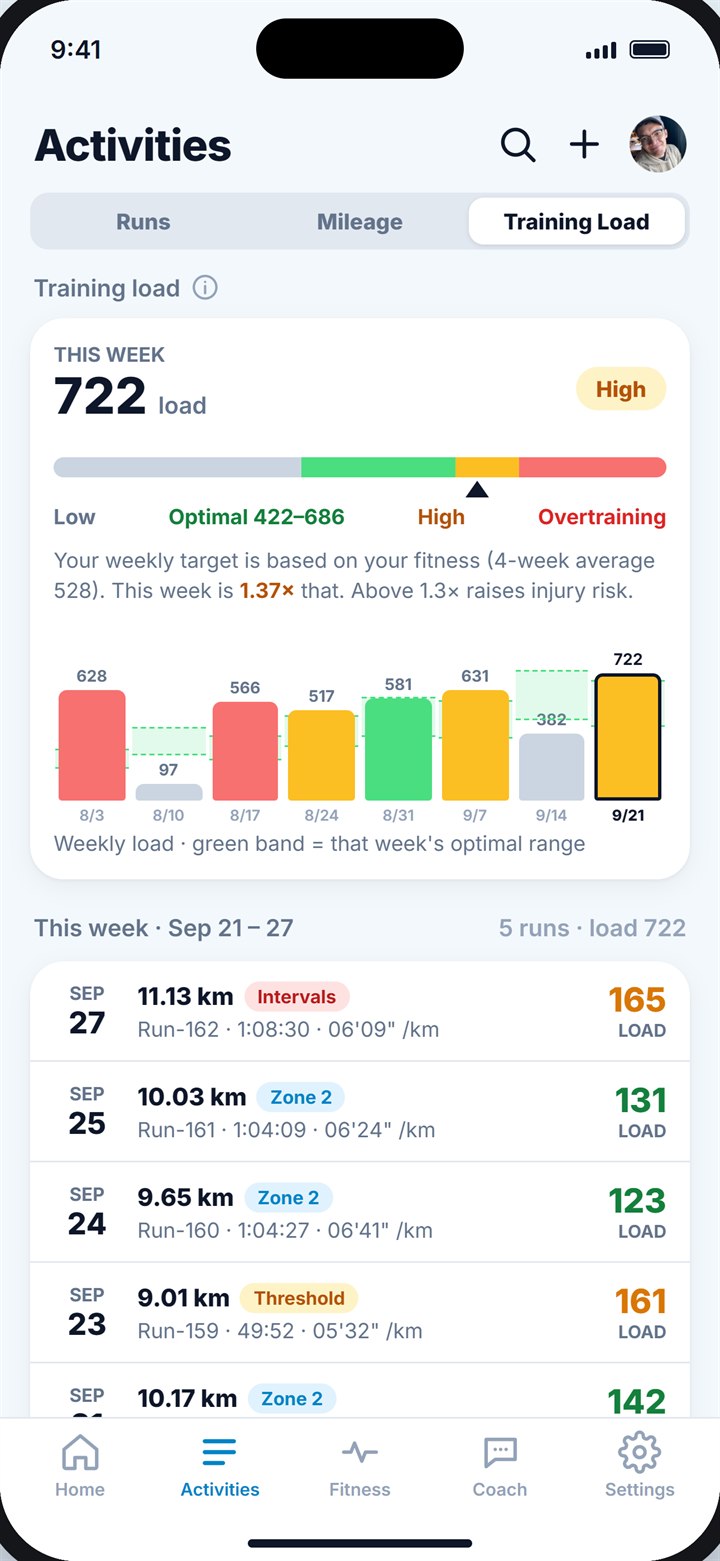 TrainingWhat is training load, and how much is too much?How hard your running really was: how training load is worked out, your optimal range, and how to build up safely.10 min read