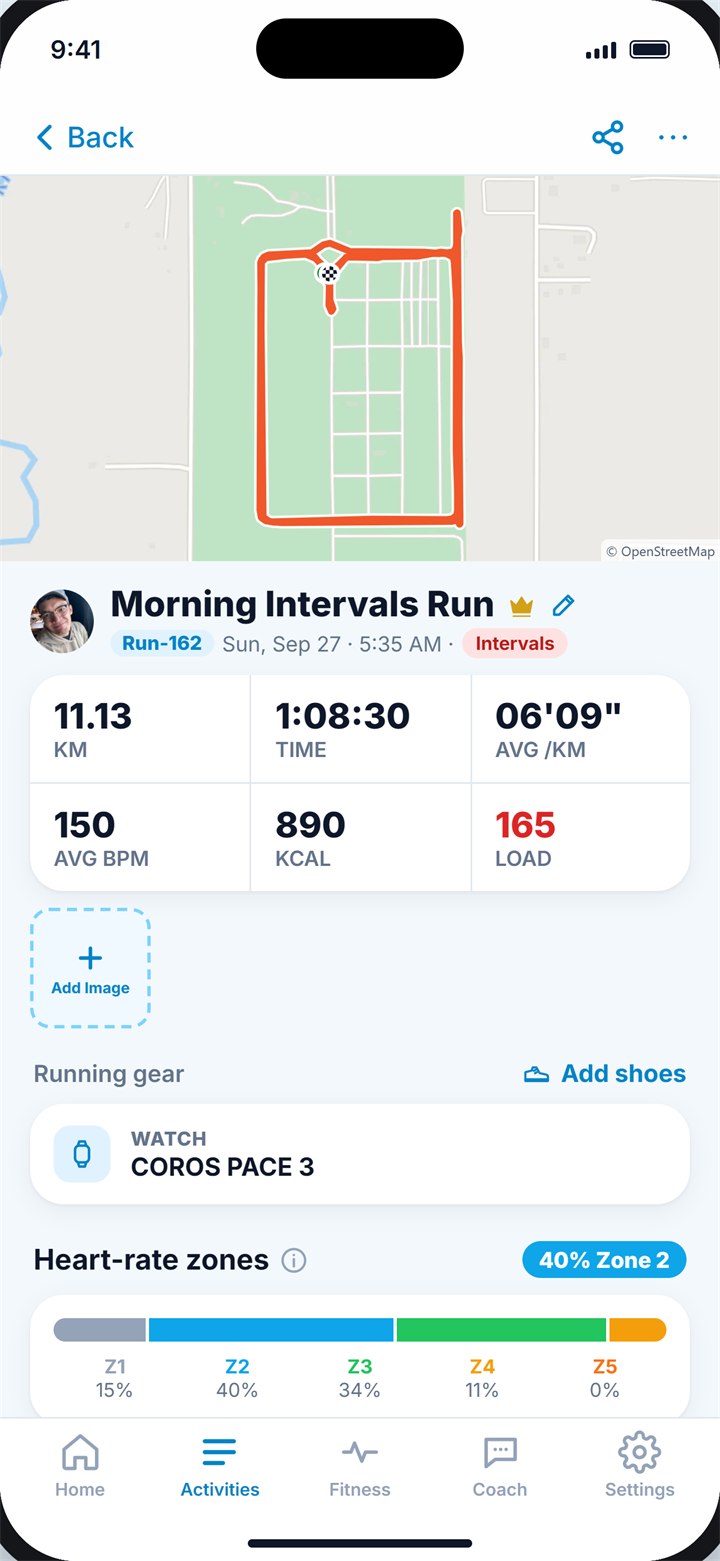
If you run with a watch or an app, you have seen a number called VO2max. It goes up after a good training block, drops after a break, and many runners check it more often than their weight. But what does it actually measure, and how much should you care about it?
What VO2max means
The name breaks down simply: V is volume, O2 is oxygen, and max is maximum. VO2max is the highest rate at which your body can take in oxygen, carry it in your blood and use it in your muscles to make energy.
When you run easily, your body uses only part of that capacity. As you speed up, you breathe harder and your heart beats faster to deliver more oxygen. At some point, running faster no longer raises how much oxygen you use. That ceiling is your VO2max.
It is written in ml/kg/min: millilitres of oxygen, per kilogram of body weight, per minute. Because it is divided by body weight, a lighter runner and a heavier runner can be compared fairly, and losing or gaining weight changes the number too.
Why VO2max matters for runners
Distance running is almost all aerobic. From the 1500 m to the marathon, most of your energy comes from oxygen. A bigger VO2max means a bigger engine, and a bigger engine lets you hold a faster pace before you tire.
- It predicts race times. Runners with a higher VO2max can usually run faster 5Ks, 10Ks and marathons.
- It shows if training is working. A rising VO2max over weeks means your aerobic fitness is improving.
- It is linked to long-term health. Research has linked higher aerobic fitness with a lower risk of heart disease and a longer life.
But it is not everything. Two runners with the same VO2max can race very differently. Running economy (how much oxygen you need at a given pace) and lactate threshold (how close to your max you can hold for a long time) matter just as much, especially in longer races.
What is a good VO2max?
"Good" depends on your age and sex. VO2max slowly drops as you get older, and women usually score a little lower than men at the same level of training, mostly because of differences in body composition and blood hemoglobin.
| Age | Men: average | Men: excellent | Women: average | Women: excellent |
|---|---|---|---|---|
| 20 to 29 | 42 | 52+ | 36 | 46+ |
| 30 to 39 | 41 | 50+ | 34 | 44+ |
| 40 to 49 | 38 | 48+ | 32 | 41+ |
| 50 to 59 | 35 | 45+ | 29 | 38+ |
| 60+ | 31 | 41+ | 26 | 35+ |
For runners, a rough picture looks like this: regular recreational runners are often 40 to 50, well-trained club runners are in the 50s, and elite distance runners are usually above 70. The best number to compare with is your own number from three months ago.
VO2max and race times
Coach Jack Daniels turned this idea into VDOT, a number worked out from your race results that behaves like VO2max. It gives a good feel for what each level means on race day:
| VDOT | 5K | 10K | Half marathon | Marathon |
|---|---|---|---|---|
| 40 | 24:08 | 50:03 | 1:50:59 | 3:49:45 |
| 45 | 21:50 | 45:16 | 1:40:20 | 3:28:26 |
| 50 | 19:57 | 41:21 | 1:31:35 | 3:10:49 |
| 55 | 18:22 | 38:06 | 1:24:22 | 2:56:01 |
| 60 | 17:03 | 35:22 | 1:18:09 | 2:43:25 |
How to test your VO2max
1. Lab test (most accurate)
You run on a treadmill wearing a mask that measures the air you breathe in and out. The speed or incline goes up every minute or two until you cannot continue. The lab sees the exact point where your oxygen use stops rising. It is accurate but costs money, and few runners need it.
2. The Cooper 12-minute test (free, on a track)
Warm up well, then run as far as you can in exactly 12 minutes. Measure the distance in metres and use this formula:
VO2max = (distance in metres − 504.9) ÷ 44.73
Example: 2,800 m in 12 minutes gives (2,800 − 504.9) ÷ 44.73 = 51.3 ml/kg/min.
3. Heart rate formula (quick, rough)
If you know your maximum and resting heart rate, the Uth formula gives a rough estimate:
VO2max ≈ 15.3 × (max heart rate ÷ resting heart rate)
Example: a max of 190 bpm and a resting rate of 55 bpm gives 15.3 × 3.45 = about 53. Use it as a rough guide only.
4. Your watch or app (easiest)
Running watches and apps estimate VO2max from the pace and heart rate of your normal runs. You do not need to do anything special, and the estimate updates as you train. It may be a few points away from a lab result, but it is very good at showing your trend, and that is what matters most.
What affects your VO2max
How to improve your VO2max
VO2max improves when you spend time running close to it, and when you build a big aerobic base underneath. The best plans do both.
Build the base with easy running
Keep about 80% of your weekly running easy, at a pace where you can talk in full sentences. Easy kilometres grow your heart's pumping power, the tiny blood vessels in your muscles and the parts of your cells that use oxygen. Adding more easy kilometres slowly, about 10% a week, is one of the surest ways to raise VO2max.
Add one VO2max session a week
Hard intervals of 2 to 5 minutes push your heart and lungs to their limit. Pick one of these and do it once a week, after a good warm-up:
Be patient and consistent
Most runners see VO2max start to rise after 6 to 8 weeks of steady training. Beginners improve fastest. Experienced runners improve more slowly, and gains come more from economy and threshold. Rest days and sleep are part of the plan: your body gets fitter while it recovers, not during the hard session.
How to track your VO2max in Windlace
Windlace works out your VO2max from your own runs, using science-based formulas that are public, and shows how it changes over time. You can record runs with your phone's GPS, sync a COROS watch, or upload .fit, .tcx or .gpx files from any watch.
- Add your runs. Record with GPS, link COROS once, or upload your files.
- Open the Fitness tab. See your VO2max, your lactate threshold and one running fitness score.
- Watch the trend. See how your VO2max changed, along with your resting heart rate and HRV from your COROS watch.
- Check your race predictions. See your predicted 5K, 10K, half and marathon times, and how your last run moved them. PREMIUM
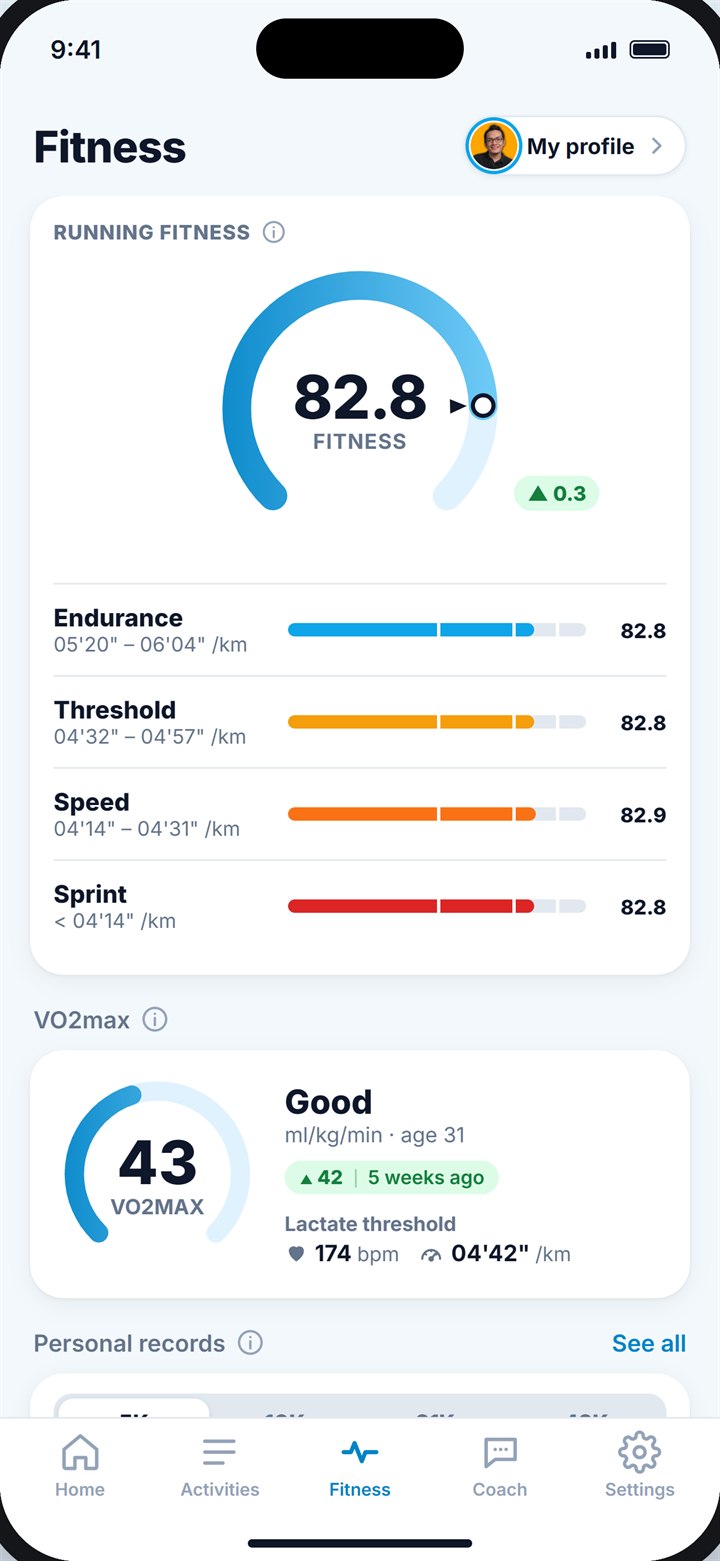
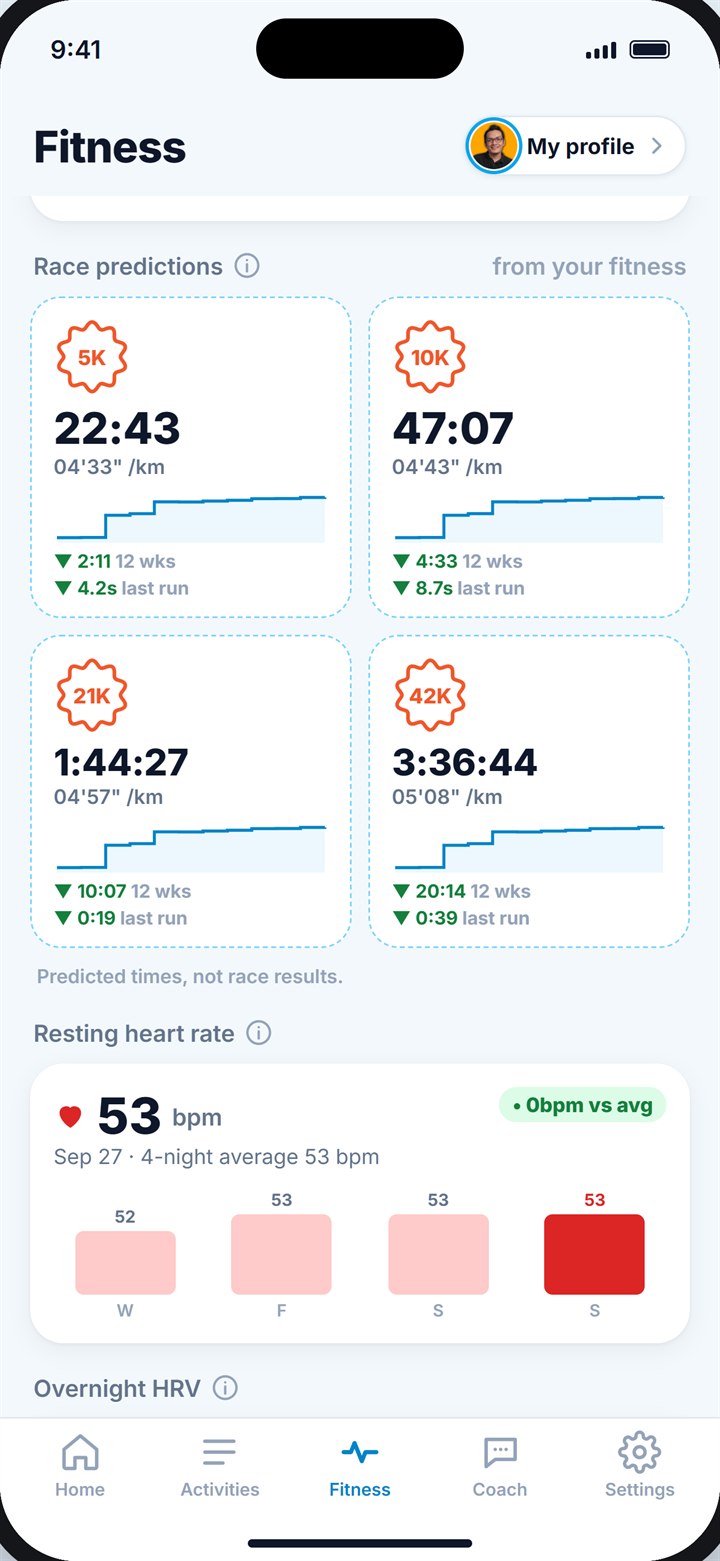
The Fitness tab (left) and race predictions with resting heart rate (right).
Key takeaways
- VO2max is the most oxygen your body can use per minute, in ml/kg/min.
- Most recreational runners score 40 to 50. Compare with your own past numbers.
- Test it in a lab, with a 12-minute run, or let your watch or app estimate it.
- Raise it with mostly easy running plus one interval session a week.
- Watch the trend over weeks, not the number after one run.
Frequently asked questions
What is a good VO2max for a runner?
For regular recreational runners, 40 to 50 ml/kg/min is common. Well-trained club runners are often in the 50s, and elite distance runners are usually above 70.
How accurate is the VO2max on my watch or app?
Estimates from pace and heart rate are usually within a few points of a lab test. They are best used to follow your own trend over weeks.
How fast can VO2max improve?
Most runners see a change after 6 to 8 weeks of steady training. Beginners improve fastest; experienced runners improve more slowly.
Does VO2max go down with age?
Yes, it slowly drops with age, but regular training slows that drop a lot.
Is VO2max the same as VDOT?
No. VDOT is a number worked out from race results that behaves like VO2max. It also includes how efficiently you run.

Keep reading
 FitnessWhat is lactate threshold, and why does it matter?The pace you can hold for about an hour: what it means, how it feels, how to find yours, and the workouts that make it faster.11 min read
TrainingHow to improve your VO2maxThe workouts that raise VO2max, how often to do them, a sample week, and how long it takes to see results.10 min read
FitnessVO2max chart by age and sexVO2max levels for men and women by age, from Poor to Powerful, and what a good VO2max is for you.7 min read