Ask a group of serious runners about their training and you will hear "Zone 2" within minutes. Pro marathoners, triathletes and podcast scientists all swear by it. The surprising part: Zone 2 is slow. For many runners it feels almost too easy.
So why does running slowly make you faster? And how slow is slow enough? Here is the plain-English version.
What Zone 2 running is
Zone 2 running is easy running at a heart rate low enough that you can comfortably hold a conversation, usually about 60 to 70% of your heart rate reserve. It is the second of the heart rate zones, just above very easy recovery jogging.
In science terms, Zone 2 sits just below your first lactate threshold (LT1): the point where lactate in your blood first starts to rise above resting levels. Below it, your body runs mainly on oxygen and fat and can keep going for hours.
Why slow running makes you faster
Easy aerobic running triggers changes that harder running cannot build as well, because you can do so much more of it:
And because Zone 2 is gentle, you recover from it quickly. That lets you run more often and more kilometres, without breaking down, and still have energy for the hard sessions that matter.
How to find your Zone 2
1. With your heart rate reserve (best with a heart rate monitor)
Zone 2 = resting HR + (max HR − resting HR) × 60% to 70%
Example: resting 50, max 190, reserve 140. Zone 2 runs from 50 + 140 × 0.60 = 134 to just under 50 + 140 × 0.70 = 148 bpm, so 134 to 147.
2. The talk test (no gadgets)
You are in Zone 2 if you can speak in full sentences, breathing a little harder than walking, but you would not want to sing. If you can only manage a few words, you are above it.
3. The MAF formula (a quick rule of thumb)
Coach Phil Maffetone's popular shortcut is 180 minus your age as the top of your easy range, adjusted up or down a few beats for fitness and health. It is simple, but like any age formula it can be off for many people.
| Resting HR | Max HR | Zone 2 |
|---|---|---|
| 60 | 185 | 135 to 147 bpm |
| 50 | 190 | 134 to 147 bpm |
| 55 | 175 | 127 to 138 bpm |
| 45 | 200 | 138 to 153 bpm |
What pace is Zone 2?
There is no single Zone 2 pace: it depends on your fitness, the weather and the route. For many runners it is roughly 1 to 2 minutes per km slower than their 5K race pace. Someone who runs a 25-minute 5K (5:00 /km) will often be in Zone 2 at around 6:30 to 7:00 /km.
Your Zone 2 pace will also change from day to day. On a hot afternoon or a hilly route you may need to slow down by 20 to 40 seconds per km to keep your heart rate in the zone. That is normal: your heart, not your pace, is doing the training.
How to do Zone 2 runs, step by step
- Start slower than you think. Heart rate rises over the first 10 minutes, so begin at a jog.
- Watch the top of the zone, not the middle. When you reach it, slow down. On hills, walk if you have to.
- Keep the run steady for 30 to 90 minutes. Longer easy runs give more of the benefits.
- Expect drift. On long or hot runs, heart rate creeps up even at the same pace. Ease off a little to stay in the zone.
- Finish feeling like you could do more. That is how a good Zone 2 run should feel.
How much Zone 2 should you do?
Most coaches recommend that around 80% of your weekly running is easy, mostly in Zones 1 and 2, with the other 20% at harder efforts. For a runner doing 4 runs a week, that could look like three Zone 2 runs (one of them a longer run) and one harder session.
Read more in The 80/20 rule in running and What is an easy run, and how slow should it be?
Common Zone 2 mistakes
How to track Zone 2 in Windlace
- Record or link your runs with heart rate. Windlace sets six zones from your resting heart rate (Karvonen), with Zone 2 starting at 60% of your reserve.
- Open a run to see how many minutes you spent in Zone 2 and in each other zone.
- Check your average Zone 2 pace on the Fitness tab: the middle of Zone 2 shown as a pace and a heart rate.
- Watch it improve. A faster pace at the same Zone 2 heart rate means your aerobic base is growing.
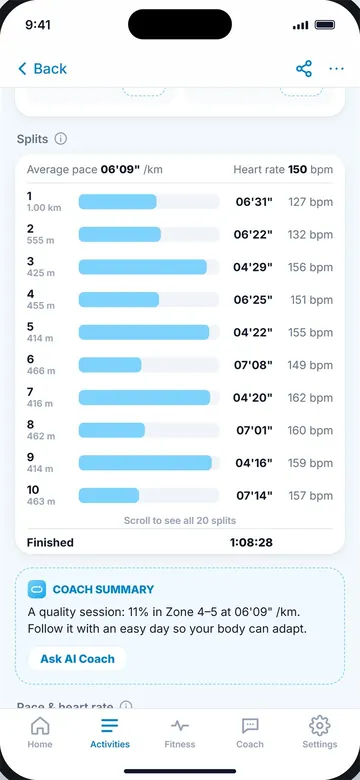
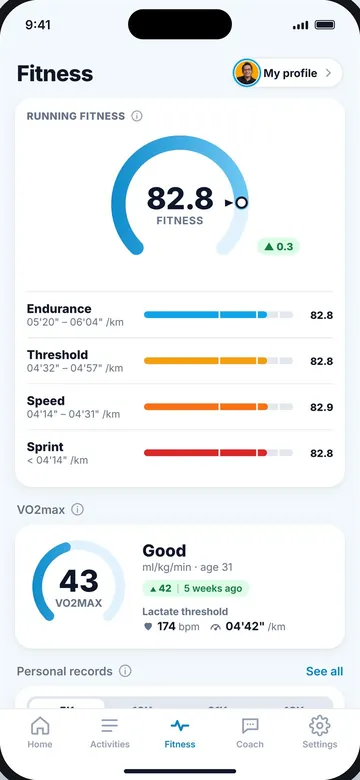
Time in each zone on a run (left) and your Zone 2 pace on the Fitness tab (right).
Key takeaways
- Zone 2 is easy running where you can still talk, about 60 to 70% of your heart rate reserve.
- It builds mitochondria, capillaries, fat burning and a stronger heart, and you recover from it quickly.
- Example: resting 50 and max 190 gives a Zone 2 of 134 to 147 bpm.
- Let pace slow down on hot days and hills; your heart rate is what counts.
- Do about 80% of your running easy, and add one or two harder sessions a week.
Frequently asked questions
What is Zone 2 heart rate?
For most runners it is about 60 to 70% of their heart rate reserve: resting heart rate plus 60 to 70% of the gap up to max heart rate. A simple check is that you can talk in full sentences.
Why is my Zone 2 pace so slow?
Your aerobic base is still developing, or it is hot, hilly or you are tired. With steady easy running, most people see their Zone 2 pace get faster within a few months.
How long should a Zone 2 run be?
Anywhere from 30 to 90 minutes. Longer runs give more endurance benefits, but frequent shorter runs work well too.
Can I walk during a Zone 2 run?
Yes. Walking up hills to keep your heart rate in Zone 2 is completely fine and common.
Is Zone 2 good for weight loss?
It burns a high share of fat and you can do a lot of it, so it helps. Overall weight loss still depends mostly on total energy in versus energy out.

Keep reading
Heart rateHeart rate zones explained, simplyWhat each zone does, three ways to calculate yours, and how much of your running belongs in each one.10 min read
TrainingHow slow should an easy run be?Four simple ways to find your easy run pace, and why running slowly most days makes you faster.9 min read
TrainingHow long should your long run be?Simple long run rules by race distance and weekly mileage, the right pace, and how fast to build up.9 min read