"Keep it in Zone 2." "Finish in Zone 4." Coaches, apps and watches all talk in zones. They are simply a way of splitting your heart rate into ranges, so that every run has a clear effort and a clear purpose.
This guide explains what each zone is for, how to calculate yours properly, and how to use them without becoming a slave to your watch.
What heart rate zones are
Heart rate zones are ranges of heartbeats per minute, from very easy to all-out, that each train a different part of your fitness. Easy zones build endurance; harder zones build speed and the ability to hold a fast pace.
Zones work because your heart rate rises with effort in a predictable way. When you know which range matches which effort, you can run easy days truly easy and hard days hard enough, which is the heart of almost every good training plan.
What each zone does
Many apps use five zones; Windlace uses six, splitting the very top into VO2max and anaerobic. The idea is the same:
| Zone | Name | How it feels | What it trains |
|---|---|---|---|
| Z1 | Recovery | Very easy, a light jog | Warm-ups, cool-downs, recovery between hard days |
| Z2 | Aerobic base | Easy, you can hold a conversation | Endurance: heart, blood vessels, fat burning |
| Z3 | Tempo | Comfortably hard, short sentences | Holding a steady, stronger pace |
| Z4 | Threshold | Hard but steady, a few words | Your threshold pace, about your 1-hour race pace |
| Z5 | VO2max | Very hard, no talking | Your top aerobic power (VO2max) |
| Z6 | Anaerobic | All-out, only for seconds | Speed and power for sprints |
Read more about the two most important ones in What is Zone 2 running? and What is lactate threshold?
How to calculate your zones: three methods
1. Percentage of max heart rate (simplest)
Take your maximum heart rate and split it into bands, for example 60 to 70% for Zone 2. It is quick, but it ignores your resting heart rate, so it tends to set easy zones too low for fit runners and too high for beginners.
2. Heart rate reserve, the Karvonen method (more personal)
This uses both your resting and maximum heart rate. The gap between them is your heart rate reserve: the beats your heart can add when you exercise. Each zone starts at a share of that reserve, added on top of your resting heart rate.
Zone start = resting HR + (max HR − resting HR) × %
Example: resting 50, max 190, so the reserve is 140 beats. Zone 2 starts at 60%: 50 + 140 × 0.60 = 134 bpm.
3. From your lactate threshold heart rate (most precise for training)
Coach Joe Friel's method builds zones around your lactate threshold heart rate (LTHR), the heart rate you can hold for about an hour in a race. Because it is anchored to a real effort you can test, it fits your body well, even if your max heart rate is unusual.
Worked example, step by step
Here is the Karvonen method for a runner with a resting heart rate of 50 and a max of 190:
- Find the reserve: 190 − 50 = 140 beats.
- Multiply by each zone's starting share: 60%, 70%, 80%, 90% and 95%.
- Add back your resting heart rate to each result.
| Zone | Starts at | Sum | Heart rate |
|---|---|---|---|
| Z2 Aerobic base | 60% | 50 + 140 × 0.60 | 134 bpm |
| Z3 Tempo | 70% | 50 + 140 × 0.70 | 148 bpm |
| Z4 Threshold | 80% | 50 + 140 × 0.80 | 162 bpm |
| Z5 VO2max | 90% | 50 + 140 × 0.90 | 176 bpm |
| Z6 Anaerobic | 95% | 50 + 140 × 0.95 | 183 bpm |
Zone 1 is everything below 134. Each zone ends one beat before the next begins, so every heartbeat belongs to exactly one zone.
How much time to spend in each zone
Studies of endurance athletes, for example by sports scientist Stephen Seiler, show that the best tend to do around 80% of their training at low intensity and about 20% at moderate to high intensity. For runners, that means:
The most common mistake is spending too much time in Zone 3. It feels productive, but it is too hard to recover from quickly and too easy to build real speed. See The 80/20 rule in running.
Why your heart rate does not always match your effort
- Lag: heart rate takes 1 to 3 minutes to catch up after you speed up. Short reps finish before it peaks.
- Heat: on hot, humid days heart rate runs 5 to 10 beats higher at the same pace.
- Drift: over a long run it slowly rises even at a steady pace, as you warm up and lose fluid.
- Fatigue, stress, caffeine: all can push it up or, after very hard training, keep it unusually low.
- Wrist sensors: optical sensors can jump around, especially in the first minutes or in cold weather. A chest strap is more accurate.
Use heart rate together with how you feel. If they disagree for a whole run, trust the feeling and check your zones.
How to use zones in your week, step by step
- Set your zones with a real resting and max heart rate, or your LTHR.
- Run easy days by heart rate: stay in Zone 2. Slow down on hills and in the heat to stay there.
- Run hard sessions by pace or effort, and use heart rate afterwards to check the work was hard enough.
- Look at time in zones each week: roughly 80% in Zones 1 to 2.
- Update your zones every couple of months, or when your fitness clearly changes.
How to see your zones in Windlace
- Link your watch or record with a heart rate sensor. Windlace reads your heart rate second by second.
- Your six zones are set for you. Windlace uses the Karvonen method with the resting heart rate your watch sends. Until it has one, the zones come from your threshold heart rate.
- Open any run to see the time spent in each zone, and the matching pace for each zone from your threshold pace.
- Check the Fitness tab for your zone limits and how they change as your resting heart rate and fitness change.
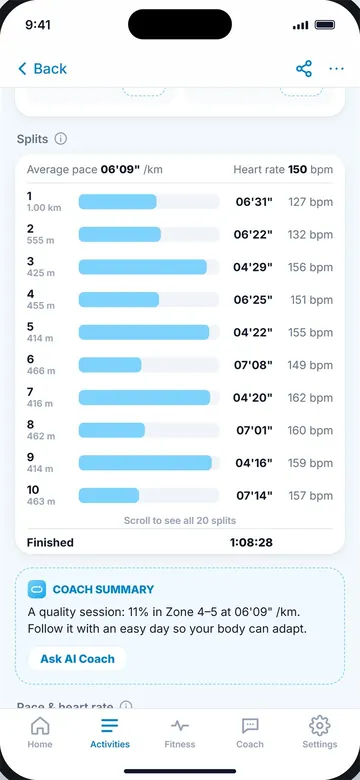
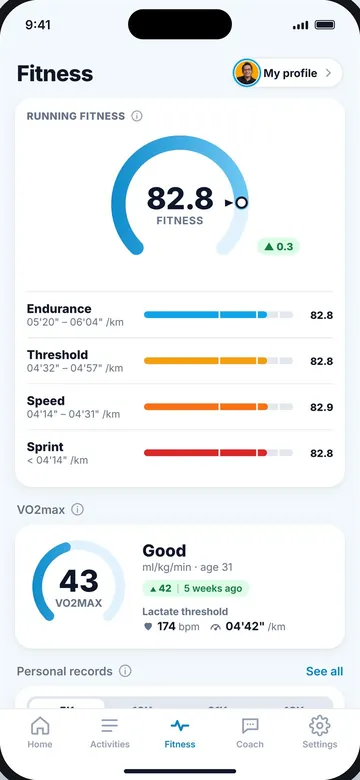
Time in each zone on a run (left) and your zones on the Fitness tab (right).
Key takeaways
- Heart rate zones split your heart rate into ranges that each train a different part of your fitness.
- The Karvonen method (resting HR + reserve × %) is more personal than a simple share of max heart rate.
- Example: resting 50, max 190 gives Zone 2 from 134 and Zone 4 from 162 bpm.
- Spend about 80% of your running in Zones 1 to 2 and about 20% harder.
- Heat, drift, lag and fatigue change heart rate, so use it together with how you feel.
Frequently asked questions
What heart rate zone should I run in?
Most of your runs, about 80%, should be in Zone 2, where you can still talk. Do one or two harder sessions a week in Zones 4 and 5.
How do I calculate my heart rate zones?
Subtract your resting heart rate from your max heart rate to get your reserve. Multiply it by 60, 70, 80, 90 and 95% and add your resting heart rate back to get where each zone starts.
Why is my heart rate always in Zone 4 or 5 on easy runs?
Your zones may be set too low, often because an age formula underestimates your max heart rate, or you are simply running too fast. Slow down, or check your max heart rate.
Are 5 zones or 6 zones better?
Both work. Six zones split the very top into VO2max and anaerobic efforts, which helps if you do short, fast reps. What matters is using the same system consistently.
Is a chest strap better than a watch for heart rate zones?
Yes, chest straps react faster and are more accurate during intervals. Wrist sensors are fine for steady easy runs.

Keep reading
Heart rateWhat is Zone 2 running, and why does everyone talk about it?Why slow running makes you faster, how to find your Zone 2 heart rate and pace, and how to use it every week.10 min read
Heart rateHow to find your maximum heart rateWhy 220 minus age is often wrong, better formulas by age, a safe field test, and what max heart rate really means.9 min read
Heart rateResting heart rate for runners: what is normal?Typical ranges for runners, how to measure yours, why it drops as you get fitter, and what a sudden rise means.8 min read