Heart rate zones are only as good as the number they are built on. Many runners use max heart rate, which is hard to measure and varies a lot between people. There is a better anchor that you can test on any flat road: your lactate threshold heart rate, or LTHR.
What LTHR means
Lactate threshold heart rate (LTHR) is the average heart rate you can hold during about an hour of hard, steady running: the heart rate at your lactate threshold. Below it you can keep going for a long time; above it, fatigue builds quickly.
It is the heart rate partner of your threshold pace. Threshold pace says how fast; LTHR says how hard your heart is working at that speed. For the science behind both, read What is lactate threshold?
Why LTHR beats max heart rate for zones
The 30-minute LTHR test, step by step
This test was made popular by coach Joe Friel. It works because running hard on your own for 30 minutes settles at close to your one-hour race effort.
- Choose the place: a flat road or a track, on a cool day if you can. No hills, no stop signs.
- Warm up for 10 to 15 minutes of easy running, with 3 or 4 short pickups.
- Start your watch and run 30 minutes as hard as you can hold steadily, alone, like a race you must pace evenly.
- Press lap at 10 minutes. Keep going at the same effort for the last 20 minutes.
- Take the average heart rate of the last 20 minutes. That is your LTHR.
- Cool down for 10 minutes of easy jogging.
Pacing the test
- Start a little conservative. If you start too fast, you will slow down and the result will be low.
- Aim for even effort, about 8 out of 10. You should be able to speak only a word or two.
- Finish strong but not sprinting. If you could go much faster at the end, you held back.
What is a typical LTHR?
LTHR depends on your max heart rate, so there is no "good" number to compare with others. In trained runners it is often somewhere around 85 to 92% of max heart rate. A runner with a max of 195 might have an LTHR in the high 160s to around 180.
Your race data can confirm it: the average heart rate of a hard 10K or the second half of an all-out half marathon is often close to your LTHR, or a little above for the 10K.
How to build zones from your LTHR
Friel's running zones are set as a share of LTHR. Here they are for a runner with an LTHR of 168 bpm:
| Zone | Share of LTHR | Heart rate | Use |
|---|---|---|---|
| 1 Recovery | below 85% | below 143 | Recovery jogs |
| 2 Aerobic | 85 to 89% | 143 to 149 | Most easy running |
| 3 Tempo | 90 to 94% | 151 to 158 | Steady, comfortably hard |
| 4 Sub-threshold | 95 to 99% | 160 to 166 | Cruise intervals |
| 5a Threshold | 100 to 102% | 168 to 171 | Threshold runs |
| 5b Aerobic capacity | 103 to 106% | 173 to 178 | VO2max intervals |
| 5c Anaerobic | above 106% | above 178 | Short, very fast reps |
Zone limit = LTHR × share
Example: the top of Zone 2 for an LTHR of 168 is 168 × 0.89 = 149.5, so about 149 bpm.
LTHR or threshold pace: which should you follow?
Both describe the same effort, so use each where it works best:
A useful habit is to run threshold sessions by pace and check heart rate afterwards. If the pace felt right but your average heart rate was well above your LTHR, it may have been hot, you may be tired, or your threshold pace may be set too fast. If it was well below, your threshold has probably improved and it is time to update both numbers.
How to use LTHR in training
- Threshold sessions: run 2 × 15 minutes or 4 × 8 minutes at around your LTHR, with short easy jogs between.
- Easy days: stay well below it, in Zone 2. If your heart rate drifts close to LTHR on an easy run, slow down.
- Racing: for a half marathon, many runners settle a few beats below LTHR; for a 10K, at or slightly above.
- Retest every 6 to 8 weeks or after a training block, and update your zones.
How Windlace finds your LTHR
You do not need a test day. Windlace looks through your runs from the last 120 days and uses Friel's 30-minute idea on your real efforts.
- It finds your hardest and fastest 30-minute stretches. For each, it takes the average heart rate of the last 20 minutes.
- It averages two measures: the middle of your 3 hardest efforts and the middle of your 3 fastest efforts.
- Not enough hard efforts yet? It starts from a share of your max heart rate, and switches to your real efforts once you have them.
- See it in Account › Lactate threshold, next to your threshold pace. Your zones use it until your watch sends a resting heart rate.
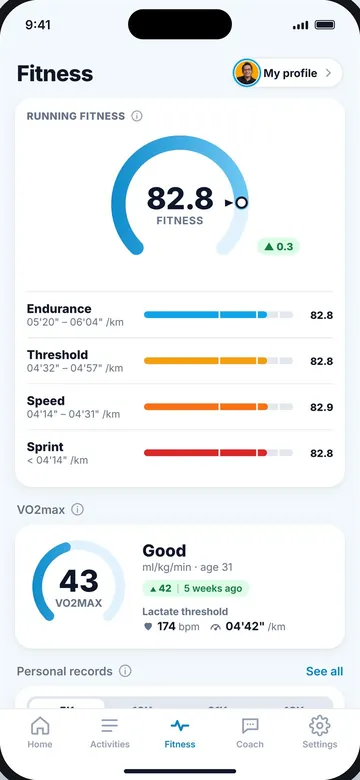
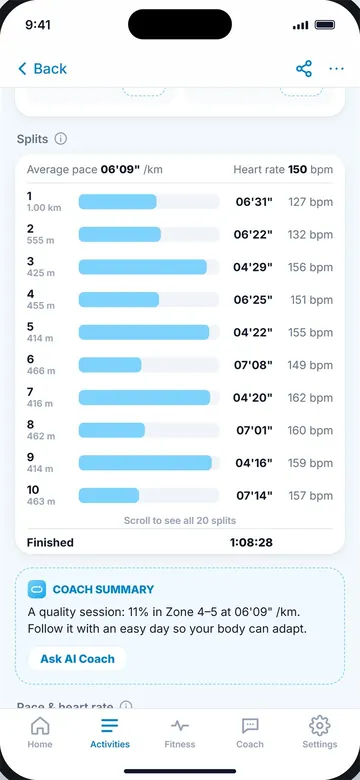
Lactate threshold on the Fitness tab (left) and heart rate zones on a run (right).
Key takeaways
- LTHR is the average heart rate you can hold for about an hour of hard running.
- Test it with a 30-minute solo effort: the average heart rate of the last 20 minutes is your LTHR.
- In trained runners it is often around 85 to 92% of max heart rate, but there is no "good" number.
- Zones from LTHR (Friel) fit your body well, even if your max heart rate is unusual.
- Retest every 6 to 8 weeks, on a cool day when you are rested.
Frequently asked questions
What is a good lactate threshold heart rate?
There is no good or bad number, because it depends on your max heart rate. What matters is that your threshold pace at that heart rate gets faster over time.
Is LTHR the same as max heart rate?
No. LTHR is the heart rate you can hold for about an hour, usually well below your max, often around 85 to 92% of it in trained runners.
Can I use a race instead of the 30-minute test?
Yes. The average heart rate of a hard 10K is often at or slightly above LTHR, and a well-paced half marathon a few beats below.
Why is my LTHR different on the treadmill?
Treadmills, heat and indoor air can change heart rate. Test where you usually run, or use outdoor data for outdoor zones.
How often should I retest my LTHR?
Every 6 to 8 weeks, or after a training block. Windlace updates it from your runs automatically.

Keep reading
FitnessWhat is lactate threshold, and why does it matter?The pace you can hold for about an hour: what it means, how it feels, how to find yours, and the workouts that make it faster.11 min read
Heart rateHeart rate zones explained, simplyWhat each zone does, three ways to calculate yours, and how much of your running belongs in each one.10 min read
PaceWhat is threshold pace, and how do you find yours?The pace you can hold for about an hour: where it sits next to your race paces, four ways to find it, and how to train with it.10 min read