Almost every heart rate zone system starts from one number: your maximum heart rate. If it is set 10 beats too low, your "easy" Zone 2 turns into a crawl. If it is 10 beats too high, your easy runs quietly become medium-hard. Either way, your training is off.
The good news: you do not need a lab. Here is how to find a number you can trust.
What maximum heart rate is
Your maximum heart rate is the highest number of beats per minute your heart can reach during an all-out effort. It is set mostly by your genes and your age, not by your fitness.
That surprises many runners. Training does not raise your max heart rate, and a high or low max does not mean you are fit or unfit. Two runners with the same race times can have max heart rates 20 beats apart. What training changes is how fast you can run at each heart rate.
Why "220 minus age" is often wrong
The famous formula comes from a rough line drawn through data in the early 1970s, not from a careful study. It is easy to remember, but it can miss your real max by 10 to 20 beats or more, especially for older, very fit runners.
Later research produced formulas that fit large groups better. The best known is from Tanaka and colleagues (2001), based on hundreds of studies: 208 − 0.7 × age. A Norwegian study of thousands of adults by Nes and colleagues (2013) found 211 − 0.64 × age.
| Age | 220 − age | Tanaka (208 − 0.7 × age) | Nes (211 − 0.64 × age) |
|---|---|---|---|
| 20 | 200 | 194 | 198 |
| 30 | 190 | 187 | 192 |
| 40 | 180 | 180 | 185 |
| 50 | 170 | 173 | 179 |
| 60 | 160 | 166 | 173 |
The easiest way: look at your own runs
If you have been running with a heart rate sensor for a while, your max may already be in your data. Look for the highest heart rate in your hardest efforts: the finish of a 5K race, the last rep of a hill session, or a sprint at the end of a race.
- Use hard efforts only. The highest number from an easy run is probably not your max.
- Ignore single spikes in the first minutes or that jump 20 beats in one second. These are usually sensor errors, common with wrist sensors.
- Prefer chest strap data, which is more reliable at high heart rates.
A field test, step by step
If you want a direct number, run a test. Only do this if you are healthy, used to hard running, and have no heart problems. If you are unsure, check with a doctor first.
- Pick a fresh day after an easy day or a rest day, not after a hard week.
- Warm up for 15 minutes: easy running, then 3 or 4 short pickups of 20 seconds.
- Run 3 minutes hard on a steady hill or a flat road, at an effort you could hold for about 3 to 4 minutes. Jog back down or easy for 2 minutes.
- Repeat it, faster. On the second rep, push harder, and in the last 30 to 60 seconds go all-out.
- Read the highest heart rate from that final minute. That is close to your max.
- Cool down for 10 to 15 minutes of easy jogging.
Your result from a test is usually a beat or two below your true max, because it is hard to reach absolute maximum on your own. A race finish often gets closer.
What changes max heart rate (and what does not)
Running vs other sports
Your max heart rate is not one fixed number for every activity. Running uses large muscles in an upright position, so it usually gives the highest values. Cycling max heart rate is often a few beats lower, and swimming often lower still, partly because you are lying flat and fewer muscles carry your weight.
So if you also ride or swim, do not copy your running max into those sports, or the other way round. Use a separate max for each, or set running zones only from running data. The same goes for treadmill and outdoor runs in very different conditions: hot, humid indoor air can push heart rate up, while cold weather can hold it down a little.
How to use your max heart rate
Your max heart rate, together with your resting heart rate, gives your heart rate reserve, and from that, all your heart rate zones. For example, with a resting heart rate of 50 and a max of 190, Zone 2 is 134 to 147 bpm. Set the max at 180 instead, and Zone 2 drops to 128 to 140: a big difference on every easy run.
Many coaches also like zones based on your lactate threshold heart rate, which you can measure more safely and which works even if your max is unusual.
How Windlace finds your max heart rate
- Add runs with heart rate, from your phone and a sensor, your COROS watch, or a file.
- Windlace takes the highest heart rate recorded in your runs as your max. It is measured from your data, not typed in by hand.
- A hard race or all-out effort updates it automatically if you go higher.
- Your six zones update with it, using your max and resting heart rate (Karvonen method).
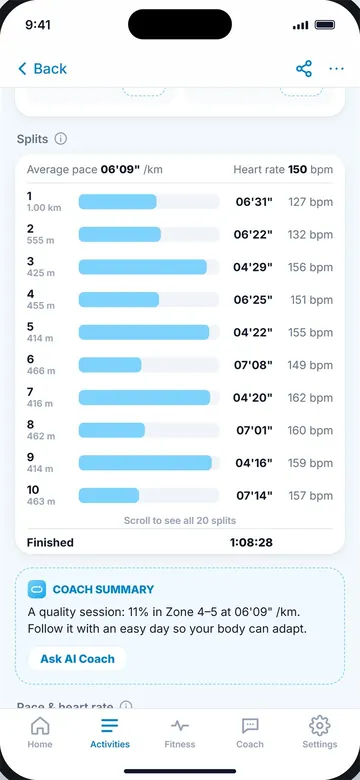
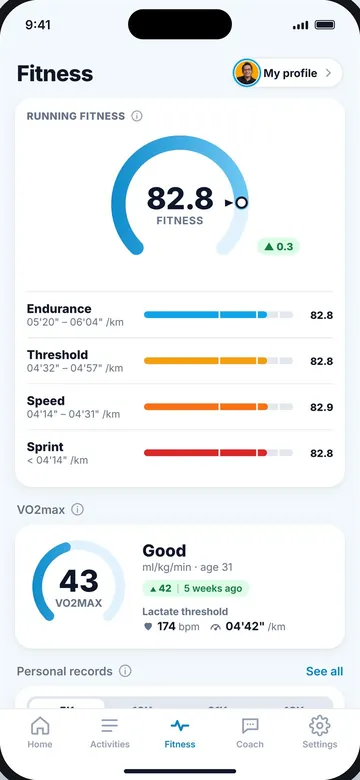
Heart rate on a run (left) and your zones on the Fitness tab (right).
Key takeaways
- Max heart rate is the highest your heart can beat in an all-out effort; it depends on genes and age, not fitness.
- 220 minus age is a rough guess; Tanaka (208 − 0.7 × age) fits groups better, but people still vary by about 10 bpm.
- The easiest real number is the highest clean reading from your hardest runs or races.
- A field test with two hard 3-minute efforts gets close, but only do it if you are healthy and used to hard running.
- A wrong max shifts every zone, so check it before trusting your Zone 2.
Frequently asked questions
Is 220 minus age accurate?
Only roughly. It can be 10 to 20 beats off for many people. Tanaka's formula, 208 minus 0.7 times age, fits large groups better, but your own data is best.
Does a higher max heart rate mean I am fitter?
No. Max heart rate is mostly set by genes and age. Fitness shows up as running faster at the same heart rate, and often a lower resting heart rate.
Can training increase my max heart rate?
Not really. It stays about the same with training and slowly falls with age.
Why is my max heart rate higher than the formula says?
Formulas show the average for your age. Many healthy people are 10 or more beats above it. If your data shows it repeatedly in hard efforts, it is probably real.
Is it safe to test my max heart rate?
For healthy people used to hard running, a careful test is generally fine. If you have heart problems, symptoms or are new to exercise, talk to a doctor first.

Keep reading
Heart rateHeart rate zones explained, simplyWhat each zone does, three ways to calculate yours, and how much of your running belongs in each one.10 min read
Heart rateLactate threshold heart rate (LTHR): how to find itThe heart rate you can hold for about an hour: the 30-minute test, typical values, and how to set your zones from it.9 min read
Heart rateWhat is Zone 2 running, and why does everyone talk about it?Why slow running makes you faster, how to find your Zone 2 heart rate and pace, and how to use it every week.10 min read