Intervals are the session most runners picture when they think of "speed work". Run fast, rest, repeat. Done well, they make you fitter quickly. Done badly, they leave you tired, sore or injured. The difference is mostly in the pace and the rest.
What interval training is
Interval training means alternating short, fast efforts (the reps) with easy recovery (jogging or walking), so you can spend more total time at a high intensity than you could in one continuous run.
For example, you could probably only run 5K pace for 20 to 30 minutes in a race. But with 2-minute jogs between, you can run five 1 km reps at that pace in a training session and recover in a day or two.
What intervals do for you
How fast should intervals be?
Faster than threshold, but not a sprint. The right pace depends on rep length:
| Rep length | Pace | Effort | Rest |
|---|---|---|---|
| 200 to 400 m | About 1500 m to mile race pace | 8 to 9 out of 10 | Same time as the rep, or more |
| 800 m to 1 km | About 3K to 5K race pace | 8 out of 10 | 50 to 100% of the rep time |
| 1.2 to 2 km | About 5K to 10K race pace | 7 to 8 out of 10 | About half the rep time |
A useful rule from Jack Daniels: VO2max-type reps should last no more than about 5 minutes each, and the total at that pace should be about 8% of your weekly distance, up to 10 km.
Six classic interval workouts
Always warm up with 10 to 15 minutes easy plus a few short strides, and cool down with 10 minutes easy.
| Workout | Main set | Good for |
|---|---|---|
| Beginner minutes | 6 × 1 min fast, 2 min walk or jog | First speed sessions |
| 400s | 8 to 12 × 400 m, 200 m jog | Speed, 5K |
| 800s | 5 to 6 × 800 m, 400 m jog | 5K and 10K |
| Kilometre repeats | 5 × 1 km, 2 to 3 min jog | VO2max, 5K and 10K |
| Pyramid | 400-800-1200-800-400 m, half-time jog | Variety, pacing |
| Long reps | 3 × 2 km at 10K pace, 3 min jog | 10K to half marathon |
How to run a good interval session, step by step
- Know your target pace from a recent race or your threshold pace.
- Warm up properly: 10 to 15 minutes easy, a few drills, and 4 strides of 20 seconds.
- Run the first rep slightly conservative. It always feels easy; that is a trap.
- Aim for even reps. All reps within 2 to 3 seconds per 400 m of each other, with the last one as fast as the first.
- Keep the recovery easy: a slow jog or walk, not a rest you rush.
- Stop if your form breaks down or the pace drops by more than a few seconds. One rep less is better than one rep too many.
Why the recovery matters
The jog between reps is part of the workout, not a break from it. Too short, and you cannot hold the pace, so the session turns into a struggle. Too long, and your heart rate drops so far that each rep starts from scratch. For VO2max reps of 800 m to 1 km, a jog of about 2 to 3 minutes lets your heart rate fall to roughly 120 to 130 bpm before the next one. For short speed reps of 200 to 400 m, take longer rest, because the aim is fast, smooth running rather than tiring your heart and lungs.
Fitting intervals into your week
A simple week for a runner doing four runs: an interval session on Tuesday, easy runs on Thursday and Sunday, and a long run on Saturday. If you also want a tempo run, swap one easy run for it, but keep at least one easy day between any two hard days. In the last week before a race, keep a short interval session with fewer reps to stay sharp without getting tired.
How often to do intervals
Once a week is enough for most recreational runners. Pair it with one tempo run or long run and keep the rest easy. Beginners should build a base of 3 to 4 easy runs a week for at least 6 to 8 weeks first, then start with short, gentle sessions like 6 × 1 minute. Take at least one easy day, ideally two, after an interval session.
Track, road or treadmill?
Gentler alternatives
Not ready for structured reps? Fartlek training mixes fast and easy running by feel, with no set distances or paces. It is a great first step into speed work, and a fun change for experienced runners too.
Intervals work best on top of mostly easy running. Read 80/20 running for the balance, and How to run a faster 5K for a plan that puts these sessions to work.
Intervals in Windlace
- Press lap at the start and end of each rep on your watch, or use a structured workout.
- Open the run: the Splits card shows your laps exactly as recorded, with pace and heart rate for every rep and recovery.
- Check your pace zones: the fast reps should land in your Speed zone, built from your threshold pace.
- Look at your training load after the session, and your recovery the next day.
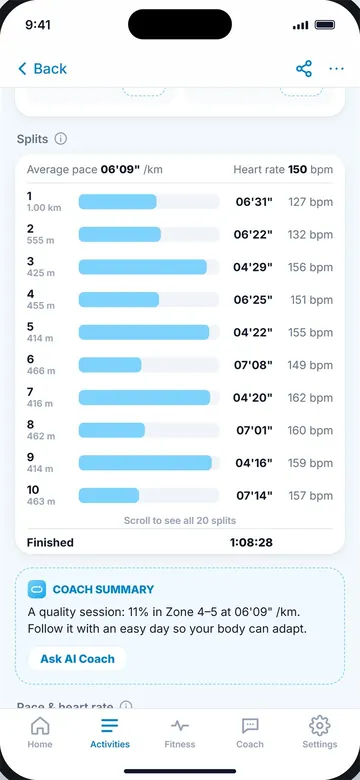
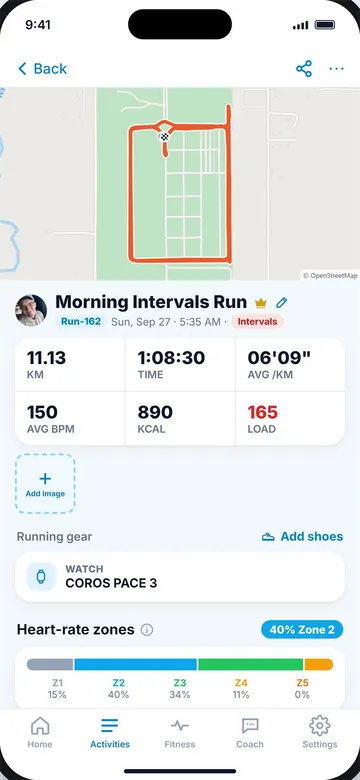
Laps for each rep (left) and the run summary (right).
Key takeaways
- Intervals alternate fast reps with easy recovery so you can spend more time at high intensity.
- Reps of 800 m to 1 km are usually run at about 3K to 5K race pace.
- Aim for even reps: the last as fast as the first, and stop if form breaks down.
- Once a week is enough for most runners, with easy days around it.
- Beginners should build an easy base first and start with short reps like 6 × 1 minute.
Frequently asked questions
What is a good interval workout for beginners?
6 × 1 minute at a fast but controlled pace with 2 minutes of walking or jogging between, after a 10-minute warm-up.
How fast should I run 400 m repeats?
About your 1500 m to mile race pace: fast, but you should be able to run every rep at the same speed.
How long should the rest be between intervals?
For 800 m to 1 km reps, about 50 to 100% of the rep time as an easy jog. Shorter reps can have equal or longer rest.
How many times a week should I do intervals?
Once a week for most recreational runners. More than that raises injury risk without much extra benefit.
Are intervals better than tempo runs?
They do different jobs. Intervals raise top-end fitness; tempo runs raise the pace you can hold for longer. Most plans use both.

Keep reading
 TrainingHow to improve your VO2maxThe workouts that raise VO2max, how often to do them, a sample week, and how long it takes to see results.10 min read
TrainingWhat is a tempo run, and how do you do one?The right tempo pace, how it differs from threshold runs, five tempo workouts and how often to do them.9 min read
TrainingHow long should your long run be?Simple long run rules by race distance and weekly mileage, the right pace, and how fast to build up.9 min read