The 5K is the most popular race distance in the world, from parkruns to city fun runs. It is also one of the most rewarding to train for: progress comes fast, and the training fits around a busy life. Whether you run 35 minutes or 20, the same principles apply.
The short answer
To run a faster 5K, build your easy weekly running, add one interval session at about 5K pace and one tempo or threshold run each week, practise even pacing, and give it 6 to 12 weeks; most newer runners can improve by 1 to 3 minutes.
Why the 5K is mostly an endurance race
It feels like a fast race, but a 5K lasting 15 to 35 minutes gets most of its energy from aerobic metabolism, using oxygen. That means the aerobic engine (built by easy running and threshold work) matters as much as speed. The fastest route to a better 5K for most runners is more consistent running plus a little targeted speed.
The four workouts that matter most
| Workout | Example | Why |
|---|---|---|
| VO2max intervals | 5 × 1 km at 5K pace, 2 to 3 min jog | Raises your top aerobic power |
| Tempo or threshold | 20 min at threshold, or 4 × 6 min | Lets you hold a faster pace for longer |
| Strides | 6 × 20 s fast and relaxed after easy runs | Speed and running form |
| Long run | 60 to 80 min easy | Endurance and aerobic base |
Read the details in Interval training for runners and What is a tempo run?
An 8-week outline
| Weeks | Interval day | Tempo day | Long run |
|---|---|---|---|
| 1 to 2 | 8 × 400 m at 5K pace | 3 × 6 min at threshold | 50 to 60 min |
| 3 to 4 | 5 × 800 m at 5K pace | 20 min tempo | 60 to 70 min |
| 5 to 6 | 5 × 1 km at 5K pace | 2 × 12 min at threshold | 65 to 75 min |
| 7 | 3 × 1.6 km at 5K pace | 20 min tempo | 60 min |
| 8 (race) | 4 × 400 m at race pace, early in the week | Easy | Race day |
Beginners can drop the tempo day and keep just one session a week with strides on easy days.
How to pace a 5K
- Warm up 10 to 15 minutes with 3 or 4 strides. A cold start costs time.
- Kilometre 1: 2 to 5 seconds slower than goal pace. The first few hundred metres are where most runners go too fast.
- Kilometres 2 to 3: settle at goal pace. This is the hard, quiet middle.
- Kilometre 4: hold on. Focus on form and the runner ahead.
- Last kilometre: push gradually, and sprint the final 200 metres.
Even or slightly faster second halves produce the best times. See Negative split.
How much faster can you get?
Common mistakes
- Only running fast: without easy volume, your aerobic base stays small.
- Racing every week: parkrun is great, but all-out every week leaves no energy for training.
- Starting too fast: the most common way to lose a minute.
- Skipping the warm-up before a short race.
Example: from 28 to 26 minutes
Jo runs three times a week, all at the same steady pace, and has been stuck at 28 minutes for a year. Jo adds a fourth run, slows the easy runs down by about 30 seconds per km, and makes one run a week an interval session (starting with 8 × 400 m, building to 5 × 1 km) and one a short tempo. The long run grows from 6 km to 10 km. After 10 weeks, Jo runs 26:10 at a local parkrun, with the second half 15 seconds faster than the first. Nothing magic: more easy running, two focused sessions and patient pacing.
The 5K warm-up
Short races need the longest warm-ups, because you start at full effort. A good routine: 10 to 15 minutes of easy jogging, a few dynamic drills (leg swings, high knees, skips), then 3 or 4 strides of 15 to 20 seconds building to race pace. Finish 5 to 10 minutes before the start, and keep moving while you wait.
Small things that add up
- Strength training twice a week: squats, lunges and calf raises improve power and lower injury risk.
- Hill repeats: a great strength and VO2max session early in a plan.
- Sleep: 7 to 9 hours, especially before hard days.
- Light, fast shoes can help a little on race day; train in them a few times first.
Popular 5K goals
Sub-30 (6:00 per km) is a great first goal for many new runners. Sub-25 (5:00 per km) is a common next step; read How to run a sub-25 minute 5K. Sub-20 (4:00 per km) needs dedicated training, often 40+ km a week.
Train for a faster 5K with Windlace
- Check your 5K prediction on the Fitness tab: what you could run today, from your runs.
- Set a 5K target with Break the PR and see if it is Realistic, Ambitious or Very hard.
- Follow the week-by-week plan built around your weekly schedule.
- Watch your 5K record: Windlace finds your fastest 5K inside any run, not only races.
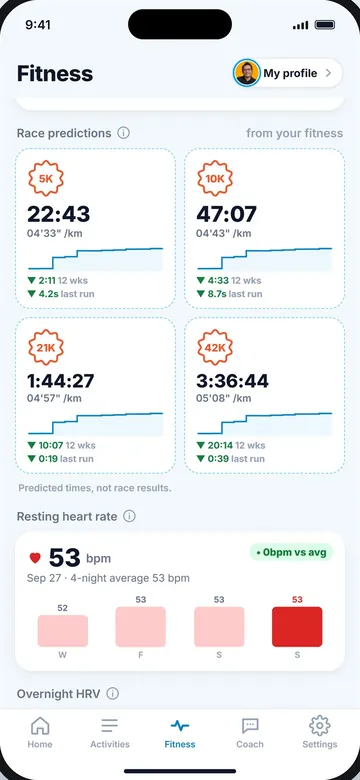
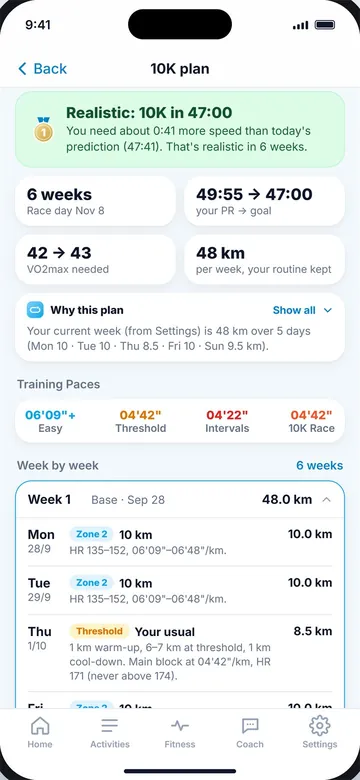
Race predictions (left) and a Break the PR plan (right).
Key takeaways
- A 5K is mostly aerobic, so easy volume matters as much as speed work.
- Key sessions: intervals at 5K pace, a tempo or threshold run, strides and a long run.
- Start the race a few seconds slower than goal pace and finish strong.
- Newer runners can often improve 1 to 3 minutes in 8 to 12 weeks.
- Do not race all-out every week; use parkrun as a tempo most of the time.
Frequently asked questions
How can I improve my 5K time fast?
Run consistently, add one interval session at 5K pace and one tempo run a week, and pace the race evenly. Many runners see gains within 4 to 6 weeks.
How many times a week should I run to get faster at 5K?
3 to 5 times, with one or two harder sessions and the rest easy.
What is the best workout for a faster 5K?
Kilometre repeats at 5K pace with 2 to 3 minutes of jogging, such as 5 × 1 km.
How long does it take to improve a 5K?
Noticeable gains usually come in 6 to 12 weeks of focused training.
Should I run a 5K every week to get faster?
Racing all-out every week is tiring. Use most weekly races as controlled tempo runs and race hard every 4 to 6 weeks.

Keep reading
 TrainingInterval training for runners: a simple guideWhat intervals are, the right pace and rest, six classic workouts and how often to do them safely.10 min read
RacingHow to run a sub-25 minute 5KThe pace you need, the fitness it takes, matching training paces, key sessions and race-day pacing.9 min read
RacingNegative split: the smartest way to raceWhy a faster second half wins races, how to plan negative splits for 5K to marathon, and how to practise them.9 min read