Twenty-five minutes is a magic number for many runners. It sits right between "new runner" and "serious club runner", and it is within reach for most healthy adults who train consistently. If you are running 26 to 30 minutes today, this guide is for you.
The short answer
A sub-25 minute 5K needs an average pace just under 5:00 per km (8:03 per mile), which matches a Daniels fitness level (VDOT) of about 38; most runners get there with 3 to 4 runs a week, one interval and one tempo session, over 8 to 16 weeks.
How fit do you need to be?
According to Jack Daniels' equivalent tables, a 25:00 5K matches roughly:
| Distance | Equivalent time |
|---|---|
| 1 mile | about 7:30 |
| 10K | about 51:53 |
| Half marathon | about 1:55 |
| Marathon (fully trained) | about 3:58 |
If you can already run a 10K in about 52 minutes, sub-25 for 5K is probably within reach right now with good pacing. To turn any recent race into a goal, see How to set a realistic race goal time.
Where are you now?
Key sessions for sub-25
- Kilometre repeats: 4 to 6 × 1 km at 4:50 to 4:55 per km, 2 to 3 minutes jog. Teaches race pace to feel normal.
- Tempo: 15 to 25 minutes at about 5:15 per km. Raises the pace you can hold.
- Long run: 50 to 75 minutes at 6:05 to 7:15 per km. Builds the base.
- Strides: 6 × 20 seconds fast and relaxed after two easy runs a week.
A sample week (4 runs)
| Day | Run |
|---|---|
| Tuesday | Warm-up, 5 × 1 km at 4:52 with 2:30 jog, cool-down |
| Wednesday | 35 min easy plus strides |
| Friday | Warm-up, 20 min at 5:15 per km, cool-down |
| Sunday | 60 to 70 min easy |
That is about 25 to 30 km a week, a common amount for sub-25 runners. More easy running helps if your body handles it.
Build the base first
Most runners stuck at 27 to 30 minutes do not lack speed. They lack aerobic fitness, because they run too little or run every run at the same medium pace. Before adding hard sessions, get to 3 or 4 runs a week for at least a month, with most of them truly easy. Our guide to a faster 5K explains why the 5K is mostly an endurance race.
How to track your progress
Run a 5K time trial or parkrun every 4 to 6 weeks, at full effort, on the same flat route. In between, watch your interval times: if 1 km repeats that took 5:05 now take 4:52 at the same effort, you are on track. Your easy pace at the same heart rate should also slowly get faster, a sign that your aerobic base is growing.
Race-day plan for sub-25
- Target splits: 5:00, 4:59, 4:59, 4:59, 4:55. That gives about 24:52 on an accurate course.
- Allow for GPS: watches often read a little long. Aim for 4:55 to 4:58 on your watch.
- Line up sensibly: near runners of your pace, not at the very front.
- Check at 2.5 km: about 12:28. If you are 15+ seconds ahead, ease off slightly.
Signs you are ready
- You can run 5 × 1 km at 4:50 to 4:55 with 2 minutes rest and the last one feels as good as the first.
- A 20-minute tempo at about 5:15 feels controlled.
- Your app's 5K prediction is under 25 minutes.
Other common mistakes
- Running every run at 5:20 to 5:30: too fast to recover, too slow to build speed.
- Skipping the long run, which builds the endurance to hold pace in kilometre 4.
- Testing yourself every week instead of training.
Pick the right race
Choose a flat, accurately measured course in cool weather. A hilly or hot course can add 30 to 60 seconds, enough to miss the goal even when you are fit enough. A well-known parkrun or a road race with a certified course is ideal. Early morning races in the cool season are best, and a small field means less weaving around other runners in the first kilometre.
Chase sub-25 with Windlace
- Check your 5K prediction on the Fitness tab to see how close you are.
- Set 24:59 as your target in Break the PR. Windlace rates it as Realistic, Ambitious or Very hard and builds a plan.
- Use your pace zones for easy runs, tempo and intervals.
- Watch your 5K record: your fastest 5K inside any run counts and earns a medal.
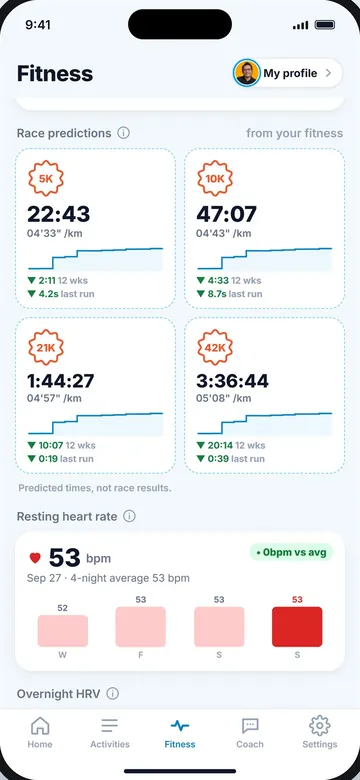
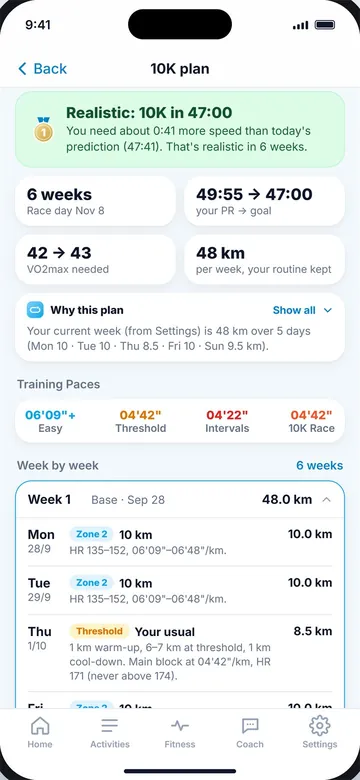
Race predictions (left) and a sub-25 plan (right).
Key takeaways
- Sub-25 for 5K means holding just under 5:00 per km (8:03 per mile).
- It matches about a 51:53 10K and a 1:55 half marathon in Daniels' tables.
- Key sessions: 1 km repeats at 4:50 to 4:55, tempo at about 5:15, long runs and strides.
- Run even splits and aim for 4:55 to 4:58 on your watch to allow for GPS.
- From 27 to 29 minutes, 8 to 12 weeks of consistent training is often enough.
Frequently asked questions
What pace is a 25 minute 5K?
5:00 per km or 8:03 per mile.
Is a sub-25 5K good?
Yes. It is faster than many recreational runners and a common milestone.
How long does it take to get from 30 to 25 minutes?
Often 3 to 6 months of consistent training for newer runners.
How many km a week for a sub-25 5K?
Many runners do it on 20 to 35 km a week with one or two quality sessions.
Can I run a sub-25 5K on three runs a week?
Yes, many runners do. Make one run intervals, one a tempo or easy run, and one a long run of 50 to 70 minutes.
What 10K time equals a 25 minute 5K?
About 51 to 52 minutes, according to Daniels' equivalent tables.

Keep reading
RacingHow to run a faster 5KThe four workouts that matter most, an 8-week plan outline, race pacing and how much faster you can get.10 min read
PaceRunning pace chart for 5K, 10K, half and marathonThe pace per km and per mile for popular goal times at every distance, plus the training paces that get you there.9 min read
RacingHow to set a realistic race goal timeUse a recent race and proven formulas, adjust for training and conditions, and test your goal in workouts.10 min read