A goal time is only useful once you turn it into a pace you can run. "Sub-2 half marathon" becomes "5:41 per km, every kilometre". These charts do that work for the most popular goal times, in kilometres and miles, so you can see at a glance what each goal asks of you.
How to use these charts
A running pace chart turns a goal finish time into the even pace you need per kilometre or mile; for example, a 25-minute 5K needs 5:00 per km (8:03 per mile), and a 4-hour marathon needs 5:41 per km (9:09 per mile).
The paces below assume an even effort the whole way. Because GPS usually reads a little long in races, many runners aim 2 to 5 seconds per km faster than the chart.
5K pace chart
| Goal time | Pace per km | Pace per mile |
|---|---|---|
| 18:00 | 3:36 | 5:48 |
| 20:00 | 4:00 | 6:26 |
| 22:00 | 4:24 | 7:05 |
| 25:00 | 5:00 | 8:03 |
| 28:00 | 5:36 | 9:01 |
| 30:00 | 6:00 | 9:39 |
| 35:00 | 7:00 | 11:16 |
| 40:00 | 8:00 | 12:52 |
10K pace chart
| Goal time | Pace per km | Pace per mile |
|---|---|---|
| 40:00 | 4:00 | 6:26 |
| 45:00 | 4:30 | 7:15 |
| 50:00 | 5:00 | 8:03 |
| 55:00 | 5:30 | 8:51 |
| 1:00:00 | 6:00 | 9:39 |
| 1:05:00 | 6:30 | 10:28 |
| 1:10:00 | 7:00 | 11:16 |
Half marathon pace chart
| Goal time | Pace per km | Pace per mile |
|---|---|---|
| 1:30:00 | 4:16 | 6:52 |
| 1:40:00 | 4:44 | 7:38 |
| 1:45:00 | 4:59 | 8:01 |
| 1:50:00 | 5:13 | 8:23 |
| 2:00:00 | 5:41 | 9:09 |
| 2:10:00 | 6:10 | 9:55 |
| 2:30:00 | 7:07 | 11:27 |
Marathon pace chart
| Goal time | Pace per km | Pace per mile |
|---|---|---|
| 3:00:00 | 4:16 | 6:52 |
| 3:15:00 | 4:37 | 7:26 |
| 3:30:00 | 4:59 | 8:01 |
| 3:45:00 | 5:20 | 8:35 |
| 4:00:00 | 5:41 | 9:09 |
| 4:30:00 | 6:24 | 10:18 |
| 5:00:00 | 7:07 | 11:27 |
| 5:30:00 | 7:49 | 12:35 |
Notice that a 1:30 half and a 3:00 marathon need the same pace on paper, 4:16 per km. In reality, a runner who can run a 1:30 half usually runs a marathon closer to 3:08 to 3:10, because holding a pace for twice the distance is much harder. For a full breakdown, see our marathon pace chart.
Training paces for each level
Race pace is only one of the paces you need. Most training should be slower, and some faster. This table, based on Jack Daniels' equivalent tables, shows typical paces for runners at different 5K levels:
| 5K time | Easy | Threshold | Interval | 400 m rep |
|---|---|---|---|---|
| 30:40 | 7:19 to 8:42 | 6:24 | 5:53 | 2:21 |
| 26:58 | 6:30 to 7:44 | 5:40 | 5:12 | 2:05 |
| 24:06 | 5:50 to 6:59 | 5:05 | 4:40 | 1:52 |
| 21:48 | 5:19 to 6:22 | 4:37 | 4:15 | 1:42 |
| 19:56 | 4:53 to 5:51 | 4:15 | 3:54 | 1:34 |
Learn more about each kind of pace in How slow should an easy run be? and What is threshold pace?
Why pace slows as races get longer
The same runner cannot hold the same pace over every distance. A well-known formula from engineer Peter Riegel (1977) describes the slowdown: when the distance doubles, the time grows by a factor of about 2.15, not 2. So each step up in distance costs a few seconds per kilometre. In practice that means:
- 10K pace is usually about 10 to 15 seconds per km slower than 5K pace.
- Half marathon pace is about 15 to 20 seconds per km slower than 10K pace.
- Marathon pace is about 15 to 25 seconds per km slower than half marathon pace, often more for newer marathoners.
That is why the charts above should be read one distance at a time. A goal at one distance tells you roughly what is possible at the others, but only if you have trained for them.
How to choose a realistic goal, step by step
- Start from a recent race or time trial, ideally at a shorter distance within the last 6 to 8 weeks.
- Use an equivalent-performance prediction (such as Riegel's formula or Daniels' tables) to estimate your time at the goal distance.
- Adjust for your training: for a half or full marathon, the prediction only holds if your long runs and weekly distance are there.
- Find the matching row in the chart above and check that the pace feels possible in training.
- Test it: a long run with 20 to 40 minutes at goal pace should feel controlled, not desperate.
The full method is in How to set a realistic race goal time.
Using your pace on race day
- Write down 3 or 4 checkpoint times, not every split. For a 50:00 10K: 10:00 at 2 km, 25:00 at 5 km, 40:00 at 8 km.
- Use course markers, not only your watch, because GPS drifts over long races.
- Start a few seconds slower than goal pace and speed up in the second half. See Negative split.
- On hot or hilly days, adjust your goal before the start rather than chasing it in the second half.
Your own pace chart in Windlace
- Add your runs from your phone, your COROS watch or a file.
- Open the Fitness tab to see your race predictions for 5K, 10K, half and marathon, worked out from your current fitness.
- Check your pace zones, built from your threshold pace, to know your easy and workout paces.
- Set a PR goal with Break the PR, and see whether your target is Realistic, Ambitious or Very hard.
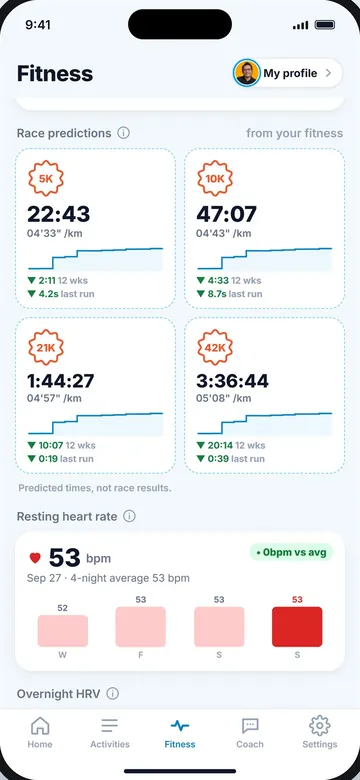
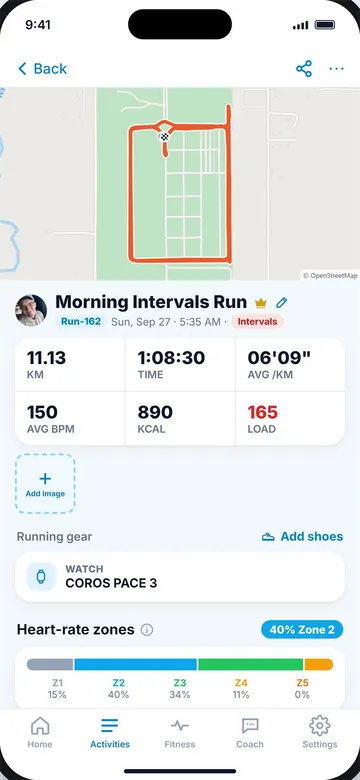
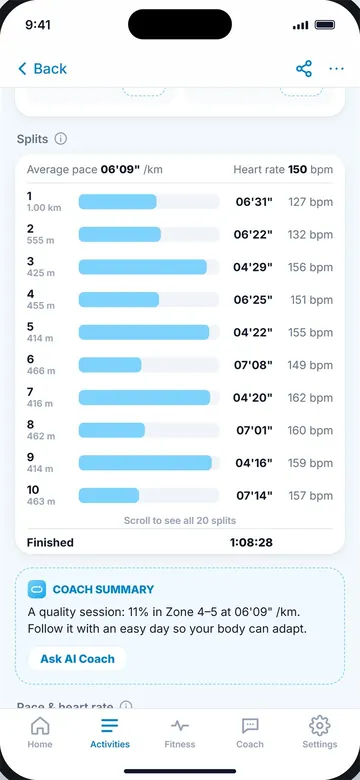
Race predictions (left) and pace on a run (right).
Key takeaways
- A pace chart turns a goal finish time into the even pace you need per km or mile.
- Sub-25 5K = 5:00 per km; sub-50 10K = 5:00 per km; sub-2 half = 5:41 per km; sub-4 marathon = 5:41 per km.
- Aim 2 to 5 seconds per km faster than the chart, because GPS often reads long.
- Most training should be slower than race pace, with some threshold and interval work faster.
- Choose your goal from a recent race and your training, not from a round number.
Frequently asked questions
What pace do I need for a sub-2 hour half marathon?
5:41 per km or 9:09 per mile, run evenly. Aim for about 5:37 to 5:39 per km to allow for GPS distance.
What pace is a 4 hour marathon?
5:41 per km or 9:09 per mile.
What pace is a 25 minute 5K?
5:00 per km or 8:03 per mile.
Why does my watch say I ran further than the race distance?
You cannot run the exact shortest line around every corner, and GPS adds small errors, so most watches read 1 to 2% long in races.
How do I convert my pace per km to per mile?
Multiply your per-km pace by 1.609. For example, 5:00 per km is about 8:03 per mile. Our pace conversion chart lists the common paces both ways.
Is it better to pick a time goal or just finish?
For a first race at a new distance, finishing comfortably is a great goal. Once you have a time to beat, a pace chart helps you plan a realistic improvement.
Should I train at my goal race pace?
Some of the time, in specific workouts. Most of your running should be easy, well slower than race pace.

Keep reading
PacePace vs speed, and a min/km to min/mile chartThe difference between pace and speed, a conversion chart with km/h and mph, and easy formulas for any pace.8 min read
 TrainingHow long should your long run be?Simple long run rules by race distance and weekly mileage, the right pace, and how fast to build up.9 min read
TrainingInterval training for runners: a simple guideWhat intervals are, the right pace and rest, six classic workouts and how often to do them safely.10 min read