Every runner knows the feeling: the start gun goes, your legs feel amazing, and you fly through the first kilometres faster than planned. Twenty minutes later, you are paying for it. The fix is a pacing strategy that elite runners have used for decades: the negative split.
What a negative split is
A negative split means running the second half of a race faster than the first half. For example, a 10K in 49:30 run as 25:00 for the first 5 km and 24:30 for the second.
The opposite, a positive split, is when the second half is slower. An even split means both halves take about the same time. See What are splits, and how do you read them? for how to read your own.
Why it works
Look at the pacing of most world records from 5K to the marathon and you will see very even splits, often with a slightly faster finish. Small differences, big discipline.
How much faster should the second half be?
Not much. A good negative split is usually only 1 to 2% faster in the second half. A huge difference usually means the first half was too slow, which wastes time too.
| Race and goal | First half | Second half |
|---|---|---|
| 5K in 25:00 | 12:40 (5:04 /km) | 12:20 (4:56 /km) |
| 10K in 50:00 | 25:15 (5:03 /km) | 24:45 (4:57 /km) |
| Half marathon in 1:55:00 | 58:00 | 57:00 |
| Marathon in 4:00:00 | 2:01:00 | 1:59:00 |
How to plan a negative split, step by step
- Set a realistic goal time from recent races or your current fitness. See How to set a realistic race goal time.
- Work out your average goal pace: goal time divided by distance.
- Start 5 to 10 seconds per km slower than goal pace for the first 10 to 20% of the race.
- Settle at goal pace through the middle of the race.
- Speed up gradually in the last quarter, and empty the tank in the final kilometre.
Average pace = goal time ÷ distance
Example: 1:55:00 for a half marathon = 6,900 seconds ÷ 21.0975 km = 327 seconds = 5:27 per km. Start around 5:33, finish around 5:20.
By race distance
How to practise it in training
- Progression runs: run 30 to 50 minutes, starting easy and finishing at about marathon or half marathon pace in the last 10 minutes.
- Negative-split long runs: run the second half of your long run 10 to 20 seconds per km faster than the first, still mostly easy.
- Tempo with a fast finish: 20 minutes at threshold, with the last 5 minutes slightly quicker.
- Even-paced intervals: make the last rep the fastest, never the first.
What a fast start really costs
Here is a simple example. A runner aiming for a 50-minute 10K runs the first 3 km at 4:45 per km instead of 5:00, "saving" 45 seconds. Running above their threshold builds fatigue, and from 6 km they slow to 5:20 per km. Over the last 5 km that costs 100 seconds. Net result: about a minute slower than an even race, and a much more painful finish. The maths nearly always works this way, because slowing down when tired loses time faster than going out hard gains it.
Staying patient in the first kilometres
- Start further back: starting among faster runners pulls you out too fast.
- Check your watch at 500 m: the first few hundred metres are when most runners go out too hard.
- Use a phrase: "hold back now, pass people later" is simple and it works.
- Breathe and relax: if you cannot breathe easily in the first kilometre of a 10K or longer, you are going too fast. See How to breathe when running.
Hills, wind and heat
On a hilly or windy course, think in even effort rather than even pace. You will be slower uphill and into the wind, and faster downhill and with the wind behind you. In the heat, start even more conservatively: heat makes the cost of a fast start much higher, and many runners slow down sharply in the second half of hot races.
Pacing is easier when the goal is right. Read How to set a realistic race goal time, and see the running pace chart for the splits of popular goal times.
How Windlace helps you pace
- Check your race prediction on the Fitness tab to set a realistic goal pace.
- Set a PR goal with Break the PR: the plan rates your target as Realistic, Ambitious or Very hard.
- After the race, open your splits to see whether you ran positive, even or negative, with heart rate for each km.
- Ask the AI coach for a split plan for your next race. It suggests; you decide.
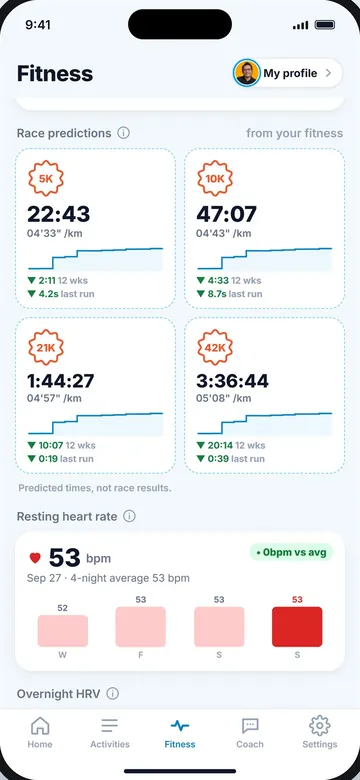
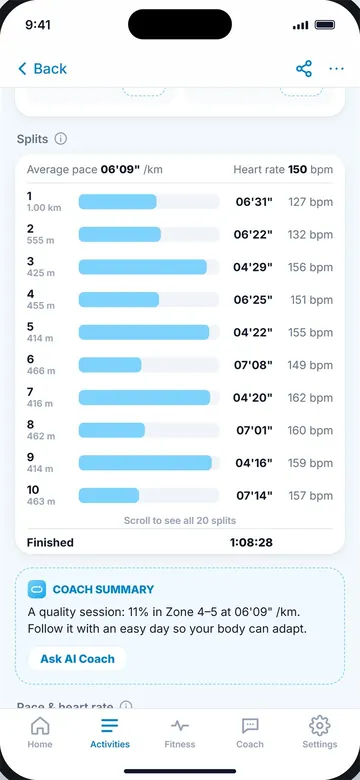
Race predictions (left) and race splits (right).
Key takeaways
- A negative split means running the second half faster than the first.
- It saves fuel, limits early fatigue and helps you finish strong.
- Aim for a second half only 1 to 2% faster; a big gap means you started too slowly.
- Start 5 to 10 seconds per km slower than goal pace, settle, then speed up in the last quarter.
- Practise with progression runs, negative-split long runs and even-paced intervals.
Frequently asked questions
What is a negative split in running?
Running the second half of a race faster than the first half, for example a 10K in 25:00 and then 24:30.
Is a negative split always best?
An even or slightly negative split is usually best on a flat course in good weather. On hilly courses, aim for even effort instead.
How do I negative split a marathon?
Start a few seconds per km slower than goal pace, stay patient until about 30 km, and only then speed up if you feel strong. Many runners aim for an even split.
Why do I always slow down in races?
Most likely you start too fast. Fresh legs and adrenaline make early kilometres feel easy. Plan your first splits slower and stick to them.
How much slower should my first kilometre be?
About 5 to 10 seconds per km slower than your goal pace is enough. Much slower than that wastes time you will not easily win back.
What is a progression run?
A run that starts easy and gets gradually faster, finishing near race pace. It is a great way to practise negative splits.

Keep reading
PaceWhat are splits in running, and how do you read them?What splits and laps are, the three kinds of split, and how to read your own splits to pace better.9 min read
RacingHow accurate are race time predictions?How predictors work, why the marathon number is often too fast, and how to turn a prediction into a smart race plan.9 min read
TrainingHow long should your long run be?Simple long run rules by race distance and weekly mileage, the right pace, and how fast to build up.9 min read