Every good race starts with a good goal. It decides your training paces, your race-day pacing and, in the end, how you feel crossing the line. Yet many runners pick a goal because it is a round number or because a friend ran it. There is a better way.
The short answer
To set a realistic race goal, start from a recent race or time trial, convert it to your goal distance with an equivalent-time formula (such as Riegel or Daniels' VDOT), then adjust for your training, the course and the weather, and check it in key workouts.
Step 1: start from a recent result
The best predictor of your race time is a recent race, ideally within the last 6 to 8 weeks, on a flat course, run all-out. A 5K or 10K is ideal: short enough to race often, long enough to reflect your endurance. No recent race? Run a time trial: a 5K on a track or flat, measured route, after a good warm-up.
Step 2: convert it with a formula
In 1977, engineer Peter Riegel published a simple formula for race times across distances:
T2 = T1 × (D2 ÷ D1)1.06
Example: 10K in 50:00. Half marathon = 50 × (21.1 ÷ 10)1.06 = 50 × 2.21 = about 1:50:20.
Jack Daniels' VDOT tables do the same job in a different way, by giving each race result a fitness level and listing equivalent times. Both work well from 5K to half marathon. For the marathon, both assume you have trained properly for the distance; many recreational runners run 5 to 10% slower than the formula predicts. See Race time predictions for how these models work.
| 5K | 10K | Half marathon | Marathon |
|---|---|---|---|
| 20:00 | 41:28 | 1:31:50 | 3:11:17 |
| 24:06 | 50:00 | 1:50:52 | 3:49:34 |
| 25:00 | 51:53 | 1:55:04 | 3:57:55 |
| 26:04 | 54:07 | 2:00:00 | 4:07:45 |
| 30:00 | 1:02:23 | 2:18:10 | 4:43:39 |
Step 3: adjust for your training
- Long runs: for a half marathon, have you run 16 to 21 km? For a marathon, 28 to 32 km? If not, add time.
- Weekly distance: marathon predictions hold best for runners on 50+ km a week. On 30 to 40 km a week, add 5 to 10%.
- Time to train: 8 to 12 weeks of focused training can usually improve a 5K or 10K by 2 to 5% for a newer runner, less for experienced runners.
- Experience: first-time marathoners often slow a lot in the last 10 km; be conservative.
Step 4: adjust for course and weather
Step 5: test it in training
Your goal should match what you can do in key workouts:
- 5K: 5 × 1 km at goal pace with 2 minutes jog should feel hard but controlled.
- 10K: 3 × 2 km at goal pace with 2 to 3 minutes jog.
- Half marathon: 2 × 5 km at goal pace with 3 minutes jog, or 8 to 10 km continuous.
- Marathon: 14 to 20 km at goal pace inside a long run, 3 to 5 weeks before the race.
If these feel desperate, adjust the goal now, not in the second half of the race.
Three goals, not one
Many experienced runners set an A, B and C goal. A: everything goes perfectly. B: a solid day. C: finish strong and enjoy it. This takes pressure off and gives you a plan for a hot or windy day. Your B goal should be the one you pace for.
Turn the goal into a pace
Divide the goal time by the distance to get your race pace, then plan to start a few seconds per km slower and finish faster. Our running pace chart lists the paces for popular goal times.
Worked example
Maya ran a 10K in 52:00 six weeks ago and wants to run a half marathon in 10 weeks. Riegel predicts 52 × 2.21 ≈ 1:55. Her longest run is 15 km and she runs about 35 km a week, so she plans to build her long run to 19 km. The race is usually warm, so she adds about 2%: a B goal of about 1:57 (5:33 per km), an A goal of 1:55 and a C goal of finishing under 2:05 feeling strong.
Check your goal in Windlace
- Open race predictions on the Fitness tab: your 5K, 10K, half and marathon potential today, from your runs.
- Set your target with Break the PR: pick one distance and a time.
- See the rating: Realistic (close to what your fitness predicts), Ambitious (possible if you hit every key session) or Very hard (a big jump from your current fitness).
- Follow the plan built around your weekly schedule, and watch your prediction move over 12 weeks.
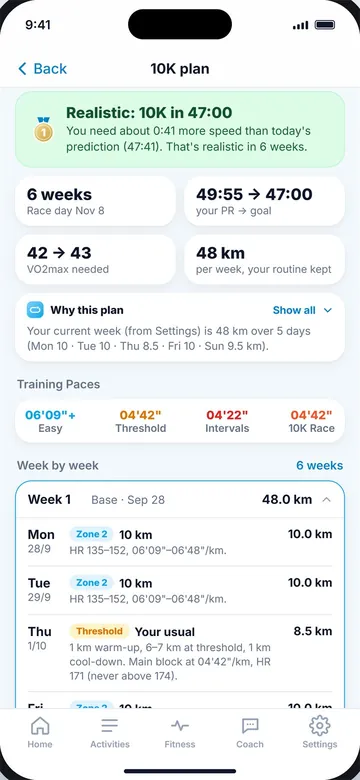
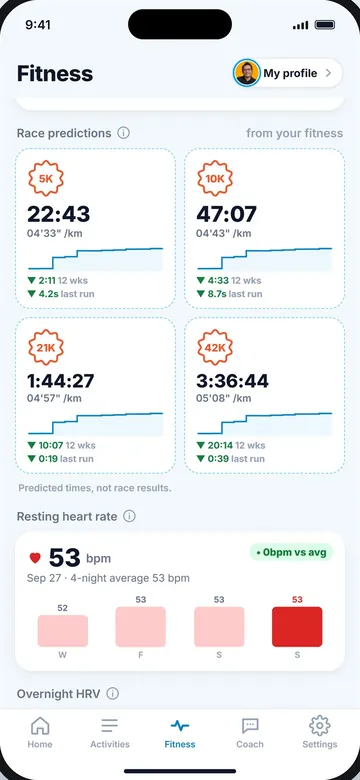
Break the PR plan (left) and race predictions (right).
Key takeaways
- Start from a recent all-out race or time trial on a flat course.
- Convert it with Riegel (T2 = T1 × (D2 ÷ D1)^1.06) or Daniels' tables.
- Add time for missing long runs, low weekly distance, heat, hills and wind.
- Test the goal in key workouts and adjust before race day, not during it.
- Set A, B and C goals and pace for your B goal.
Frequently asked questions
How do I know what time I can run a half marathon?
Use a recent 5K or 10K and an equivalent-time formula. A 50:00 10K predicts about 1:50 to 1:51 for a half, if you have done the long runs.
What is the Riegel formula?
T2 = T1 × (D2 ÷ D1)^1.06. It predicts a race time at one distance from a time at another.
Are marathon predictions accurate?
Only if you have trained for the marathon. Many recreational runners run 5 to 10% slower than the formula predicts.
How much can I improve in 12 weeks?
Newer runners often improve 2 to 5% at 5K or 10K; experienced runners usually less.
Should I set more than one goal?
Yes. A, B and C goals give you a plan for good and bad days.

Keep reading
RacingHow accurate are race time predictions?How predictors work, why the marathon number is often too fast, and how to turn a prediction into a smart race plan.9 min read
PaceRunning pace chart for 5K, 10K, half and marathonThe pace per km and per mile for popular goal times at every distance, plus the training paces that get you there.9 min read
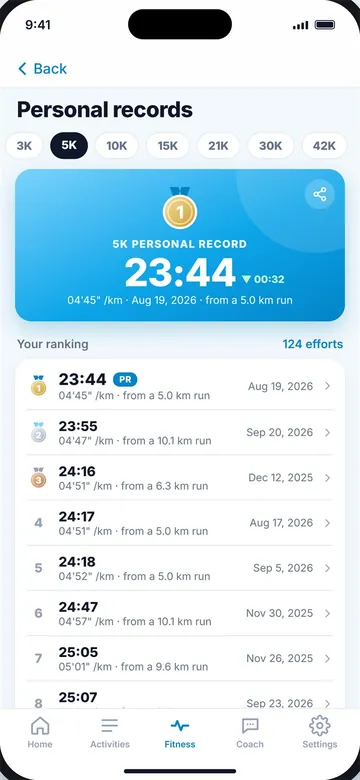 RacingWhat is a PR in running, and how do you beat it?What PR means, PR vs PB, which distances count, and simple ways to beat your personal record.9 min read