"I got a PR!" is one of the happiest sentences in running. It means you ran faster than you ever have before at a distance. For many runners, chasing PRs is what keeps training fun, because there is always a new target, whatever your level.
What PR means
A PR (personal record) is your fastest ever time at a given distance, such as 5K, 10K, half marathon or marathon; outside the US it is usually called a PB (personal best), and the two mean the same thing.
You can also have PRs for things like your longest run, your biggest week or your fastest mile, but most runners mean race distances when they say PR.
PR vs PB
There is no difference in meaning. "PR" is more common in the United States; "PB" is more common in the UK, Australia, Europe and much of Asia. Some runners also use "SB" (season best) for their fastest time this year, which is a nice way to track progress when an old PR is out of reach.
What counts as a PR?
| Type | Counts? | Notes |
|---|---|---|
| Official race result | Yes, the classic PR | Measured course, official timing |
| Time trial on your own | Yes, for most runners | Best on a track or a measured route |
| Fastest 5K inside a 10K run | Yes, as a best effort | Many apps track these automatically |
| Downhill or wind-assisted course | Often marked separately | Fast, but not comparable |
There is no single rulebook for personal records. The important thing is to compare like with like: race with race, or best effort with best effort, on accurate distances.
Common PR distances
- Short: 400 m, 1 km, 1 mile.
- Classic: 5K and 10K.
- Long: 15K, half marathon (21.1 km) and marathon (42.2 km).
- Other: 3K, 30K and ultra distances for some runners.
How to beat your PR, step by step
- Know your current fitness. Your PR may be from a fitter time, or you may now be fitter than your PR shows.
- Pick a realistic target: often 1 to 3% faster for a recent PR, more if you are newer or your PR is old. See How to set a realistic race goal time.
- Train for 8 to 12 weeks: mostly easy running, with one or two key sessions a week for your distance.
- Taper so you start fresh.
- Pace evenly: most PRs are run with even or slightly faster second halves. See Negative split.
- Choose a good day: a flat course, cool weather and little wind make a big difference.
How fast do PRs improve?
New runners often see big PRs in their first year, sometimes minutes off a 5K, because fitness grows quickly from a low base. After 2 to 3 years of steady training, progress slows: improvements of a few seconds to a minute a year are normal and still worth celebrating. Older runners can keep setting age-group PRs, or "age-graded" PRs, even when their all-time bests are behind them.
Why the day matters
Heat, humidity, wind and hills can easily add 2 to 5% to a race time. A runner capable of a 50-minute 10K on a cool, flat day may run 52 to 53 minutes on a hot, hilly one, with the same fitness. Before calling a race a failure, check the conditions. And when chasing a PR, pick a race known for being flat and fast, in a cool season.
Training that sets PRs
| Distance | Key sessions |
|---|---|
| 1 mile to 5K | Intervals of 400 m to 1 km at 3K to 5K pace, strides, one tempo run |
| 10K | 1 to 2 km reps at 10K pace, tempo runs, long runs of 12 to 16 km |
| Half marathon | Threshold runs, long runs of 16 to 21 km with some at goal pace |
| Marathon | Long runs to 30 to 32 km, marathon-pace blocks, higher weekly distance |
Whatever the distance, the base is the same: consistent weeks of mostly easy running. Workouts sharpen the fitness that easy running builds.
Race-day habits of PR runners
- Warm up: 10 to 15 minutes easy plus a few strides before a 5K or 10K; less before a marathon.
- Start slightly slower than goal pace for the first kilometre.
- Check pace at markers, not every second on your watch.
- Save the push for the last third of the race.
Other ways to win
Your PRs in Windlace
- Windlace finds your PRs automatically for 400 m, 1 km, 1 mile, 3K, 5K, 10K, 15K, half marathon, 30K and marathon.
- Fast parts inside longer runs count too, not only races: your fastest 5K inside a 10K run is a 5K best effort.
- Medals: gold for your best time, silver for your 2nd best and bronze for your 3rd, shown on your runs.
- Set a target with Break the PR and get a plan to beat it.
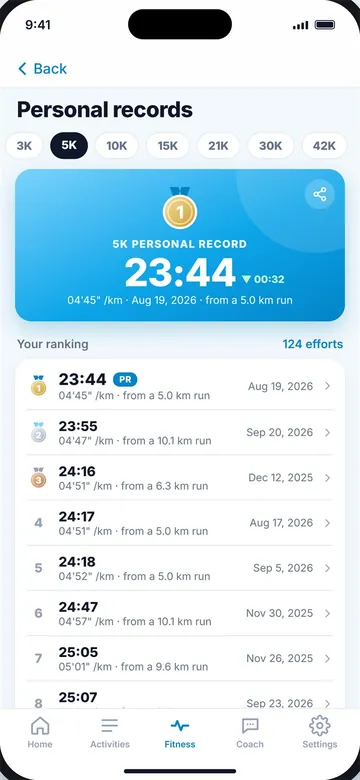
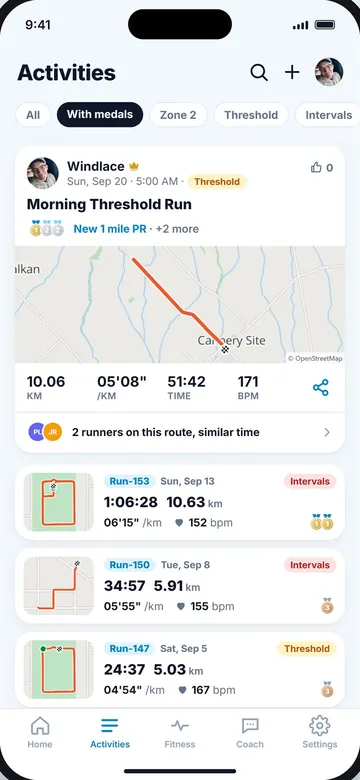
Personal records (left) and medals (right).
Key takeaways
- A PR (personal record) is your fastest ever time at a distance; PB means the same.
- Races, time trials and best efforts inside longer runs can all count, but compare like with like.
- Beat your PR with a realistic target, 8 to 12 weeks of training, a taper and even pacing.
- Weather, wind and hills can add 2 to 5% to a time with the same fitness.
- New runners set big PRs quickly; experienced runners improve by smaller steps.
Frequently asked questions
What does PR mean in running?
Personal record: your fastest ever time at a distance.
What is the difference between a PR and a PB?
None. PR (personal record) is common in the US; PB (personal best) is common elsewhere.
Does a PR have to be in a race?
No. Many runners count time trials and best efforts in training, as long as the distance is accurate.
How often can I set a PR?
New runners may set PRs every few weeks. Experienced runners usually set a few a year, after focused training.
What is a good 5K PR?
It depends on your age, sex and experience. Many recreational runners run 25 to 35 minutes; the best target is a little faster than your current PR.
What is a best effort?
Your fastest time for a distance found inside any run, such as the fastest 5K within a 10K run.

Keep reading
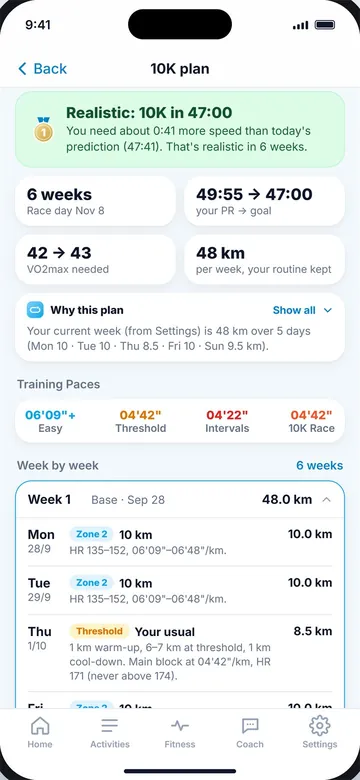 RacingHow to set a realistic race goal timeUse a recent race and proven formulas, adjust for training and conditions, and test your goal in workouts.10 min read
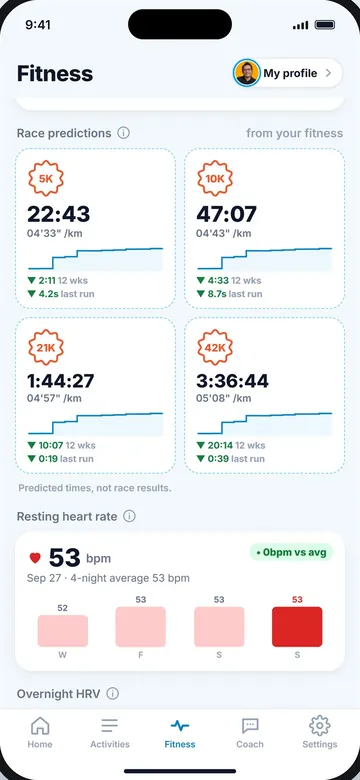 RacingHow accurate are race time predictions?How predictors work, why the marathon number is often too fast, and how to turn a prediction into a smart race plan.9 min read
RacingNegative split: the smartest way to raceWhy a faster second half wins races, how to plan negative splits for 5K to marathon, and how to practise them.9 min read