If you run most of your runs at a "comfortably hard" pace, you are in good company: it is what most recreational runners do. It is also one of the main reasons many of them stop improving. The 80/20 approach flips the pattern: most running really easy, a small amount really hard.
What 80/20 running is
80/20 running means spending about 80% of your training time at a low, easy intensity and about 20% at moderate to high intensity, following the pattern seen in elite endurance athletes.
The 80% is conversational running: heart rate Zones 1 to 2, easy pace. The 20% is tempo runs, intervals, hill repeats and races. The split is usually counted by time, not by distance or by number of runs.
Where the idea comes from
Sport scientist Stephen Seiler studied how elite endurance athletes train: runners, rowers, cross-country skiers and cyclists. Across sports and countries he found the same pattern: roughly 80% of training at low intensity and 20% at high intensity, with little in between. Later studies compared this "polarised" approach with more middle-intensity training and often found equal or better results for the 80/20 group. Coach and author Matt Fitzgerald popularised the idea for everyday runners in his book 80/20 Running.
Why it works
The trap: the moderate middle
Studies that measure recreational runners often find the opposite of 80/20: a big share of training in the middle zone (around Zone 3), a pace that feels productive but is too hard to recover from easily and too easy to bring the gains of real workouts. This is sometimes called the "grey zone" or "junk miles". Moving those runs to properly easy pace, and making one or two sessions properly hard, is the whole idea of 80/20.
What counts as easy and hard?
| Part | Heart rate | Feel | Examples |
|---|---|---|---|
| 80% easy | Zones 1 to 2 | Can talk in full sentences | Easy runs, long runs, recovery runs |
| 20% moderate to hard | Zones 3 to 5 | Short phrases to single words | Tempo, threshold, intervals, hills, races |
Warm-ups and cool-downs on workout days count as easy time. That is why a week with two workouts can still be close to 80/20. See heart rate zones for running for how the zones are set.
A simple 80/20 week
| Day | Run | Hard time |
|---|---|---|
| Monday | Rest | 0 |
| Tuesday | 60 min with 5 × 4 min intervals | 20 min |
| Wednesday | 40 min easy | 0 |
| Thursday | 60 min with 25 min tempo | 25 min |
| Friday | 30 min easy | 0 |
| Saturday | 90 min long run, last 15 min steady | 15 min |
| Sunday | 20 min recovery jog or rest | 0 |
How to switch to 80/20, step by step
- Measure your current split. Add up your time in each zone over the last 2 weeks.
- Slow your easy runs down until heart rate stays in Zone 2. See How slow should an easy run be?
- Keep one or two harder sessions a week, and make them clearly hard.
- Check again after 2 weeks and adjust.
- Give it 6 to 8 weeks. Most runners see easy pace get faster at the same heart rate.
What the research shows
Several studies have compared 80/20-style training with more time at moderate intensity. In one study of recreational runners by Muñoz and colleagues (2014), the group that trained closer to 80/20 improved their 10K time more than the group that spent more time in the middle zone, even though both trained for similar total time. Other studies find similar or smaller differences. The overall message is consistent: easy days easy, hard days hard, and not too much in between.
Common mistakes
- Counting runs, not time: four easy runs and one workout is not automatically 80/20 if the workout is long and the easy runs short.
- Easy runs that drift into Zone 3 on hills or hot days.
- Hard sessions that are only medium hard, because the legs are tired from fast easy runs.
- Treating 80/20 as exact: 75/25 or 85/15 is fine. The point is the pattern.
How to check your 80/20 balance in Windlace
- Open any run to see the time in each heart rate zone and pace zone.
- Look at your easy runs: most of the bars should sit in Zones 1 and 2.
- Check what each run trained with training effect (Recovery, Base, Tempo, Threshold, VO2max, Anaerobic).
- Watch your average Zone 2 pace on the Fitness tab get faster as your base grows.
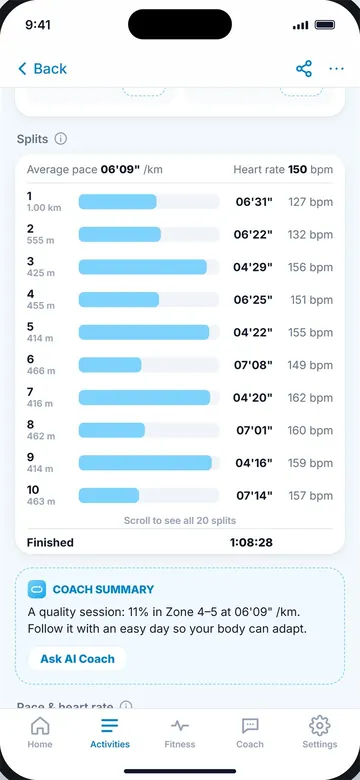
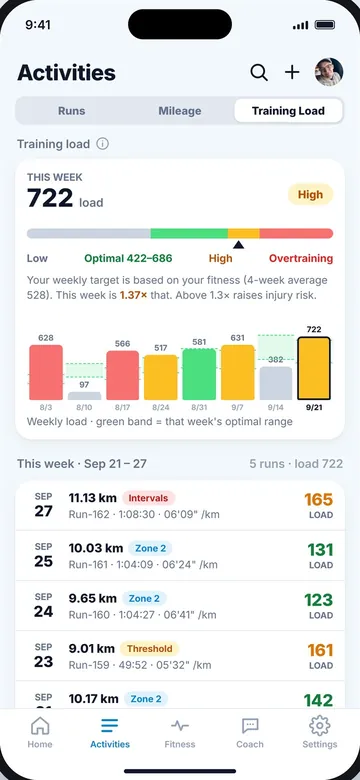
Zones on one run (left) and training load (right).
Key takeaways
- 80/20 running means about 80% of training time easy and 20% moderate to hard.
- It mirrors how elite endurance athletes train, as studied by Stephen Seiler.
- Most recreational runners spend too much time in the moderate middle zone.
- Count the split by time in zones; warm-ups and cool-downs count as easy.
- Slow down easy runs, keep one or two truly hard sessions, and check your zones every 2 weeks.
Frequently asked questions
What is the 80/20 rule in running?
Spend about 80% of your running time at an easy intensity and about 20% at moderate to high intensity.
Is 80/20 running good for beginners?
Yes. New runners can run almost everything easy at first and add one harder session once they have a base.
Is 80/20 by time or distance?
Usually by time. Measuring time in heart rate or pace zones is the simplest way.
What heart rate zone is the 80%?
Zones 1 and 2, where you can talk in full sentences.
Can I do 80/20 with only 3 runs a week?
Yes. Make two runs easy and keep one session with a hard part, such as intervals or a tempo block. The warm-up and cool-down count as easy time.
Does 80/20 work for marathon training?
Yes. Most marathon plans are close to 80/20, with long runs and easy runs making up most of the time.

Keep reading
TrainingHow slow should an easy run be?Four simple ways to find your easy run pace, and why running slowly most days makes you faster.9 min read
Heart rateWhat is Zone 2 running, and why does everyone talk about it?Why slow running makes you faster, how to find your Zone 2 heart rate and pace, and how to use it every week.10 min read
Heart rateHeart rate zones explained, simplyWhat each zone does, three ways to calculate yours, and how much of your running belongs in each one.10 min read