Look at the heart rate graph of any long, steady run and you will often see the same shape: a quick rise in the first minutes, a plateau, and then a slow climb that continues to the end, even though your pace never changed. That slow climb has a name: heart rate drift, also called cardiac or cardiovascular drift.
What heart rate drift is
Heart rate drift is the gradual rise in heart rate during a long, steady run, even though your pace and effort stay the same. It is a normal response of the body, and it usually becomes noticeable after about 20 to 30 minutes.
Drift tends to be larger in the heat, when you are dehydrated, and when the run is long compared with what you are used to. A small amount is normal for everyone. A large amount often means the run was too hard, too hot, or your aerobic base is still developing.
Why it happens
How to measure it: aerobic decoupling
Coaches measure drift by comparing the first and second halves of a steady run. The idea, made popular by coach Joe Friel, is called aerobic decoupling (or pace-to-heart-rate decoupling): how much your pace and heart rate "come apart" over the run.
- Run steadily for at least 60 minutes on a flat route, at an easy, even effort.
- Split the run into two halves. Note the average pace and average heart rate of each.
- Work out the efficiency of each half: speed divided by heart rate.
- Compare them. The drop in efficiency from the first half to the second, as a percentage, is your decoupling.
Decoupling = (efficiency 1st half − efficiency 2nd half) ÷ efficiency 1st half
Example: 6:00 /km is 10 km/h. First half: 10 ÷ 145 = 0.0690. Second half: 10 ÷ 152 = 0.0658. Drop = 0.0032 ÷ 0.0690 = about 4.6%.
If your pace was not quite even, the formula still works because it uses both pace and heart rate. Many apps calculate it for you.
How much drift is normal?
| Decoupling | What it usually means |
|---|---|
| Below 5% | Good aerobic base for this pace and duration |
| 5 to 10% | Base still building, or the run was warm or a bit fast |
| Above 10% | Too fast, too hot, dehydrated, or longer than your current base |
Use these as guides, not grades. A hot, humid day can double your drift even if your fitness is great. Compare runs done in similar conditions.
How to reduce heart rate drift
- Build your aerobic base. Weeks of easy Zone 2 running are the most reliable way to lower drift.
- Start slower. A fast first half is the most common cause of a big second-half drift.
- Drink on long runs. Sip regularly in warm weather, especially beyond an hour.
- Beat the heat: run early or late, wear light clothing, and seek shade.
- Take carbohydrate on runs over 75 to 90 minutes to keep fuel steady.
- Extend your long run slowly, so your body adapts to longer durations.
Drift or something else?
Not every rising heart rate is drift. Drift is slow and smooth, over tens of minutes. A sudden jump of 20 beats in a few seconds is more likely a sensor error, and a heart rate that is high from the first kilometre usually points to heat, tiredness or a pace that is too fast (see Why is my heart rate so high when I run?). Drink to replace what you sweat on long runs; our guide on how much water to drink when running gives simple amounts.
Drift and racing
Drift matters most in longer races. In a half marathon or marathon, a runner who sets a heart rate target for the whole race will usually see it rise in the second half even at the same pace. Experienced marathoners expect this and plan for it: they run the first half by pace and feel, and let heart rate creep up later. Low decoupling on long training runs at goal pace is one of the best signs that you are ready for the distance.
Common mistakes
How to check drift in Windlace
- Run a long, steady effort with heart rate, recorded on your phone or synced from your watch.
- Open the run and look at the heart rate and pace across the run, and at your splits.
- Compare the first and second half of your splits: same pace with a higher heart rate shows drift.
- Repeat every few weeks on a similar route and in similar weather. Less drift at the same pace means a stronger aerobic base.
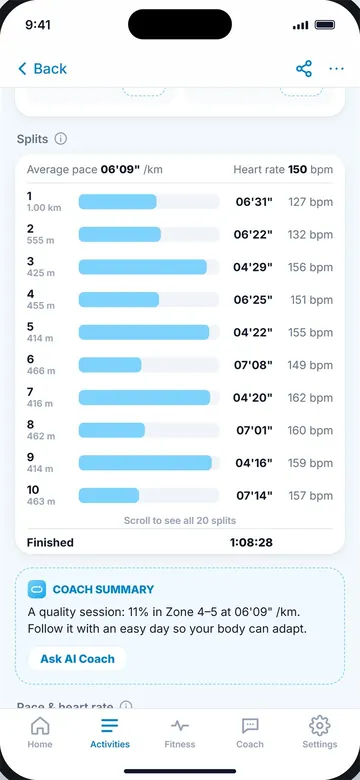
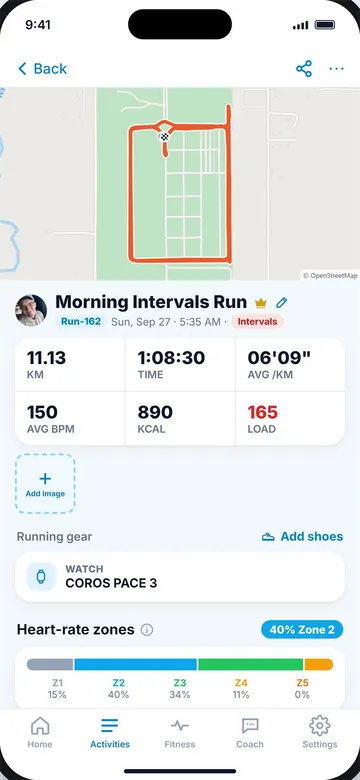
Splits with pace and heart rate (left) and the run summary (right).
Key takeaways
- Heart rate drift is the slow rise in heart rate on a long run at a steady pace.
- It comes from fluid loss, rising body temperature, tiring muscle fibres and fuel shifts.
- Measure it with aerobic decoupling: compare speed ÷ heart rate between the two halves.
- Under about 5% on an hour-long steady run in mild weather is a sign of a good aerobic base.
- Reduce it with easy base training, an even start, drinking, carbohydrate and avoiding the heat.
Frequently asked questions
Is heart rate drift bad?
No, a small amount is normal for everyone. A large drift often means the run was too fast, too hot or longer than your current base allows.
How much heart rate drift is normal?
Many coaches use under 5% decoupling on a steady run of an hour or more as a sign of a good aerobic base, and above 10% as a sign the run was too hard for now.
Why does my heart rate go up when my pace stays the same?
Mainly because you lose fluid through sweat and your body heats up, so your heart beats faster to supply both your muscles and your skin.
Does drinking water stop heart rate drift?
It reduces it, especially in warm weather, but does not stop it completely.
Should I slow down when my heart rate drifts?
On easy runs done by heart rate, yes, slowing down a little to stay in your zone is fine. In races, most runners keep their pace and accept some drift.

Keep reading
Heart rateWhy is my heart rate so high when I run?The most common reasons your running heart rate is high, how to bring it down step by step, and when to get checked.9 min read
Heart rateWhat is Zone 2 running, and why does everyone talk about it?Why slow running makes you faster, how to find your Zone 2 heart rate and pace, and how to use it every week.10 min read
TrainingHow long should your long run be?Simple long run rules by race distance and weekly mileage, the right pace, and how fast to build up.9 min read