It is one of the most common questions new runners ask. You are running at what feels like an easy pace, yet your heart rate is in the 170s or 180s. Is something wrong? Usually not. Most of the time the cause is simple: the pace, the weather, the sensor, or how fit you are right now.
The short answer
A high running heart rate is usually caused by running faster than your current easy pace, heat and humidity, dehydration, tiredness, caffeine, or a wrist sensor reading wrong, and it often drops as your aerobic fitness improves.
"High" is also personal. A heart rate of 175 is very hard for someone with a max of 180, but moderate for someone with a max of 205. Before anything else, know your own maximum heart rate and your heart rate zones.
9 common causes
1. You are running faster than your easy pace
The number one cause. For many newer runners, a truly easy pace is much slower than expected, sometimes even a jog-walk. If you cannot speak in full sentences, you are above easy.
2. Heat and humidity
When it is hot, your heart pumps extra blood to your skin to cool you down, so it has to beat faster to supply your muscles too. Running in the heat can raise heart rate by about 10 beats or more at the same pace.
3. Dehydration
When you lose fluid through sweat, your blood volume drops. Each beat moves less blood, so your heart beats faster to keep up.
4. Heart rate drift on longer runs
Even at a steady pace, heart rate slowly climbs over a long run. This is called cardiac drift and is normal, especially in the heat.
5. A low aerobic base
If you are new to running or coming back from a break, your heart and muscles are not yet used to the work. Heart rate rises fast at slow paces, and this improves with weeks of easy running.
6. Fatigue, poor sleep and stress
After a hard week, a short night or a stressful day, your body is already under strain, and heart rate runs higher. Check your morning resting heart rate: if it is up too, take it easy.
7. Caffeine, medicines and illness
Coffee, energy drinks, some cold medicines and an oncoming illness can all raise your heart rate. A fever is a clear sign to skip the run.
8. Hills and wind
Going uphill or into a headwind is harder work at the same pace, so heart rate climbs. Run hills by effort, not by pace.
9. The sensor is wrong
Wrist sensors can lock onto your running cadence instead of your heartbeat, showing a number around 160 to 180 that matches your steps. Signs of a bad reading: a sudden jump in the first minutes, a reading that does not match how you feel, or a heart rate that equals your cadence.
Is it the sensor? A quick check
| What you see | Likely cause |
|---|---|
| Jumps to 180+ in the first 5 minutes, then drops | Sensor error |
| Reading matches your steps per minute | Sensor locked onto cadence |
| Slow, steady climb over the run | Heat, drift or dehydration (real) |
| High from the start and you feel tired | Fatigue, stress or illness (real) |
| High and you feel breathless at an easy pace | Running too fast for now (real) |
To improve wrist readings, wear the watch snug, a finger's width above the wrist bone, and warm up before starting. For intervals or if you see frequent errors, a chest strap is much more reliable.
How to lower your running heart rate, step by step
- Slow down until you can talk. Walk the hills if needed. This alone fixes most cases.
- Run in the coolest part of the day, and drink regularly in hot weather.
- Use run-walk intervals if you are new, for example 3 minutes running, 1 minute walking.
- Keep most runs easy for 6 to 12 weeks. As your aerobic base grows, the same pace needs a lower heart rate.
- Sleep well and take rest days. A tired body runs a higher heart rate.
- Check your zones. If they come from an age formula, they may be set too low for you.
A real-world example
Imagine a runner with a max heart rate of 190 who sets out for an easy 6 km at 6:30 per km on a humid afternoon. After 10 minutes the watch shows 165, which is Zone 4 for them. Before deciding they are unfit, they check three things: the wrist reading looks steady (not a sudden spike), they can still talk but only in short sentences, and it is 32 °C. The answer is heat plus a pace that is too quick for those conditions. Slowing to 7:10 per km brings heart rate back to the mid-140s, and the run becomes the easy run it was meant to be.
When to see a doctor
A high heart rate during running is usually normal. But stop running and get medical advice if you have:
How to spot the cause in Windlace
- Open the run and look at heart rate alongside pace, elevation and splits.
- Check time in zones. Lots of Zone 4 on an "easy" run means the pace was too fast for today.
- Compare similar runs. Same route, same pace, higher heart rate? Look at the weather, your sleep and your recovery level.
- Watch your Zone 2 pace on the Fitness tab. As it gets faster at the same heart rate, your aerobic fitness is improving.
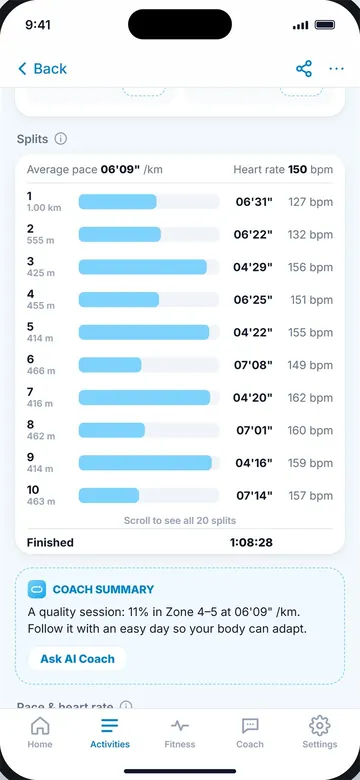
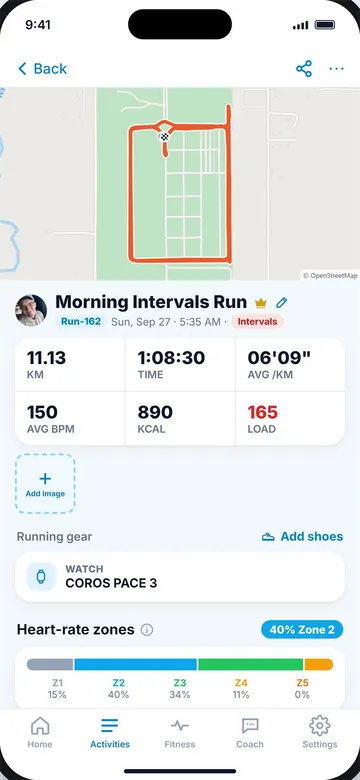
Heart rate zones and splits on a run (left) and the run summary (right).
Key takeaways
- The most common cause of a high running heart rate is simply running faster than your current easy pace.
- Heat, dehydration, drift, fatigue, caffeine, hills and wrist-sensor errors all push the number up.
- A reading that matches your steps per minute is usually the sensor, not your heart.
- Slow down until you can talk, run cooler, and keep most runs easy for a few months.
- Chest pain, dizziness or a racing, irregular beat are reasons to stop and see a doctor.
Frequently asked questions
Is a heart rate of 180 while running bad?
Not necessarily. It depends on your max heart rate. For someone with a max of 200, 180 is hard but normal during intervals. On an easy run, it usually means you are going too fast or it is hot.
Why is my heart rate high even when I run slowly?
Common reasons are a low aerobic base, heat, dehydration, tiredness or a wrist sensor error. Slowing down further, even walking, and building easy kilometres over weeks usually brings it down.
Why is my heart rate higher than my friend's at the same pace?
Max heart rates differ a lot between people, and so does fitness. Compare zones, not raw numbers.
How long does it take to lower my running heart rate?
Many runners notice a lower heart rate at the same pace within 6 to 12 weeks of mostly easy running.
Can coffee raise my heart rate when running?
Yes, caffeine can raise it by a few beats for several hours. It is not harmful for most healthy people, but it can make easy runs look harder.

Keep reading
Heart rateHeart rate zones explained, simplyWhat each zone does, three ways to calculate yours, and how much of your running belongs in each one.10 min read
Heart rateWhat is heart rate drift, and should you worry about it?Why heart rate climbs at a steady pace, how to measure drift with aerobic decoupling, and how to reduce it.9 min read
Heart rateWhat is Zone 2 running, and why does everyone talk about it?Why slow running makes you faster, how to find your Zone 2 heart rate and pace, and how to use it every week.10 min read