Many runners feel guilty taking a day off, as if they were losing fitness. In fact, rest is when training turns into fitness. Your muscles repair, your energy stores refill, and your bones and tendons adapt to the load. Skip rest for too long, and the gains stop while the risk of injury climbs.
The short answer
Most recreational runners do well with 1 to 2 rest days a week; beginners usually need 2 to 3, while experienced runners on high mileage may take one rest day a week or replace some with very easy recovery runs.
Rest days by level
| Runner | Runs per week | Rest days |
|---|---|---|
| Beginner (first 3 to 6 months) | 3 | 3 to 4, never two runs in a row at first |
| Recreational | 4 to 5 | 2 to 3 |
| Experienced | 5 to 6 | 1 to 2 |
| High mileage | 6 to 7 | 0 to 1, plus easy weeks |
Age matters too. Many runners over 40 or 50 find they recover better with an extra easy day after hard sessions. Life stress counts as well: a hard week at work, a new baby or travel all use up recovery, so add a rest day when life is busy.
What happens on a rest day
Full rest or active rest?
A full rest day means no training at all. An active rest day means light movement: a walk, easy cycling, swimming, yoga or mobility work. Both help. Active rest can loosen stiff legs; full rest is better when you are very tired, ill or nursing a niggle. A third option is a very easy recovery run, which suits runners on 5 or more days a week.
Where to put rest days
- After your hardest day, usually the long run or the main workout.
- Before a key session, so you start it fresh.
- On your busiest day at work or home, so rest fits your life.
- Never two hard days in a row: keep a rest or easy day between them.
Signs you need an extra rest day
- Heavy legs that do not improve after a few easy minutes.
- Resting heart rate clearly higher than normal in the morning.
- Overnight HRV clearly lower than your usual range.
- Poor sleep, low mood or no wish to run.
- Pain that changes how you run, or pain in one spot.
- Getting ill: fever, chest cold or body aches.
If several of these last for more than a few days, read Signs of overtraining.
Sleep: the hidden rest day
A rest day does little if you sleep badly. Most adults need 7 to 9 hours, and athletes in hard training often benefit from the upper end. Studies on athletes show that extending sleep improves reaction time, mood and sometimes performance, while short sleep raises the risk of injury and illness. If you are short on sleep for several nights, treat the next hard workout as optional and make it an easy day instead.
Rest days and cross-training
Low-impact activities like cycling, swimming and walking can sit on rest days, as long as they stay easy. They keep blood flowing and give your legs a break from the pounding of running. The rule is simple: a rest day should leave you feeling fresher the next day, not more tired. If a spin class or a long hike leaves your legs heavy for your next run, it was not a rest day.
What to do on a rest day
- Sleep: aim for 7 to 9 hours. It is the most powerful recovery tool there is.
- Eat normally: do not cut food on rest days; your body is rebuilding.
- Move gently: a walk or light mobility helps stiff muscles.
- Optional strength work: a short, light session is fine for many runners.
Example weeks with rest days
| Runner | Mon | Tue | Wed | Thu | Fri | Sat | Sun |
|---|---|---|---|---|---|---|---|
| 3 runs | Rest | Easy | Rest | Workout | Rest | Long | Rest |
| 4 runs | Rest | Workout | Easy | Rest | Easy | Long | Rest |
| 5 runs | Rest | Workout | Easy | Easy | Rest | Long | Recovery |
In each case, the hard days (workout and long run) are separated by easy or rest days. Swap the days to fit your life, but keep that pattern.
Common mistakes
- Making rest days hard cross-training days, like a tough spin class after a long run.
- Moving rest days around so that hard days end up back to back.
- Running through warning signs because the plan says so.
- Feeling guilty: rest is part of training, not a break from it.
Plan rest days with Windlace
- Check your recovery after every run: Fresh, Good, Tired or Exhausted, with the hours until you are recovered.
- Look at resting heart rate and overnight HRV from your watch on the Fitness tab.
- Watch training load: High or Overtraining means plan easier days.
- Set your rest days in My Weekly Schedule, so your plan works around them.
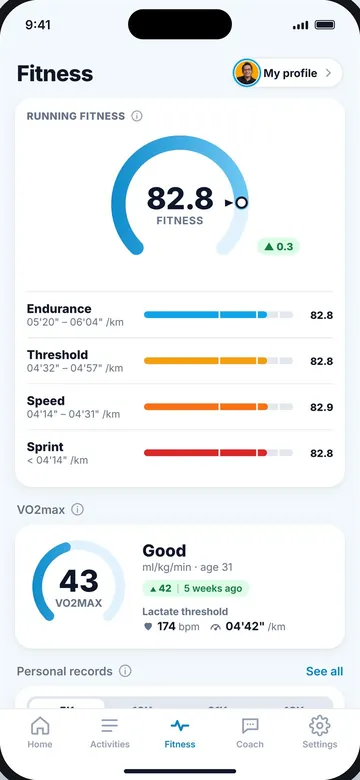
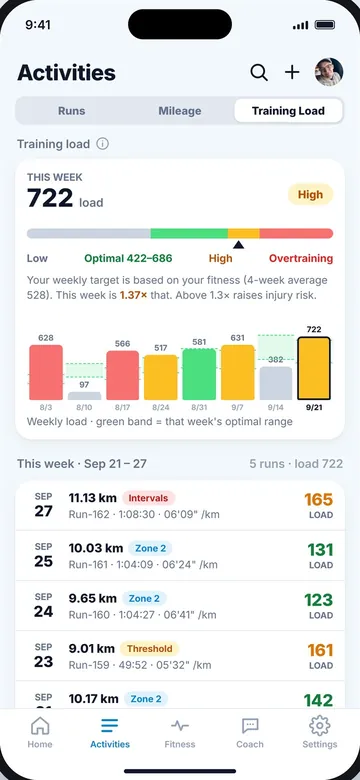
Fitness and recovery (left) and training load (right).
Key takeaways
- Most recreational runners need 1 to 2 rest days a week; beginners 2 to 3 or more.
- Rest is when muscles repair, fuel refills and bones and tendons adapt.
- Put rest after your hardest day and never schedule two hard days in a row.
- A raised resting heart rate, low HRV, heavy legs or poor sleep mean take an extra day.
- One or two days off do not reduce fitness; losses start after 1 to 2 weeks of full rest.
Frequently asked questions
How many rest days a week should a runner take?
Most recreational runners take 1 to 2. Beginners need 2 to 3 or more; high-mileage runners may take one.
Is it OK to run every day?
Experienced runners can, if most runs are easy and they take easier weeks. Beginners should not.
Should I rest after a long run?
Yes, the day after a long run is a good rest day or a very easy short run.
Will I lose fitness if I rest for a few days?
No. Measurable losses take about 1 to 2 weeks of complete rest.
Can I do strength training on a rest day?
A short, light session is fine for most runners. Keep heavy leg work away from the day before a key run.
What is active rest?
Light movement like walking, easy cycling, swimming or yoga, which helps recovery without adding stress.

Keep reading
RecoveryHow long should you recover after a run?Typical recovery times after easy runs, hard sessions and races, the signs you need more rest, and how to recover faster.9 min read
 RecoveryWhat is a recovery run, and do you need one?The right recovery run pace and length, when to run one instead of resting, and when to take the day off.9 min read
RecoverySigns of overtraining in runners (and what to do)The early warning signs, how to check your data for them, how to recover and how to avoid it.10 min read