Look at the training of almost any experienced runner and you will find runs that seem pointless: 25 minutes, very slow, the day after a big workout. These are recovery runs. They are not about fitness gains on the day. They are about arriving fresh and healthy at the next session that matters.
What a recovery run is
A recovery run is a short, very easy run of about 20 to 40 minutes, done within a day after a hard workout or long run, at a pace slower than your normal easy runs, with heart rate in Zone 1 to low Zone 2.
It is the gentlest run in your week. If you finish feeling like you did a workout, it was not a recovery run.
Recovery run vs easy run
| Recovery run | Easy run | |
|---|---|---|
| When | The day after a hard session | Any non-workout day |
| Length | 20 to 40 minutes | 30 to 75 minutes |
| Pace | Slowest of the week | Conversational |
| Heart rate | Zone 1 to low Zone 2 | Zone 2 |
| Main goal | Feel better, add some easy volume | Build your aerobic base |
Why do recovery runs at all?
Here is an honest answer: research has not shown that a slow jog clears fatigue much faster than resting does. The old idea that it "flushes out lactic acid" is outdated; lactate clears from your blood within an hour or so of finishing a workout, whatever you do. So why do coaches still use recovery runs?
For runners who only run three or four times a week, a rest day is usually just as good, often better. Recovery runs make most sense once you run five or more days a week. See Rest days for runners for how to choose.
How slow should a recovery run be?
Very slow. A helpful guide:
- By feel: effort 2 out of 10. You could chat easily the whole way, even sing.
- By pace: about 30 to 60 seconds per km slower than your normal easy pace, or slower.
- By heart rate: Zone 1 to the bottom of Zone 2. Many runners use about 65 to 70% of max heart rate as a ceiling.
Example: a runner whose easy pace is 6:15 per km might run recovery days at 6:50 to 7:30 per km. That can feel almost awkwardly slow at first. That is the point.
How to run a recovery run, step by step
- Pick a flat, soft route if you can: a park, grass or a trail without steep hills.
- Start walking for a minute or two to let stiff legs loosen up.
- Jog at the slowest comfortable pace and keep it there. Ignore runners passing you.
- Stop at 20 to 40 minutes, even if you feel good. Feeling good is the goal.
- Skip the strides and pick-ups on this day. Save them for an easy day.
When to rest instead
Choose a full rest day, not a recovery run, if any of these apply:
- Pain that changes how you run, or sharp pain in one spot.
- Illness below the neck: fever, chest cold, body aches or an upset stomach.
- Very poor sleep for several nights, or unusual tiredness.
- Resting heart rate clearly higher than normal, or HRV clearly lower, for more than a day or two.
- You run 3 to 4 days a week: rest days are part of your plan anyway.
Example: a five-day week
Here is how a runner training five days a week for a half marathon might use one or two recovery runs:
| Day | Run |
|---|---|
| Monday | Rest |
| Tuesday | Intervals: 5 × 1 km at 5K pace |
| Wednesday | Recovery run: 25 minutes very easy |
| Thursday | Easy run: 45 minutes |
| Friday | Rest or easy 30 minutes |
| Saturday | Long run: 90 minutes |
| Sunday | Recovery run: 30 minutes very easy, or a walk |
Notice that the hard days never sit next to each other. The recovery runs act as a buffer, so each hard session starts on reasonably fresh legs.
Other ways to recover actively
If you want to move without the impact of running, try 20 to 40 minutes of easy cycling, swimming, walking or a gentle yoga session. These keep blood flowing and your body loose, with almost no extra stress on your legs. Many runners alternate: a recovery jog after intervals, a walk or a swim after the long run.
After the long run or a race
After a long run, the next day should be rest or a short recovery run. After a race, recovery takes longer: a common rule is about one easy day per kilometre raced at hard effort for shorter races, and one to two weeks of easy running after a marathon. Read How long does it take to recover after a run? for the details.
Recovery in Windlace
- Check your recovery level after each run: Fresh, Good, Tired or Exhausted, with the hours until you are recovered.
- When it says Tired or Exhausted, make the next day a recovery run or rest.
- Open your recovery run afterwards: most of the time should be in heart rate Zone 1 to 2.
- Ask the AI coach whether to jog or rest tomorrow. It suggests; you decide.
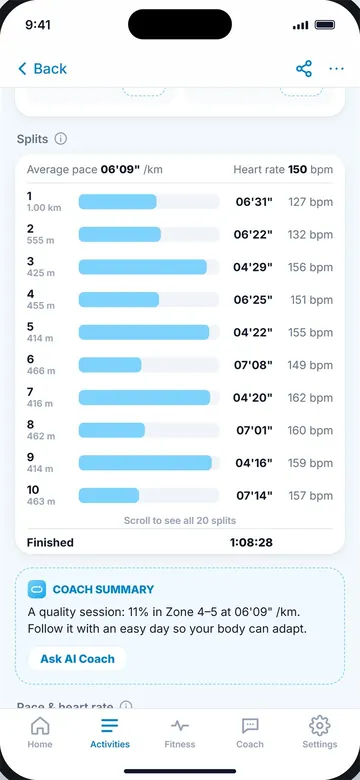
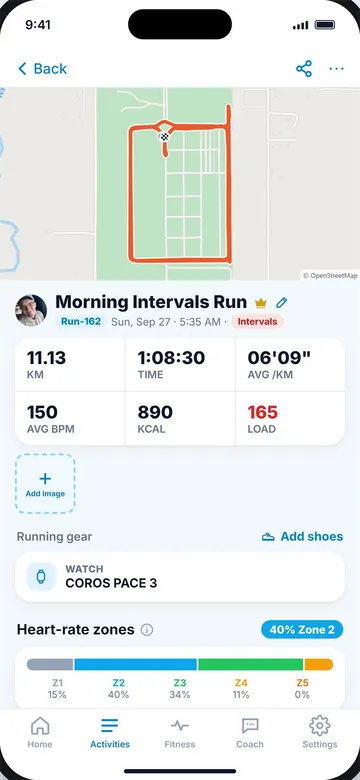
Zones for one run (left) and the run summary (right).
Key takeaways
- A recovery run is 20 to 40 minutes, very easy, done the day after a hard session.
- Run it slower than your normal easy pace, with heart rate in Zone 1 to low Zone 2.
- It does not flush out lactic acid; its value is easy volume and looser legs.
- If you run only 3 to 4 days a week, a rest day often works just as well.
- Rest instead when you have pain, illness, poor sleep or a raised resting heart rate.
Frequently asked questions
How slow should a recovery run be?
Very slow: about 30 to 60 seconds per km slower than your easy pace, at an effort of about 2 out of 10.
How long should a recovery run be?
About 20 to 40 minutes for most runners.
Is a recovery run better than a rest day?
Not always. For runners on 3 to 4 days a week, rest is usually just as good. Recovery runs suit runners on 5 or more days a week.
Do recovery runs flush out lactic acid?
No. Lactate clears from your blood within about an hour after a workout. Recovery runs help in other ways, mainly extra easy volume and looser legs.
Can I walk instead of a recovery run?
Yes. A 30 to 45 minute walk is a great low-impact alternative.

Keep reading
TrainingHow slow should an easy run be?Four simple ways to find your easy run pace, and why running slowly most days makes you faster.9 min read
 RecoveryRest days for runners: how many do you need?How many rest days you need by level, what to do on them, and the signs you need a day off.9 min read
 RecoveryHow long should you recover after a run?Typical recovery times after easy runs, hard sessions and races, the signs you need more rest, and how to recover faster.9 min read