Four hours is the line that separates marathon finishers into two groups in many runners' minds. Breaking it takes good fitness, but even more it takes patience: in training, in fuelling and above all in the first half of the race.
The short answer
A sub-4 hour marathon needs an average pace just under 5:41 per km (9:09 per mile), which matches a Daniels fitness level (VDOT) of about 38, or roughly a 25-minute 5K and a 1:56 half marathon, plus 16 to 20 weeks of training with long runs up to 30 to 32 km.
How fit do you need to be?
| Distance | Equivalent time |
|---|---|
| 5K | about 25:14 |
| 10K | about 52:22 |
| Half marathon | about 1:56 |
These tables assume full marathon training. Many runners with a 1:56 half but low weekly distance run 4:10 to 4:20. A safer rule of thumb for first-time marathoners: aim for a half marathon of about 1:52 to 1:54 before going for sub-4.
Your training paces
| Run | Pace per km |
|---|---|
| Easy and long runs | 6:06 to 7:17 |
| Marathon pace | 5:35 to 5:41 |
| Threshold | about 5:19 |
| Intervals | about 4:53 |
How much do you need to run?
Most sub-4 runners peak at about 50 to 70 km a week, over 4 to 5 runs. Some do it on 40 to 45 km, but the last 10 km of the race are much harder on low volume. Build up gradually over the first half of your plan, with an easier week every 3 to 4 weeks. See How much should you run per week?
The long run
The long run is the most important session in marathon training. Build it to 28 to 32 km, about 3 to 3.5 hours at most, at an easy pace. Two or three runs of 30 km or more in the last 8 weeks are typical. In the later long runs, include marathon-pace blocks: for example, 32 km with the middle 12 to 16 km at 5:38. These teach your body to run at pace on tired legs and let you practise fuelling.
Key sessions
- Long run: building to 30 to 32 km, with marathon-pace blocks in the last 6 to 8 weeks.
- Threshold: 4 × 2 km at about 5:19 with 2 minutes jog, or a 30-minute tempo.
- Medium-long run: 14 to 18 km midweek at easy pace, for runners on 5 days.
- Marathon-pace run: 10 to 16 km at 5:38 on its own, every 2 to 3 weeks.
A sample peak week (about 60 km)
| Day | Run |
|---|---|
| Tuesday | Warm-up, 4 × 2 km at 5:19 with 2 min jog, cool-down (about 13 km) |
| Wednesday | 8 km easy |
| Thursday | 14 km easy |
| Friday | Rest or 5 km recovery |
| Sunday | 30 km: 14 km easy, 12 km at 5:38, 4 km easy |
For a full 16 to 18 week structure, read Marathon training plan for beginners.
Fuelling: the secret of the last 10 km
Your body stores enough carbohydrate for roughly 90 to 120 minutes of hard running. In a 4-hour race, you have to top it up. Most sports nutrition guidelines suggest about 30 to 60 grams of carbohydrate per hour in the marathon, and some runners use up to 90 grams. In practice, that is one gel every 30 to 40 minutes, starting around 30 to 45 minutes in, with water. Practise this in every long run. Eat extra carbohydrate in the 2 to 3 days before the race.
Avoiding "the wall"
"Hitting the wall" usually happens after 30 km, when carbohydrate stores run low and pace collapses. The three best defences: start slower than you think, fuel early and often, and do long runs that prepare your legs. Analyses of large marathon datasets show that runners who slow the most in the second half tend to be those who started too fast. Read Negative split for the pacing idea behind this.
Race-day plan
- Km 1 to 5: 5:45 to 5:50. It will feel too easy. That is the point.
- Km 5 to 30: 5:38 to 5:40. Halfway at about 1:59:30 to 2:00:00.
- Km 30 to 38: hold on. Keep fuelling, keep form.
- Km 38 to finish: whatever is left.
- GPS: watches often read 0.5 to 1 km long over a marathon. Aim for about 5:33 to 5:36 on your watch, or follow the 3:59 or 4:00 pacer.
Heat changes everything
Marathons are especially sensitive to temperature. Above about 15 °C, times start to slow, and in hot, humid races many runners are 5 to 10% slower. If race day is warm, start at 5:50 to 6:00 per km and decide at halfway. A 4:05 on a hot day can be a better run than a 3:58 on a cold one.
Signs you are ready
- You have completed two or more long runs of 30 km or more.
- 16 km at 5:38 inside a long run felt controlled.
- Your half marathon is about 1:52 to 1:56.
- You have practised your fuelling plan at least three times.
Chase sub-4 with Windlace
- Check your marathon prediction on the Fitness tab, from your runs, on a flat course.
- Set 3:59:59 as your target in Break the PR. Windlace rates it and builds a plan around your weekly schedule, including the taper.
- Watch weekly mileage against your goal line, and training load to avoid big jumps.
- Review your splits after long runs and the race to see how evenly you paced.
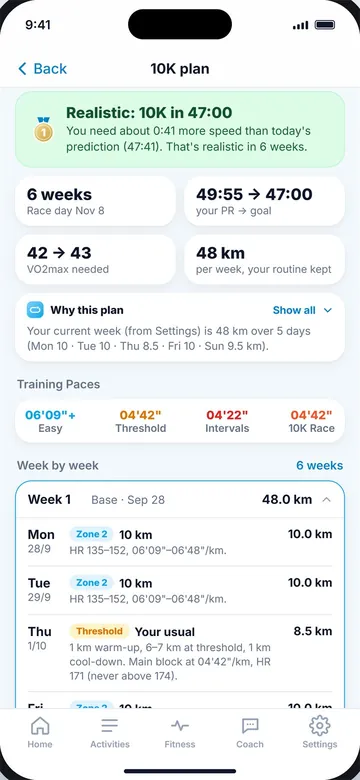
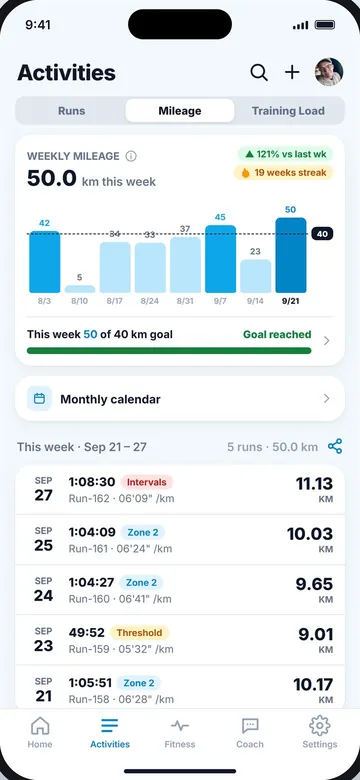
A sub-4 plan (left) and weekly mileage (right).
Key takeaways
- Sub-4 means just under 5:41 per km (9:09 per mile) for 42.2 km.
- It matches about a 25-minute 5K and a 1:56 half, if you have trained for the marathon.
- Peak at about 50 to 70 km a week with long runs of 28 to 32 km.
- Take about 30 to 60 g of carbohydrate per hour and practise it in long runs.
- Start at 5:45 to 5:50 per km; even pacing beats banking time.
Frequently asked questions
What pace is a 4 hour marathon?
About 5:41 per km or 9:09 per mile.
Is a sub-4 marathon good?
Yes. It is faster than the average marathon finish time of about 4:30.
What half marathon time do I need for a sub-4 marathon?
About 1:56 by the tables; first-timers are safer with 1:52 to 1:54.
How many km a week to run a sub-4 marathon?
Most runners peak at 50 to 70 km a week.
How long should my longest run be?
About 28 to 32 km, or up to about 3.5 hours.

Keep reading
Training plansMarathon training plan for beginners (18 weeks)An 18-week beginner marathon plan: 4 runs a week, long runs to 32 km, step-back weeks, fuelling and a taper.12 min read
 RacingAverage marathon time by age and genderTypical marathon finish times, a good time by age and gender, first-marathon expectations and how to predict yours.9 min read
 RacingHow to taper for a raceHow long to taper for each distance, how much to cut, why to keep some speed, and how form rises on race day.9 min read