Every year, more than a million people finish a marathon around the world. Their times range from just over 2 hours at the front to 7 hours or more at the back. Wherever you land, you ran 42.2 km. Still, it helps to know what is typical, especially when you are setting a goal.
The short answer
The average marathon finish time worldwide is about 4 hours 30 minutes; men average roughly 4:20 and women roughly 4:50, according to large analyses of race results, while a "good" time depends on age and sex, such as about 3:40 to 4:00 for men and 4:10 to 4:35 for women aged 20 to 49.
Average marathon times
A large analysis of millions of marathon results by RunRepeat found an average finish time of about 4:30 worldwide, with men around 4:20 and women around 4:50. Averages differ between races: big-city marathons with qualifying times (like Boston) are much faster, while charity-heavy races are slower.
| Runner | Typical marathon time | Pace per km |
|---|---|---|
| First-time, run-walk | 5:30 to 6:30 | 7:49 to 9:14 |
| First-time, running | 4:15 to 5:15 | 6:03 to 7:28 |
| Experienced recreational | 3:30 to 4:30 | 4:59 to 6:24 |
| Strong club runner | 2:45 to 3:15 | 3:55 to 4:37 |
| Elite | about 2:00 to 2:20 | about 2:51 to 3:19 |
What is a good marathon time by age?
The table shows marathon times that match a "Good" VO2max level for each age group, based on the fitness norms Windlace uses and Jack Daniels' equivalents. They assume full marathon training. Think of them as a strong, fit recreational level, not an average.
| Age | Men | Women |
|---|---|---|
| 20 to 29 | 3:40 | 4:10 |
| 30 to 39 | 3:50 | 4:22 |
| 40 to 49 | 4:00 | 4:35 |
| 50 to 59 | 4:16 | 4:58 |
| 60+ | 4:35 | 5:24 |
Interestingly, the average marathoner is not getting faster with youth. Many runners set their best marathon times in their 30s and 40s, because endurance keeps improving with years of training even as top speed slowly falls.
What to expect in your first marathon
For a first marathon, the best goal is to finish strong and enjoy it. Most first-timers finish between 4:15 and 5:30. The marathon is different from shorter races: the last 10 km are much harder than the first 32, and many first-timers slow down a lot. A conservative goal and steady pace usually lead to a faster time than an ambitious start. If you are getting ready, see Marathon training plan for beginners.
How to predict your marathon time
- Start from a recent half marathon (best) or 10K, run all-out.
- Use an equivalent-time formula: Riegel's formula roughly doubles your half marathon time and adds about 5%.
- Adjust for your training: without long runs of 28 to 32 km and 50+ km weeks, add 5 to 10%.
- Adjust for the day: heat, hills and wind can add several minutes.
Example: a 2:00 half marathon predicts about 4:10 by the formula. On 40 km a week, a realistic goal might be 4:20 to 4:30. Read Race time predictions to learn how prediction models work.
Popular marathon milestones
What affects marathon times most
- Weekly distance and long runs: the biggest training factor.
- Pacing: a too-fast first half is the most common reason for a slow finish.
- Fuelling: about 30 to 60 g of carbohydrate per hour helps avoid "the wall".
- Temperature: above about 15 °C, times start to slow; hot races can be 5 to 10% slower.
- Course: hills and many turns add time.
Your second marathon is usually faster
Most runners improve a lot from their first to their second marathon, often by 10 to 20 minutes or more. Part of it is fitness, but much of it is experience: better pacing, a fuelling plan that works and knowing what the last 10 km feel like. If your first marathon did not go to plan, that is normal, and the lessons are valuable.
How to improve your marathon time
- Build weekly distance gradually over months, with easier weeks.
- Build long runs to 28 to 32 km, with marathon-pace blocks near the end of training.
- Practise fuelling in every long run.
- Taper for 2 to 3 weeks before the race.
- Pick a flat course in a cool season.
Predict and track your marathon in Windlace
- See your marathon prediction on the Fitness tab, on a flat course, from your runs.
- Watch its 12-week trend as your training builds.
- Find your marathon record: Windlace keeps your best times from 400 m up to the marathon.
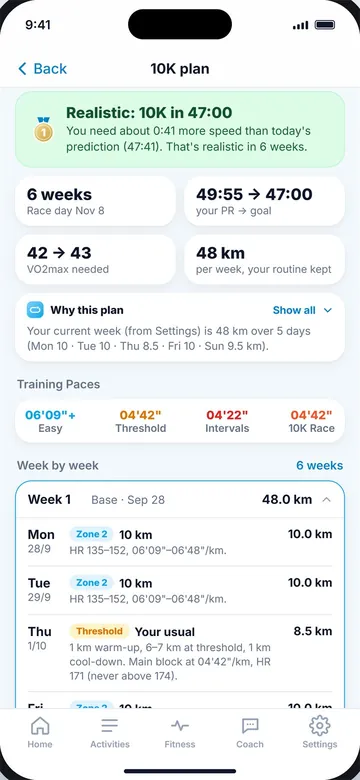
- Set a target with Break the PR and get a plan built around your weekly schedule.
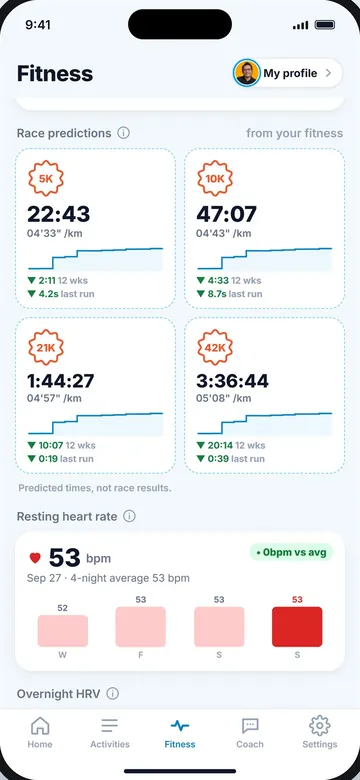
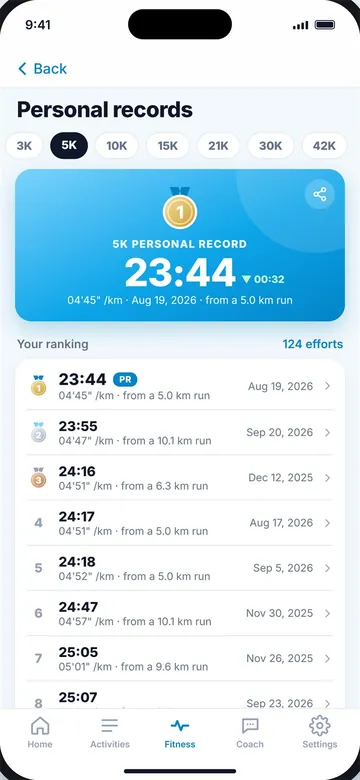
Race predictions (left) and personal records (right).
Key takeaways
- The average marathon time worldwide is about 4:30: roughly 4:20 for men and 4:50 for women.
- Most first-timers finish between about 4:15 and 5:30.
- A good time depends on age and sex, such as about 3:50 for men and 4:22 for women in their 30s.
- Predict yours from a recent half marathon, then adjust for training and conditions.
- Weekly distance, long runs, pacing and fuelling decide most marathon times.
Frequently asked questions
What is the average marathon time?
About 4 hours 30 minutes worldwide, according to large analyses of race results.
Is a 5 hour marathon good?
Yes. Finishing a marathon is a big achievement, and 5 hours is a common time for first-timers.
What is a good first marathon time?
Finishing strong is the best goal. Most first-timers finish between about 4:15 and 5:30.
What is the average marathon time for women?
Roughly 4:50 in large datasets, with many regular runners between 4:00 and 5:00.
What percentage of runners finish a marathon under 4 hours?
A minority. With an average around 4:30, sub-4 is faster than most finishers.

Keep reading
 RacingHow to run a sub-4 hour marathonThe pace you need, the fitness it takes, long runs, weekly distance, fuelling and a pacing plan that avoids the wall.11 min read
Training plansMarathon training plan for beginners (18 weeks)An 18-week beginner marathon plan: 4 runs a week, long runs to 32 km, step-back weeks, fuelling and a taper.12 min read
RacingHow accurate are race time predictions?How predictors work, why the marathon number is often too fast, and how to turn a prediction into a smart race plan.9 min read