Running a marathon is one of the most rewarding things you can do. It is also a challenge that rewards patience: most first-time marathon problems come from doing too much too soon, not from doing too little. This plan is designed to get you to the start healthy, with enough endurance to enjoy the last 10 km.
The short answer
A beginner marathon training plan usually lasts 16 to 20 weeks, with 4 runs a week, a long run building gradually to about 30 to 32 km, a lighter week every 3 to 4 weeks and a 2 to 3 week taper; you should be able to run about 10 km comfortably before you start.
Are you ready to start?
- You have been running regularly for at least 6 months, ideally a year.
- You can run 10 km comfortably and run about 25 to 30 km a week.
- You have run a half marathon or at least 15 km (helpful, not required).
- You can commit 4 to 6 hours a week for 18 weeks, more in the peak weeks.
Not there yet? A half marathon first is a great step. See our half marathon training plan.
How the plan is built
The 18-week plan
| Week | Tuesday | Wednesday | Thursday | Long run |
|---|---|---|---|---|
| 1 | 6 km easy + strides | 6 km easy | 5 km steady | 13 km |
| 2 | 6 km easy + strides | 7 km easy | 6 km steady | 14 km |
| 3 | 7 km easy + strides | 7 km easy | 6 km steady | 16 km |
| 4 (easier) | 6 km easy | 6 km easy | 5 km steady | 13 km |
| 5 | 7 km easy + strides | 8 km easy | 7 km steady | 18 km |
| 6 | 8 km easy + strides | 8 km easy | 7 km steady | 19 km |
| 7 | 8 km easy + strides | 8 km easy | 8 km with 5 km MP | 21 km |
| 8 (easier) | 6 km easy | 7 km easy | 6 km steady | 16 km |
| 9 | 8 km easy + strides | 10 km easy | 10 km with 6 km MP | 24 km |
| 10 | 8 km easy + strides | 10 km easy | 10 km with 6 km MP | 26 km |
| 11 | 8 km easy + strides | 11 km easy | 12 km with 8 km MP | 28 km |
| 12 (easier) | 7 km easy | 8 km easy | 8 km steady | 21 km |
| 13 | 8 km easy + strides | 12 km easy | 12 km with 8 km MP | 30 km |
| 14 | 8 km easy + strides | 12 km easy | 13 km with 10 km MP | 26 km, last 8 km MP |
| 15 | 8 km easy + strides | 13 km easy | 12 km with 8 km MP | 32 km |
| 16 (taper) | 8 km easy + strides | 10 km easy | 10 km with 6 km MP | 24 km |
| 17 (taper) | 6 km easy + strides | 8 km easy | 8 km with 5 km MP | 16 km |
| 18 (race) | 5 km with 3 × 1 km MP | 5 km easy | Rest or 3 km easy | Race: 42.2 km |
Friday is a rest day; Monday is rest or a very short recovery jog. If you can only run 3 days, drop the Wednesday run in most weeks.
Long run rules
- Easy pace: 45 to 90 seconds per km slower than marathon pace. You should be able to talk.
- Time cap: about 3 to 3.5 hours. Slower runners can stop at 28 to 30 km.
- Fuel: practise your race-day fuel on every run over 90 minutes.
- Walk breaks are fine: if you plan to use them in the race, use them in long runs too.
Read How long should your long run be? for more on time limits and pacing.
Choosing your marathon pace
For a first marathon, take a recent half marathon time, double it and add about 10 to 20 minutes. A 2:00 half suggests a first marathon of about 4:10 to 4:20. Use that pace for the MP parts. If you are aiming for a specific time, see How to run a sub-4 hour marathon and Average marathon time to set a fair target.
Fuelling and hydration
Practise taking about 30 to 60 grams of carbohydrate per hour in long runs: roughly one gel every 30 to 40 minutes with water, starting 30 to 45 minutes in. Find a gel your stomach likes, and check which drink the race offers. In the last 2 to 3 days before the race, eat more carbohydrate than usual.
Looking after your body
- Sleep 7 to 9 hours, especially in peak weeks.
- Do 2 short strength sessions a week in the first 12 weeks: squats, lunges, calf raises, planks.
- Replace worn shoes early in the plan, not in race week.
- Take pain seriously: pain that changes how you run means rest and get it checked.
Race day
- Start 10 to 15 seconds per km slower than your goal pace for the first 5 km.
- Fuel early: first gel around 30 to 45 minutes, then every 30 to 40 minutes.
- Halfway check: you should feel like you are holding back.
- After 32 km: this is where the training pays off. Keep fuelling and focus on form.
Follow your plan with Windlace
- Set your weekly running days in My Weekly Schedule.
- Set a marathon target in Break the PR to get a rating and a plan around your schedule, including the taper.
- Watch training load: stay in the Optimal range and avoid sudden spikes into High or Overtraining.
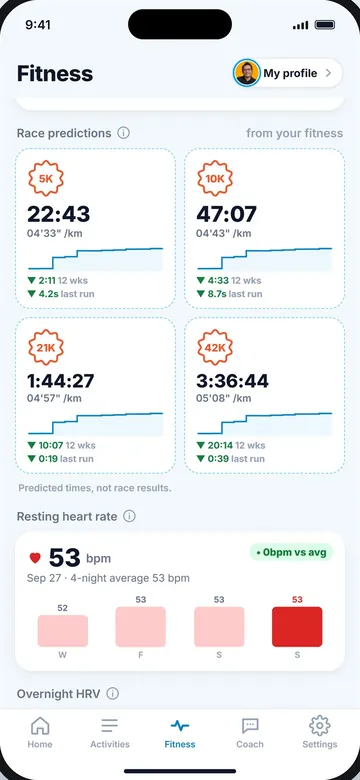
- Check recovery after long runs, and your marathon prediction as fitness builds.
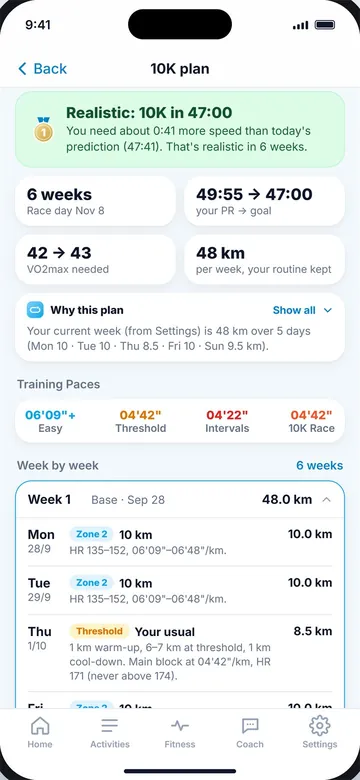
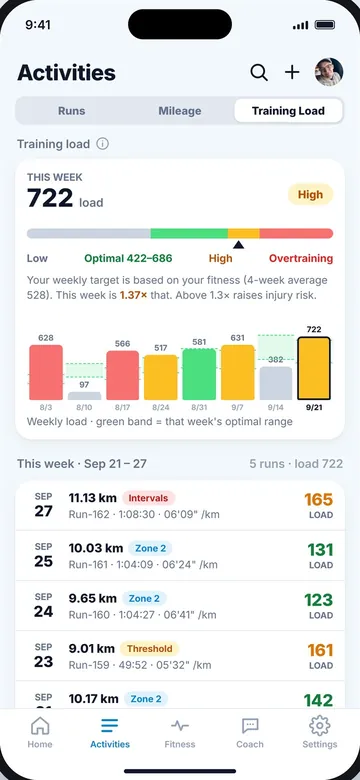
A marathon plan (left) and training load (right).
Key takeaways
- Beginner marathon plans usually last 16 to 20 weeks with 4 runs a week.
- Start when you can run 10 km comfortably and about 25 to 30 km a week.
- Build the long run gradually to 30 to 32 km, with an easier week every 4th week.
- Practise fuelling (30 to 60 g of carbohydrate per hour) in every long run.
- Taper for 3 weeks and start the race slower than goal pace.
Frequently asked questions
How long does it take to train for a first marathon?
Most beginner plans last 16 to 20 weeks, after at least 6 months of regular running.
How many days a week should I run for a marathon?
Four is a good number for beginners. Three can work with lower weekly distance.
What is the longest run in marathon training?
Usually 30 to 32 km, or about 3 to 3.5 hours, 3 to 4 weeks before the race.
Do I need to run 42 km before the marathon?
No. Long runs of 30 to 32 km are enough; race-day energy and the taper carry you the rest.
Can I walk during a marathon?
Yes. Many runners use planned walk breaks, and they can lead to a faster, more comfortable finish.

Keep reading
RacingHow to run a sub-4 hour marathonThe pace you need, the fitness it takes, long runs, weekly distance, fuelling and a pacing plan that avoids the wall.11 min read
 RacingAverage marathon time by age and genderTypical marathon finish times, a good time by age and gender, first-marathon expectations and how to predict yours.9 min read
RacingHow to taper for a raceHow long to taper for each distance, how much to cut, why to keep some speed, and how form rises on race day.9 min read