Most running apps show a number like "+120 m" or "Elevation gain: 120 m" next to your distance and pace. It is easy to ignore, but it explains a lot: why a run felt harder than its pace suggests, why your heart rate was higher, and why two runs of the same distance can be completely different workouts.
What elevation gain means
Elevation gain (or total ascent) is the sum of all the climbing on your run, in metres or feet; it counts every uphill section and ignores the downhills, so a loop that ends where it started can still have a large gain.
It is different from the difference between your highest and lowest point. A route with ten small 10-metre hills has 100 m of gain, even if it never rises more than 10 m above the start. Some apps also show elevation loss (total descent). On a loop, gain and loss are about equal.
How much elevation gain is a lot?
The easiest way to compare routes is gain per kilometre. Here is a rough guide for road running:
| Gain per km | Example over 10 km | Feels like |
|---|---|---|
| Under 5 m | Under 50 m | Flat |
| 5 to 10 m | 50 to 100 m | Gently rolling |
| 10 to 20 m | 100 to 200 m | Hilly |
| 20 to 40 m | 200 to 400 m | Very hilly, steep sections |
| Over 40 m | Over 400 m | Mountain or trail running |
How much do hills slow you down?
Climbing costs extra energy, and descending only gives part of it back. Running downhill is faster, but you cannot recover all the time you lost going up, especially on steep descents where you have to brake.
One well-known rule from hill running, studied by statistician Philip Scarf in his work on Naismith's rule, is that each metre of climbing costs about the same time as 8 metres of flat running. So 100 m of gain is roughly like adding 0.8 km to a flat run.
Flat-equivalent distance ≈ distance + (elevation gain × 8)
Example: 10 km with 100 m of gain ≈ 10 + 0.8 = 10.8 km of flat running. At an effort that gives 6:00 per km on the flat, expect about 6:29 per km on this route.
Treat this as a rough guide. Steep climbs cost more than gentle ones, heat makes hills harder, and strong climbers lose less time.
Why pace lies on hills
On a hilly route, your pace jumps around even when your effort stays steady: slower on the climbs, faster on the descents. That makes plain pace a poor way to judge a hilly run. Three better measures:
Why two watches show different elevation gain
Run side by side with a friend and your elevation gain can differ by 20% or more. The reasons:
- GPS-only elevation is noisy. GPS is much less accurate up and down than side to side, so small false climbs add up.
- Barometric altimeters measure air pressure, which is more precise for climbs, but weather changes and wind can shift the reading.
- Map correction: some apps replace your recorded heights with heights from a map, which smooths small errors but can miss bridges and tunnels.
- Smoothing: every app filters out tiny bumps differently, which changes the total.
Because of this, compare elevation gain mostly between runs recorded by the same device on the same route. For more on signal errors, see How accurate is GPS for running?
How to train for hilly races
- Check the course profile and work out the gain per kilometre.
- Add hills to your easy runs gradually, building towards similar gain per km.
- Do hill repeats once a week: 6 to 10 × 60 to 90 seconds uphill at a hard effort, jogging down. See Hill repeats.
- Practise downhills too: short, quick steps and relaxed arms. Descents load your quads heavily.
- Pace by effort on race day: slow down on climbs, use the descents, and do not chase your flat-road pace.
Simple technique for climbs and descents
Why hills are good for you
Hills are not only a cost. Running uphill builds leg strength and power with less impact than fast running on the flat, and it raises your heart rate without needing a fast pace. Many coaches call hill running "strength training in disguise". A regular hilly route is one of the simplest ways to get stronger and fitter.
Ready to train on hills? Read Hill repeats for sessions that build climbing strength, and GPS accuracy for running for why elevation numbers differ between devices.
How to see elevation in Windlace
- Open any run. The Running form card shows your total climbing in metres.
- Look at the grey area on the run chart: it shows the elevation along your route. Tap it to see how many metres above or below your start you were.
- Check pace effort: your pace as if the route were flat, so you can compare a hilly run with a flat one fairly.
- Compare runs on the same route recorded with the same device, for the most reliable climbing numbers.
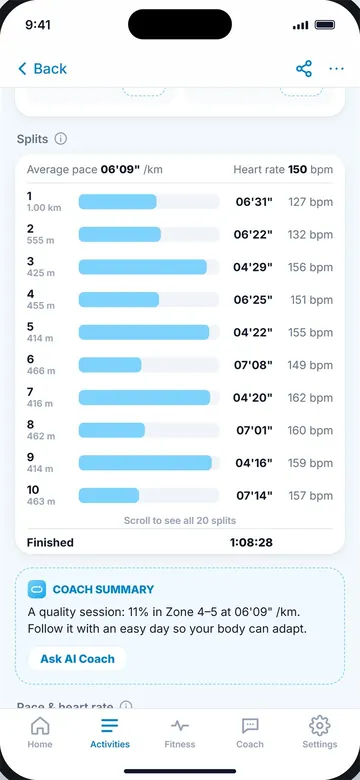
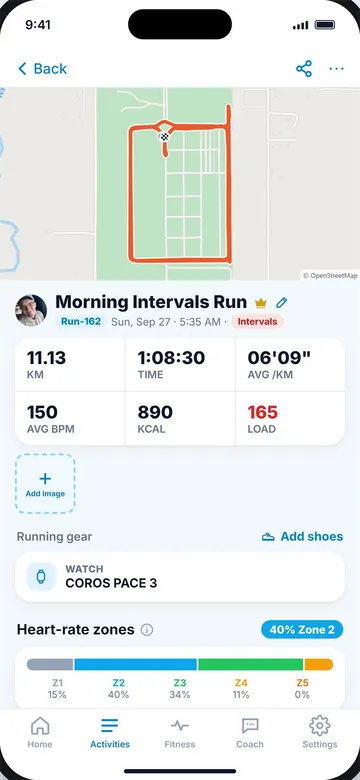
Run details with climbing (left) and the run summary (right).
Key takeaways
- Elevation gain is the total of all climbing on a run; downhills do not count.
- Under 5 m per km is flat; 10 to 20 m per km is hilly for road running.
- Each metre climbed costs about as much time as 8 metres of flat running.
- Judge hilly runs by heart rate, effort or grade-adjusted pace, not plain pace.
- Elevation numbers vary between devices; compare runs from the same device and route.
Frequently asked questions
What does elevation gain mean on a run?
It is the total of all the climbing you did, in metres or feet. Downhills are not subtracted.
Is 100 m of elevation gain a lot?
Over 10 km it is gently rolling to hilly, about 10 m per km. Over 5 km it is clearly hilly.
How much do hills slow down my pace?
A common rule is that each metre of climbing costs about the same as 8 metres of flat running, so 100 m of gain adds roughly 0.8 km of effort.
Why is my elevation gain different from my friend's?
Devices measure height differently (GPS, barometer or maps) and smooth the data differently, so totals can differ by 20% or more.
What is grade-adjusted pace?
Your pace converted to the equivalent on flat ground, so climbs and descents do not distort it. In Windlace it is called pace effort.

Keep reading
TrainingRunning by heart rate vs by pace: which is better?The pros and cons of each, which to use for every kind of run, and how to combine them with how you feel.9 min read
TrainingHow long should your long run be?Simple long run rules by race distance and weekly mileage, the right pace, and how fast to build up.9 min read
TrainingInterval training for runners: a simple guideWhat intervals are, the right pace and rest, six classic workouts and how often to do them safely.10 min read