Your watch shows two big numbers while you run: pace and heart rate. Training plans tell you to follow one or the other, and runners argue about which is "right". Both are useful. They simply measure different things, and each one shines in different situations.
The short answer
Heart rate is better for easy runs, long runs, hills and hot days, because it measures how hard your body is working; pace is better for intervals, tempo runs and races on flat ground, because it reacts instantly and matches your goal time. The best approach uses both, checked against how you feel.
What each one measures
On a cool, flat day when you are fresh, the two match closely. The moment conditions change, they come apart: the same pace costs more heart rate in the heat, and the same heart rate gives a slower pace uphill.
Pros and cons
| Heart rate | Pace | |
|---|---|---|
| Reacts to heat, hills, fatigue | Yes, adjusts effort automatically | No, same number regardless |
| Speed of response | Slow: lags 1 to 3 minutes | Instant |
| Short intervals (under 3 min) | Poor, finishes before it catches up | Very good |
| Accuracy problems | Wrist sensor errors, cadence lock | GPS errors in cities, trees, tunnels |
| Matches race goals | Indirectly | Directly |
| Keeps easy runs easy | Very good | Only if you set an honest easy pace |
Which to use for each run
| Run | Lead with | Why |
|---|---|---|
| Easy and recovery runs | Heart rate | Stops you running too fast, especially in heat or on hills |
| Long runs | Heart rate, then pace | Keeps the start easy; drift is fine later |
| Tempo and threshold runs | Pace, check heart rate | Pace is precise; heart rate confirms the effort |
| Intervals and hill reps | Pace or effort | Heart rate is too slow to react |
| Races | Pace and feel | Goal times are paces; heart rate rises late in races |
| Hot or hilly days | Heart rate or effort | Pace targets become unrealistic |
When the numbers lie
Both tools can give wrong readings. GPS pace jumps around between tall buildings, under trees and in tunnels, so a pace that suddenly shows 3:30 per km on an easy run is usually a signal error, not a burst of speed. Wrist heart rate can lock onto your steps and show your cadence instead of your heartbeat. A good rule: if a number changes suddenly and you did not change your effort, the number is probably wrong. Look at the average over a few minutes, or the shape of the graph afterwards, rather than every second.
The third tool: how it feels
Rate of perceived exertion (RPE) is simply how hard a run feels, on a scale from 1 to 10. It needs no gadget, never has a GPS error, and it automatically includes heat, hills, sleep and stress. Experienced runners lean on it heavily.
| Effort (1 to 10) | Talk test | Matches |
|---|---|---|
| 2 to 3 | Full conversation | Easy, Zone 1 to 2 |
| 5 to 6 | Short sentences | Tempo, Zone 3 |
| 7 to 8 | A few words | Threshold, Zone 4 |
| 9 | Single words | VO2max intervals, Zone 5 |
| 10 | No talking | Sprints, all-out |
How to use both together, step by step
- Set honest zones for both. Heart rate zones from your real max or LTHR; pace zones from your threshold pace.
- Easy days: show heart rate on your watch's main screen. Stay in Zone 2 and let pace be whatever it is.
- Workouts: show pace. Hit the target pace, then check afterwards that heart rate was in the expected zone.
- When they disagree, trust feel. High heart rate at an easy pace and you feel bad? Ease off. Low heart rate but you are working hard? It may be a sensor issue, or deep fatigue.
- Review weekly. Faster pace at the same heart rate over weeks is the clearest sign of improvement.
A sample week using both
Here is how a runner doing four runs a week might use each tool:
| Day | Run | Main screen | Target |
|---|---|---|---|
| Tuesday | Intervals, 5 × 1 km | Pace | About 5K race pace; heart rate checked after |
| Thursday | Easy 40 minutes | Heart rate | Zone 2, any pace |
| Saturday | Long run, 80 minutes | Heart rate, then pace | Zone 2; let heart rate drift late in the run |
| Sunday | Recovery jog, 25 minutes | Feel | Effort 2 out of 10 |
Notice the pattern: the harder and shorter the effort, the more pace leads; the easier and longer the effort, the more heart rate and feel lead.
Beginners vs experienced runners
For new runners, heart rate is often the most useful tool, because the most common beginner mistake is running every run too fast. A heart rate cap on easy days teaches what easy really feels like. Many beginners are surprised by how slow it is at first, and by how quickly it speeds up.
Experienced runners usually know their paces well and lean more on pace for workouts and feel for easy days, using heart rate as a check rather than a rule. They also use heart rate to spot trouble: a higher heart rate than usual at a familiar pace is an early sign of tiredness, illness or heat stress.
Common mistakes
How to use both in Windlace
- Open a run to see pace and heart rate side by side, with your time in each heart rate zone.
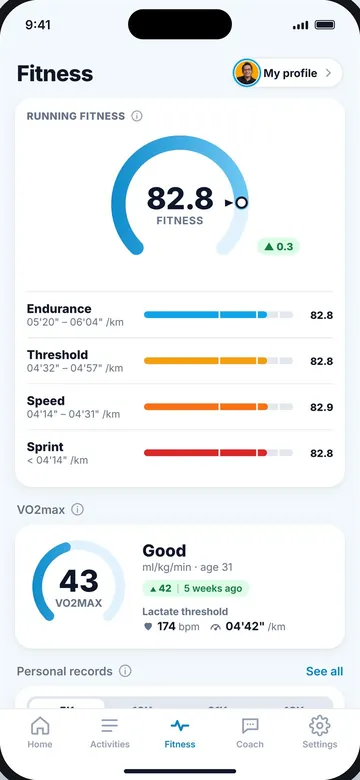
- Check the pace for each zone on the Fitness tab, built from your threshold pace.
- Watch your average Zone 2 pace: the pace and heart rate in the middle of Zone 2. A faster pace at the same heart rate means you are getting fitter.
- Look at pace effort on hilly runs: Windlace adjusts your pace for the climbs so you can compare hilly and flat runs fairly.
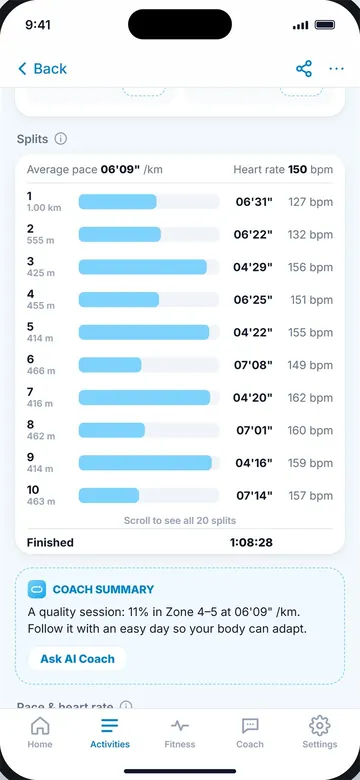
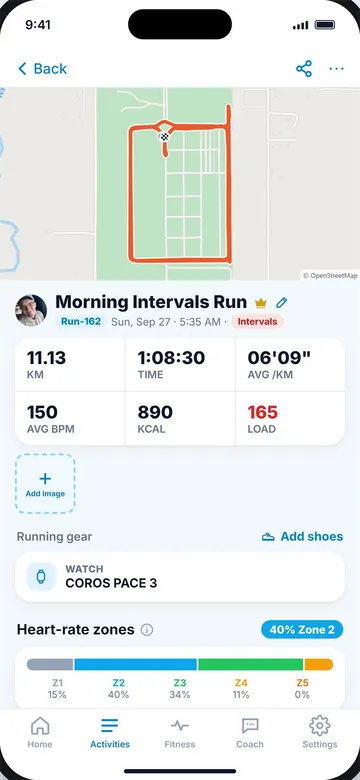
Splits with pace and heart rate (left) and the run summary (right).
Key takeaways
- Pace measures how fast you run; heart rate measures how hard your body works to do it.
- Lead with heart rate on easy runs, long runs, hills and hot days.
- Lead with pace for intervals, tempo runs and races on flat ground.
- Use how it feels (RPE) as the tie-breaker when the numbers disagree.
- A faster pace at the same heart rate over weeks is the clearest sign you are improving.
Frequently asked questions
Is it better to train by heart rate or pace?
Neither is always better. Heart rate is best for easy and long runs and in heat or hills; pace is best for intervals, tempo runs and races.
Why does my heart rate say I am running too hard at an easy pace?
Heat, tiredness, a low aerobic base or a sensor error are the usual reasons. On easy days, follow heart rate or feel and slow down.
Should beginners run by heart rate?
It can help beginners avoid running too fast, which is the most common mistake. A simple talk test works just as well.
How do I run intervals by heart rate?
For long intervals (5+ minutes), heart rate works. For short ones, use pace or effort and check heart rate afterwards.
What is RPE in running?
Rate of perceived exertion: how hard a run feels on a 1 to 10 scale. Easy runs feel about 2 to 3, threshold about 7 to 8, sprints 10.

Keep reading
Heart rateHeart rate zones explained, simplyWhat each zone does, three ways to calculate yours, and how much of your running belongs in each one.10 min read
 PaceWhat is threshold pace, and how do you find yours?The pace you can hold for about an hour: where it sits next to your race paces, four ways to find it, and how to train with it.10 min read
Heart rateWhat is Zone 2 running, and why does everyone talk about it?Why slow running makes you faster, how to find your Zone 2 heart rate and pace, and how to use it every week.10 min read