Ask coaches for one workout that does the most with the least risk, and many will say hill repeats. Running uphill forces you to push hard with your hips, thighs and calves, raises your heart rate quickly, and does it all at a slower speed with less pounding than fast running on the flat.
What hill repeats are
Hill repeats are short, hard efforts run up a hill, with an easy jog or walk back down as recovery, repeated several times; they build leg strength, power and fitness with less impact than flat-ground speed work.
Why hills make you better
Hill work was central to the training of New Zealand coach Arthur Lydiard, whose athletes did weeks of hill circuits before moving on to track speed work. The idea is still used by many coaches today.
How steep and how long?
For most hill workouts, a steady gradient of about 4 to 8% works well: steep enough to feel, not so steep that your form falls apart. Short sprints can use a steeper hill (up to about 10%). Long repeats need a gentler, longer climb.
| Type | Length | Effort | Recovery | Builds |
|---|---|---|---|---|
| Hill sprints | 8 to 12 seconds | Near all-out | Walk down, about 2 min | Power, speed |
| Medium hills | 45 to 90 seconds | About 5K effort | Jog down | VO2max, strength |
| Long hills | 2 to 4 minutes | 10K to threshold effort | Jog down | Strength endurance |
Five hill workouts
Warm up with 10 to 15 minutes of easy running on flat ground first, and cool down with 10 minutes easy.
| Workout | Main set | Level |
|---|---|---|
| Hill strides | 6 × 15 s fast but relaxed up a gentle hill, walk down | Beginner |
| Hill sprints | 6 to 10 × 10 s very hard up a steep hill, full walk-down recovery | All levels, after strides |
| Classic hill repeats | 6 to 10 × 60 s at 5K effort, jog down | Intermediate |
| Long hills | 4 to 6 × 3 min at 10K effort, jog down | Intermediate to advanced |
| Hill circuit | Uphill repeat, then 1 min of bounding or skipping at the top, jog down; 6 to 8 rounds | Advanced |
Good uphill form
- Lean slightly forward from the ankles, not the waist. Keep your chest up.
- Shorten your steps and keep your cadence quick.
- Drive with your arms: elbows bent, swinging forward and back, not across your body.
- Push the ground behind you and lift your knees a little more than on the flat.
- Look a few metres ahead, not down at your feet or up at the top.
- Run over the top: keep the effort for a few steps past the crest.
Run hills by effort, not pace
Your pace will be much slower uphill, and that is fine. Judge the repeats by effort, breathing and heart rate. A good set of hill repeats feels the same for the last rep as for the first: if you are slowing a lot or your form is breaking down, stop. Comparing your times on the same hill week by week is a great way to see progress, because the hill does not change.
How often and when
Once a week is plenty, in place of another hard workout. Hill sprints are short enough to add to an easy run once or twice a week after a few weeks of practice. Many plans put hill work early in a training block, to build strength before faster track or road intervals. Treat the day after hill repeats as an easy day: your calves and Achilles often feel it.
A 6-week hill block
A simple way to add hills for a runner who already runs 3 to 4 times a week:
| Week | Hill session |
|---|---|
| 1 | 6 × 15 s hill strides, walk down |
| 2 | 6 × 45 s at 5K effort, jog down |
| 3 | 8 × 45 s at 5K effort, jog down |
| 4 | 6 × 60 s at 5K effort, jog down (easier week overall) |
| 5 | 8 × 60 s at 5K effort, jog down |
| 6 | 4 × 3 min at 10K effort, jog down |
After six weeks, most runners notice that hills on their normal routes feel easier, and that flat running feels a little more powerful.
What about downhill running?
Downhills deserve practice too, especially before hilly races. Running downhill makes your quads work while they lengthen, which causes much of the soreness after hilly races. A few short, controlled downhill sections on easy runs in the weeks before such a race help your legs adapt. Keep steps short and quick, land under your hips and avoid leaning back.
No hills nearby?
Try a treadmill at 4 to 6% incline, a multi-storey car park ramp, a bridge or a set of stairs. Stair running builds similar strength, though it is harder on the calves; start with just a few repeats. Strength exercises like step-ups and lunges also build the same muscles.
Hills on race day
Hill repeats teach you to climb strongly, but on race day the goal is even effort. Slow down a little on climbs, keep your form, and use the descents to regain time. To understand how climbs change your pace, read Elevation gain in running.
Hills are one of the best tools for a faster race. Read How to run a faster 5K and How to run a faster 10K to see where hill sessions fit in a training plan.
Hill repeats in Windlace
- Press lap at the bottom and top of each repeat on your watch.
- Open the run: the Splits card shows each climb and each jog-down as its own row with pace and heart rate.
- Check the grey elevation area on the run chart and your total climbing.
- Use pace effort to see what your uphill pace would have been on the flat.
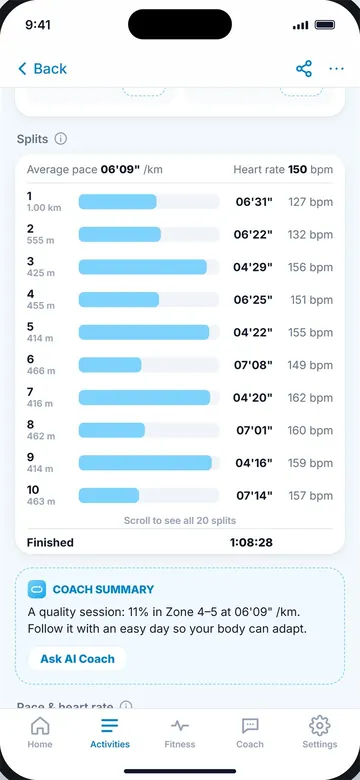
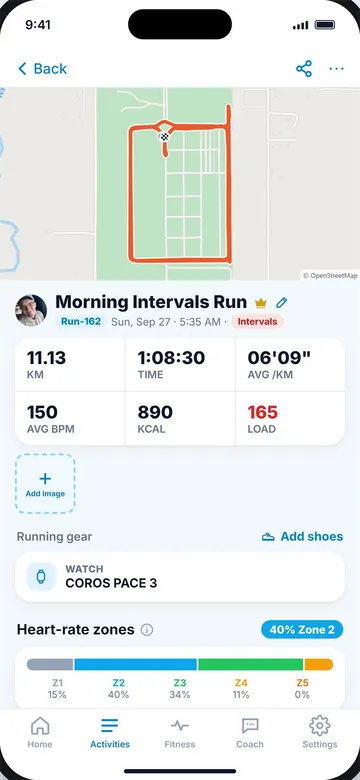
Laps for each climb (left) and the run summary (right).
Key takeaways
- Hill repeats are hard uphill efforts with an easy jog or walk down, repeated several times.
- They build strength, power and fitness with less impact than flat speed work.
- Use a 4 to 8% hill for most workouts; 60-second repeats at 5K effort are a classic.
- Lean from the ankles, shorten your steps, drive your arms and judge by effort, not pace.
- Once a week is enough; jog down slowly and keep the next day easy.
Frequently asked questions
How steep should a hill be for hill repeats?
About 4 to 8% for most workouts. Short sprints can use up to about 10%.
How many hill repeats should I do?
Beginners can start with 4 to 6. Experienced runners do 8 to 12 short repeats or 4 to 6 long ones.
Are hill repeats good for beginners?
Yes, once you can run 30 minutes comfortably. Start with gentle hill strides of 15 seconds.
Do hill repeats make you faster on the flat?
Yes. They build the strength and power that improve your push-off and running economy.
Should I run down the hill fast?
No. Jog or walk down slowly as recovery. Fast downhills strain your quads and knees.

Keep reading
PaceElevation gain in running: what it means and why it mattersWhat elevation gain means, how much hills slow your pace, why watches disagree, and how to compare hilly runs.9 min read
TrainingInterval training for runners: a simple guideWhat intervals are, the right pace and rest, six classic workouts and how often to do them safely.10 min read
 RacingHow to run a faster 5KThe four workouts that matter most, an 8-week plan outline, race pacing and how much faster you can get.10 min read