Ten kilometres is long enough that pacing and endurance matter, and short enough that speed still counts. That makes it a great test of all-round running fitness, and a great target for a training block.
The short answer
To run a faster 10K, focus on raising your threshold with weekly tempo or cruise interval sessions, add one session of longer intervals at 5K to 10K pace, build long runs to 12 to 16 km, and run the race at an even pace from the start.
Why threshold is the key
Your threshold pace is roughly the pace you could hold for about an hour. For most recreational runners, a 10K takes 40 to 70 minutes, so 10K race pace sits just a little faster than threshold pace. Raise the threshold and the whole 10K curve moves with it. That is why tempo runs and cruise intervals are the backbone of good 10K training. Read What is threshold pace? for how it is measured.
Key 10K workouts
| Session | Example | Purpose |
|---|---|---|
| Cruise intervals | 4 × 8 min at threshold, 90 s jog | Raise threshold |
| Continuous tempo | 20 to 30 min at threshold | Hold pace under fatigue |
| 10K-pace reps | 3 × 2 km at goal 10K pace, 3 min jog | Learn race rhythm |
| VO2max reps | 5 × 1 km at 5K pace, 2 to 3 min jog | Raise top aerobic power |
| Long run | 12 to 16 km easy | Endurance |
A sample 10K training week
- Tuesday: threshold session (cruise intervals or tempo).
- Wednesday: easy 30 to 45 minutes with strides.
- Thursday: easy or rest.
- Friday: 10K-pace or VO2max reps (alternate weeks), or easy for 4-day runners.
- Saturday or Sunday: long run of 12 to 16 km.
Keep about 80% of your time easy. Two quality sessions plus a long run is plenty; newer runners can do one quality session.
How long should 10K long runs be?
Most 10K runners benefit from long runs of 12 to 16 km, about 1.2 to 1.6 times the race distance, at an easy pace. They build the endurance that keeps your pace steady in the last 3 km, where most 10K races are won or lost. See How long should your long run be?
How to pace a 10K, kilometre by kilometre
| Section | Pace | How it should feel |
|---|---|---|
| Km 1 to 2 | 5:03 to 5:05 | Controlled, almost too easy |
| Km 3 to 6 | 5:00 | Steady, comfortably hard |
| Km 7 to 8 | 5:00 | Hard, focus needed |
| Km 9 to 10 | 4:52 to 4:58 | Push, then sprint the last 200 m |
The middle third is where 10Ks fall apart: the excitement has gone, the finish is far away. Break it into small chunks and think one kilometre at a time.
How much can you improve?
With 8 to 12 weeks of focused training, many recreational runners improve their 10K by 1 to 4 minutes, depending on how much they trained before. Runners stepping up from 5K often gain the most by adding threshold work and longer long runs, because those are what the 10K needs more of.
Common mistakes
- Training like a 5K runner: lots of short reps, too little threshold and endurance.
- Going out at 5K pace and paying from kilometre 6.
- Tempo runs that become races: threshold should be controlled.
- Long runs too fast: keep them conversational.
Example: a 12-week 10K build
| Weeks | Main focus | Long run |
|---|---|---|
| 1 to 4 | Easy volume, strides, one short tempo a week | 10 to 12 km |
| 5 to 8 | Cruise intervals plus VO2max reps every other week | 12 to 15 km |
| 9 to 11 | 10K-pace reps and a longer tempo | 14 to 16 km |
| 12 | Taper: short race-pace efforts, then race | Race day |
Every fourth week, cut the distance by about 20% to let your body catch up.
Fuel and water
Most runners do not need gels for a 10K. Eat a normal breakfast 2 to 3 hours before, drink to thirst, and take a sip of water at an aid station in warm weather. On hot days, start a little slower than planned; heat costs more time in the second half than in the first.
Popular 10K goals
Sub-60 (6:00 per km) is a common first goal. Sub-50 (5:00 per km) is a popular next step; read How to run a sub-50 minute 10K. Sub-45 and sub-40 need consistent training with 40 to 60+ km weeks.
Train for a faster 10K with Windlace
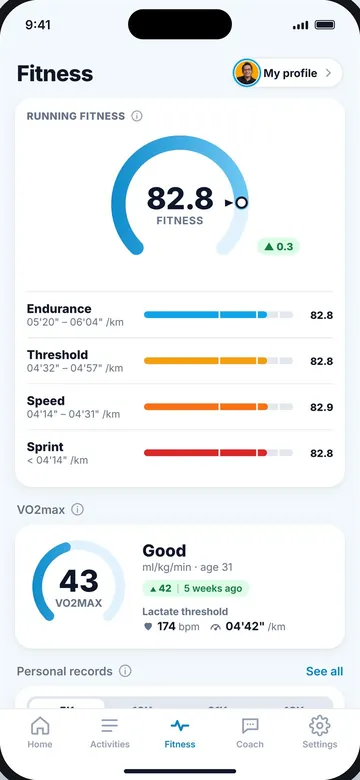
- See your threshold pace on the Fitness tab, from your fastest 3 to 20 minute stretches, and the pace zones built from it.
- Check your 10K prediction, and watch it change over the last 12 weeks.
- Set a 10K target with Break the PR for a week-by-week plan.
- Open each workout to see time in each pace zone and every lap.
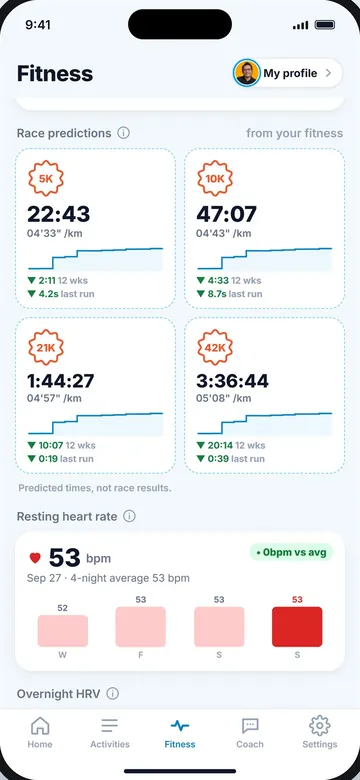
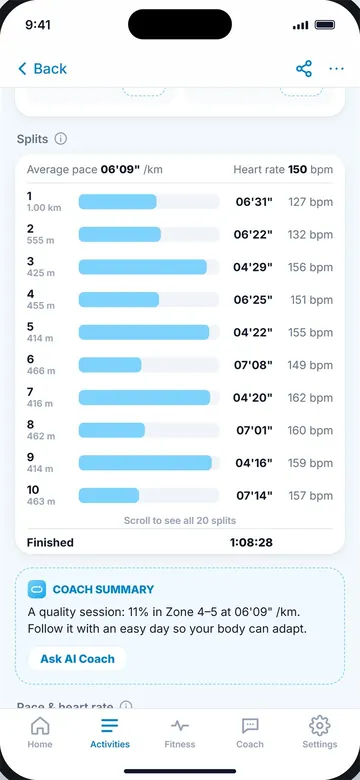
Race predictions (left) and a workout's laps and zones (right).
Key takeaways
- 10K race pace is only a few seconds per km faster than threshold pace.
- Make threshold work (tempo and cruise intervals) the core of your training.
- Add one session of 10K-pace or VO2max reps and long runs of 12 to 16 km.
- Start the first 2 km slightly slower than goal pace and push in the last 2 km.
- Many recreational runners improve 1 to 4 minutes in 8 to 12 weeks.
Frequently asked questions
What is the best workout for a faster 10K?
Cruise intervals at threshold pace, such as 4 × 8 minutes with 90 seconds of jogging.
How long should my long run be for a 10K?
About 12 to 16 km at an easy pace.
How many weeks do I need to train for a 10K?
Eight to 12 weeks of focused training works well for most runners with a base.
What pace should I run a 10K at?
Your goal time divided by 10. A 50-minute 10K is 5:00 per km. Start a few seconds slower.
Is a 10K harder than a 5K?
It is longer, so it needs more endurance and better pacing, but it is run at a slightly slower pace. Many runners find the middle kilometres the hardest part.
Do I need energy gels for a 10K?
Usually not. A normal breakfast and water are enough for most runners.

Keep reading
 PaceWhat is threshold pace, and how do you find yours?The pace you can hold for about an hour: where it sits next to your race paces, four ways to find it, and how to train with it.10 min read
RacingHow to run a sub-50 minute 10KThe pace you need, the fitness it takes, matching training paces, the sessions that work and race-day pacing.9 min read
TrainingWhat is a tempo run, and how do you do one?The right tempo pace, how it differs from threshold runs, five tempo workouts and how often to do them.9 min read