For many runners, sub-50 is the 10K goal that says "I am a proper runner now". It is a real step up from sub-60, and it usually takes a mix of consistency, threshold training and good race-day discipline.
The short answer
A sub-50 minute 10K needs an average pace just under 5:00 per km (8:03 per mile), which matches a Daniels fitness level (VDOT) of about 40 and roughly a 24-minute 5K; most runners need 30 to 45 km a week with tempo and interval sessions.
How fit do you need to be?
| Distance | Equivalent |
|---|---|
| 5K | about 24:06 |
| Half marathon | about 1:50:52 |
| Marathon (fully trained) | about 3:49:34 |
A good test: if you can run a 5K in 24 minutes or a bit under, you probably have the speed for sub-50 (see How to run a sub-25 minute 5K if you are not there yet). What usually decides it is endurance at that pace, which threshold work and long runs build.
Your training paces
| Run | Pace per km |
|---|---|
| Easy and long runs | 5:51 to 6:59 |
| Threshold (tempo, cruise intervals) | about 5:05 |
| 10K race pace | 4:58 to 5:00 |
| Intervals (VO2max) | about 4:40 |
Sessions that get you there
- Cruise intervals: 4 × 8 minutes at 5:05 per km with 90 seconds jog.
- Race-pace reps: 3 × 2 km at 4:58 with 3 minutes jog. Later, 2 × 3 km.
- VO2max reps: 5 × 1 km at 4:40 with 2 to 3 minutes jog, every other week.
- Long run: 12 to 16 km at 6:00 to 7:00 per km.
See How to run a faster 10K for how to build a full week around these.
How long will it take?
Race-day plan
- Km 1: 5:02 to 5:05. Resist the crowd.
- Halfway: 24:55 to 25:05.
- Km 6 to 8: hold 5:00. This is where focus wins.
- Km 9 to 10: squeeze to 4:50 to 4:56 and sprint the final 200 m.
- On your watch: aim for about 4:56 to 4:58 average, because GPS usually reads slightly long.
Signs you are ready
- 3 × 2 km at 4:58 with 3 minutes rest feels hard but controlled.
- A 25-minute tempo at about 5:05 per km feels steady.
- You have run 14 to 16 km comfortably as a long run.
- Your app's 10K prediction is under 50 minutes.
A sample sub-50 week
| Day | Run |
|---|---|
| Tuesday | Warm-up, 4 × 8 min at 5:05 with 90 s jog, cool-down |
| Wednesday | 40 min easy plus strides |
| Thursday | 30 min easy |
| Friday | Warm-up, 3 × 2 km at 4:58 with 3 min jog, cool-down |
| Sunday | 14 km easy |
Rest on Monday and Saturday. Newer runners can swap Friday for an easy run and keep just one quality session.
Why threshold decides it
A 50-minute 10K is run just above threshold pace, the effort you could hold for about an hour. If your threshold is 5:15 per km, holding 5:00 for 50 minutes will feel desperate after halfway. If it is 5:05, sub-50 is a strong, controlled effort. That is why the cruise interval session is the most important run of the week. Read What is threshold pace?
Course and weather
Heat is the biggest enemy of time goals. Above about 20 °C, many runners slow by 1 to 3% or more. If race day is hot, set a slightly slower first half and see what is possible in the second. A flat, certified course in the cool season gives you the best chance. Wind matters too: on an out-and-back course, run the headwind half with a group and use them as shelter, then push with the tailwind. And if you miss the goal by a few seconds on a hot day, the fitness is still there; pick another race 3 to 4 weeks later.
Common mistakes
- Only running 5K efforts: sub-50 needs endurance at pace, not just speed.
- Long runs that are too short, under 10 km.
- Cruise intervals run too fast, turning them into races.
- Easy days at 5:30 per km, leaving the legs tired for quality sessions.
Chase sub-50 with Windlace
- Check your 10K prediction on the Fitness tab, and its trend over the last 12 weeks.
- Set 49:59 as your target in Break the PR to get a rating and a plan built around your schedule.
- Use your threshold pace and pace zones for every workout.
- Check your splits after the race to see how evenly you paced.
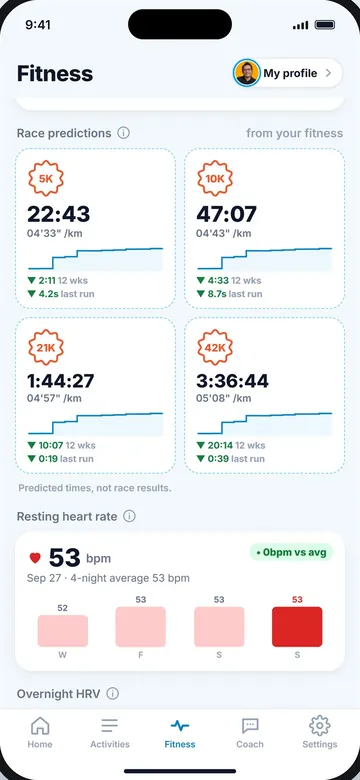
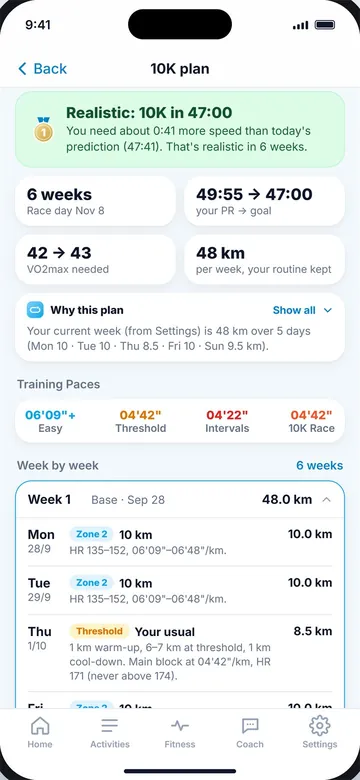
Race predictions (left) and a sub-50 plan (right).
Key takeaways
- Sub-50 for 10K means just under 5:00 per km (8:03 per mile).
- It matches about a 24-minute 5K and a 1:51 half marathon.
- Train with cruise intervals at about 5:05, race-pace reps at 4:58 and long runs of 12 to 16 km.
- Start at 5:02 to 5:05, hold 5:00 through the middle and finish strong.
- From 52 to 54 minutes, 8 to 12 weeks of focused training is often enough.
Frequently asked questions
What pace is a 50 minute 10K?
5:00 per km or 8:03 per mile.
Is a sub-50 10K good?
Yes. It is faster than most recreational 10K finishers and a respected milestone.
What 5K time do I need for a sub-50 10K?
About 24 minutes or a little faster.
How many km a week to run a sub-50 10K?
Most runners do it on about 30 to 45 km a week.
What is a good half marathon time if I can run a sub-50 10K?
About 1:50 to 1:52, if you have trained for the distance with long runs of 16 to 21 km.
Can a beginner run a sub-50 10K?
Usually after a year or more of consistent running. Sub-60 is a great first goal.

Keep reading
RacingHow to run a faster 10KWhy threshold training matters most for 10K, the key workouts, long run length and a pacing plan.10 min read
RacingHow to run a sub-25 minute 5KThe pace you need, the fitness it takes, matching training paces, key sessions and race-day pacing.9 min read
 PaceWhat is threshold pace, and how do you find yours?The pace you can hold for about an hour: where it sits next to your race paces, four ways to find it, and how to train with it.10 min read