Stride length gets less attention than cadence, but it is the other half of how fast you run. Every faster pace comes from taking more steps per minute, covering more ground with each step, or both. Understanding how the two fit together helps you avoid the most common form mistake in running.
What stride length is
Stride length (often called step length in running apps) is the distance you cover with each step, and for most recreational runners it is roughly 0.8 to 1.3 metres, getting longer as you run faster.
Scientists sometimes use "stride" for two steps (left foot to left foot) and "step" for one. Most running watches and apps, including Windlace, show the length of a single step. Just make sure you compare numbers that are measured the same way.
Step length = speed ÷ cadence
Example: 5:00 per km is 200 metres per minute. At 170 steps per minute: 200 ÷ 170 = 1.18 m per step.
What is an average stride length?
There is no single "right" number. Stride length depends on your speed first, and then on your height, leg length, strength and flexibility. A rough guide for single steps:
| Pace | Typical step length |
|---|---|
| Slow jog (7:00+ per km) | 0.75 to 0.95 m |
| Easy run (6:00 to 7:00 per km) | 0.85 to 1.05 m |
| Steady to tempo (4:45 to 6:00 per km) | 1.00 to 1.25 m |
| Fast (under 4:30 per km) | 1.20 to 1.50 m |
| Elite distance racing | 1.70 m and more |
The elite numbers show where speed really comes from. Top distance runners do not take many more steps per minute than good club runners. They cover much more ground per step, because they push off the ground with more force.
How stride and cadence work together
Speed is cadence times step length. As runners speed up from an easy jog to a tempo pace, most of the gain comes from longer steps. Near top speed, step length levels off and cadence rises more. You can see this in the chart above: the step gets longer at each faster pace, while cadence rises more slowly. To learn more about the other half, read What is a good running cadence?
The problem with overstriding
Overstriding means your foot lands far in front of your hips, usually with the knee nearly straight and the heel hitting first. It feels like a way to cover more ground, but each landing acts like a small brake. You lose speed, and more of the impact goes into your knee and hip.
The fix is not to stop landing on your heel. Many good runners land heel first. The fix is to land with your foot closer under your body, with a slightly bent knee. A small cadence increase of 5 to 10% often does this automatically, which is why coaches suggest it so often.
How to check your own stride
- Look at your watch or app data. Note your step length and cadence at an easy pace and at a faster pace.
- Film yourself from the side on a flat road at your normal easy pace, in slow motion if your phone can.
- Pause at the moment your foot lands. Is it under or just in front of your knee (good), or far ahead with a straight leg (overstriding)?
- Repeat at a faster pace. Your step should get longer mostly behind you, from a stronger push-off.
How to improve your stride length safely
The good way to lengthen your stride is to make each push-off more powerful. That comes from strength, elasticity and practice at speed:
- Strength training twice a week: squats, lunges, step-ups and calf raises build the push-off. See Strength training for runners.
- Hill repeats: running uphill forces a strong push from the hips and calves without overstriding. Try hill repeats once a week.
- Strides: 6 × 20 seconds of fast, relaxed running after easy runs teach your body to cover ground smoothly at speed.
- Hip mobility: tight hip flexors limit how far your leg can extend behind you. Gentle lunges and leg swings help.
- Plyometrics, carefully: skipping, bounding and small jumps build springiness. Start with very few reps.
Why stride length shrinks when you are tired
Late in a long run or race, many runners notice their pace falling even though cadence stays about the same. The cause is a shorter step: tired muscles push off with less force, so each step covers less ground. Strength training, good fuelling and well-paced races all help you hold your stride for longer. Comparing your step length in the first and last kilometres of a long run is a simple way to see fatigue in your data.
Does height matter?
Yes, but less than you might think. Taller runners with longer legs tend to have a slightly longer step and a slightly lower cadence at the same pace. But two runners of the same height can differ a lot because of strength and technique. Compare yourself with yourself over time, not with other runners.
Stride length is only half of the speed equation. Read What is a good running cadence? for the other half, and Hill repeats for one of the best ways to build the power behind a longer stride.
How to see your stride in Windlace
- Record or sync a run from your phone or watch. Stride is shown when your device records it.
- Open the run and find the Running form card: it shows your stride (length of each step in centimetres, so 90 means 0.90 m) next to your cadence.
- Compare an easy run with a fast one. Your stride should grow at the faster pace.
- Watch it over months. A longer stride at the same cadence and heart rate is a sign your push-off is getting stronger.
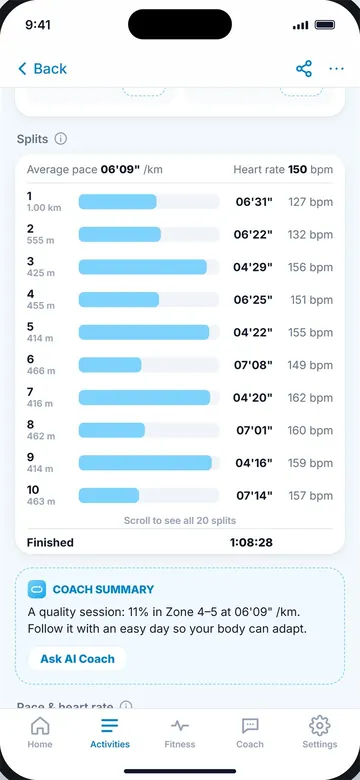
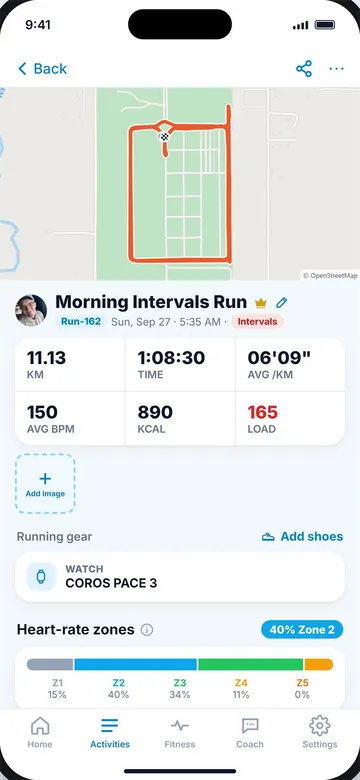
Run details (left) and the run summary (right).
Key takeaways
- Stride (step) length is the distance covered by each step, about 0.8 to 1.3 m for most runners.
- Speed = cadence × step length; going faster usually lengthens the step more than it raises cadence.
- Lengthening your stride by reaching forward (overstriding) brakes you and loads the knee.
- Longer steps should come from a stronger push-off: strength work, hills and strides.
- Stride shortens when you tire, so compare early and late kilometres to see fatigue.
Frequently asked questions
What is a good stride length for running?
It depends on your speed and height. At easy paces, most recreational runners take steps of about 0.85 to 1.05 m. The best stride lands under your body without reaching forward.
Should I take longer strides to run faster?
Not by reaching forward. Build power with strength training, hills and strides, and your step will lengthen naturally.
What is the difference between stride and step?
In science, a stride is two steps (left to left). Most running apps call one step a stride. Check which your device uses before comparing.
Does stride length depend on height?
Partly. Taller runners tend to have slightly longer steps, but strength and technique matter as much.
How do I know if I am overstriding?
Film yourself from the side. If your foot lands far in front of your knee with a straight leg, you are overstriding.

Keep reading
FormWhat is a good running cadence?Why 180 steps per minute is a myth, typical cadence by pace, and how to raise yours safely by 5 to 10%.9 min read
TrainingHow long should your long run be?Simple long run rules by race distance and weekly mileage, the right pace, and how fast to build up.9 min read
TrainingInterval training for runners: a simple guideWhat intervals are, the right pace and rest, six classic workouts and how often to do them safely.10 min read