Cadence is one of the few parts of running form you can measure easily and change gradually. It is also surrounded by a myth: that everyone should run at 180 steps per minute. The truth is more useful, and more personal.
What running cadence means
Running cadence is the number of steps you take per minute (spm), counting both feet; most recreational runners run at roughly 150 to 175 spm on easy runs, and cadence rises naturally as you run faster.
Speed is simply cadence times stride length: how many steps you take and how far each one carries you. To run faster you can take more steps, longer steps, or both. Read more in Stride length: does it matter?
Speed = cadence × step length
Example: 5:00 per km is 200 metres per minute. At 170 steps per minute, each step covers 200 ÷ 170 = 1.18 m.
Where "180" comes from
Coach Jack Daniels counted the steps of elite runners at the 1984 Olympics and found that almost all of them took 180 or more steps per minute. That observation turned into a rule for everyone. But those were elite athletes running at race pace. At easy paces, even elite runners often take fewer steps, and shorter or taller runners naturally differ.
So 180 is not a target for every run. It is better to know your own cadence at each pace, and to check whether a small increase helps. Studies of recreational runners usually find average cadences in the 160s at their normal training pace, well below 180, and plenty of them run healthy and injury-free.
Typical cadence by pace
| Run | Typical cadence |
|---|---|
| Easy jog | 150 to 165 spm |
| Steady run | 160 to 175 spm |
| Tempo or 10K pace | 170 to 185 spm |
| 5K pace and faster | 175 to 195 spm |
| Sprinting | 200+ spm |
Why cadence matters: overstriding and load
A very low cadence often goes together with overstriding: landing with your foot far in front of your body, knee straight, heel first. That acts like a brake on every step and sends more force into the knee and hip.
Research by Heiderscheit and colleagues (2011) found that increasing step rate by 5 to 10% reduced the load on the knee and hip during running. Because of that, a small cadence increase is a common recommendation for runners with knee pain such as runner's knee, and for those who clearly overstride.
How to measure your cadence
- Use your watch or phone: most record cadence automatically from wrist or phone movement.
- Or count: count every time your right foot lands for 30 seconds, then multiply by 4.
- Measure on a normal easy run, on flat ground, after warming up for 10 minutes.
- Note your pace too. Cadence only means something next to the pace you ran.
How to raise your cadence safely, step by step
- Find your current easy-run cadence, for example 160 spm.
- Add 5%, no more: 160 × 1.05 = 168 spm.
- Use a metronome app or a playlist at that beat for a few minutes at a time during easy runs.
- Keep the same pace: take quicker, shorter steps, not faster running.
- Practise for 3 to 4 weeks until it feels natural, then try another small step if needed, up to about 10% in total.
- Add strides and drills, such as 6 × 20 seconds of quick, relaxed running, to make faster turnover feel normal.
Signs a cadence change could help you
Not everyone needs to change their cadence. These are the signs that a small increase is worth trying:
If none of these fit and you run without pain, focus on consistent training instead. Cadence is one part of good running form, not the whole story.
Simple drills for quicker feet
- Strides: 6 × 20 seconds at a fast but relaxed pace after an easy run, walking back between them.
- Quick feet: 3 × 15 seconds of very short, fast steps on the spot or moving slowly forward.
- A-skips: 2 × 20 metres of skipping with your knee up and your foot landing under your hip.
- Short hill repeats: running uphill naturally shortens your stride and raises cadence. See hill repeats.
What else changes cadence
- Hills: cadence often rises uphill (short steps) and can rise or fall downhill.
- Fatigue: cadence tends to drop as you tire late in a long run or race.
- Shoes and surface: very cushioned shoes and soft trails can change your natural rhythm a little.
- Height: taller runners with longer legs often have a slightly lower natural cadence.
Cadence and stride length work together: your speed is simply the two multiplied. Read What is a good stride length? for the other half, and What is a good running pace? to see how they add up to your pace.
How to see your cadence in Windlace
- Record or sync a run from your phone or watch; cadence is recorded automatically when your device measures it.
- Open the run to see your average cadence and how it moved through the run.
- Compare runs at the same pace to see whether your cadence is changing over weeks.
- Ask the AI coach for cadence drills that fit your next easy run.
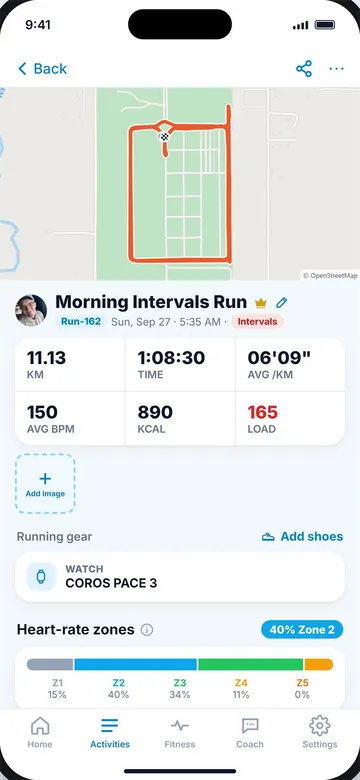
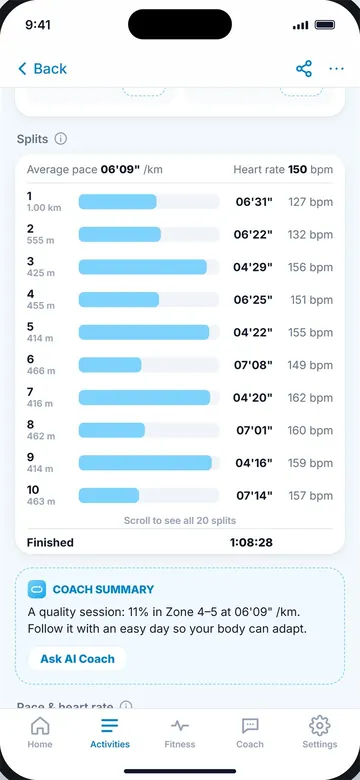
A run summary (left) and its details (right).
Key takeaways
- Cadence is steps per minute; most recreational runners run about 150 to 175 spm on easy runs.
- 180 comes from elite runners at race pace; it is not a rule for every run or every runner.
- Cadence rises with speed, so always look at it next to your pace.
- A 5 to 10% increase can reduce overstriding and load on the knee and hip.
- Raise it slowly: 5% at a time, at the same pace, over several weeks.
Frequently asked questions
What is a good running cadence?
For most recreational runners, about 160 to 175 steps per minute on steady runs, and higher at faster paces. The best cadence is one that feels smooth and avoids overstriding.
Is 180 cadence necessary?
No. It was observed in elite runners at race pace. Many good runners run lower at easy paces.
Will increasing cadence make me faster?
Not directly. It mainly improves efficiency and lowers load per step. Speed comes from fitness and training.
Can a higher cadence prevent injury?
Research shows a 5 to 10% increase reduces knee and hip load, which may help some runners, especially those who overstride.
Does cadence change with height?
Yes, a little. Taller runners with longer legs often have a slightly lower natural cadence at the same pace, which is one reason a single number like 180 does not fit everyone.
How do I count my cadence?
Count how often your right foot lands in 30 seconds and multiply by 4.

Keep reading
FormStride length in running: does it matter?How stride, cadence and speed fit together, what is average, and how to improve your stride safely.9 min read
TrainingHow long should your long run be?Simple long run rules by race distance and weekly mileage, the right pace, and how fast to build up.9 min read
TrainingInterval training for runners: a simple guideWhat intervals are, the right pace and rest, six classic workouts and how often to do them safely.10 min read