"Is my pace good?" is one of the most searched running questions. The honest answer is: it depends on who you are and what the run is for. A pace that is perfect for an easy run would be a poor choice for a race, and a pace that is "slow" for one runner is a big achievement for another.
The short answer
A good running pace is one that matches the purpose of the run and your current fitness: easy runs should feel conversational, often 1 to 2 minutes per km slower than your 5K race pace, while race pace is the fastest you can hold for the distance.
For a sense of scale, many recreational runners finish a 5K race somewhere between 25 and 40 minutes, which is a pace of 5:00 to 8:00 per km (about 8:00 to 12:50 per mile).
Typical paces by level
Here are 5K race paces with the matching easy and threshold paces, based on Jack Daniels' equivalent performance tables. Find the row nearest your own 5K time.
| 5K time | 5K pace | Threshold pace | Marathon pace | Easy pace |
|---|---|---|---|---|
| 30:40 | 6:08 | 6:24 | 6:52 | 7:19 to 8:42 |
| 26:58 | 5:23 | 5:40 | 6:04 | 6:30 to 7:44 |
| 24:06 | 4:49 | 5:05 | 5:26 | 5:50 to 6:59 |
| 21:48 | 4:21 | 4:37 | 4:56 | 5:19 to 6:22 |
| 19:56 | 3:59 | 4:15 | 4:31 | 4:53 to 5:51 |
| 17:02 | 3:24 | 3:40 | 3:52 | 4:13 to 5:04 |
Two things stand out. First, easy pace is far slower than race pace at every level. Second, threshold pace sits only about 15 seconds per km slower than 5K pace, so "comfortably hard" is a narrow band.
The right pace for each kind of run
What affects your pace
- Fitness: the biggest factor, and the one training changes.
- Heat and humidity: can slow the same effort by 10 to 30 seconds per km or more.
- Hills and surface: trails, sand and climbs all slow you down at the same effort.
- Age and sex: on average, pace slows slowly with age, and men are faster on average than women. Age-graded tables account for this.
- Sleep, stress and recent training: a tired runner is a slower runner.
Why pace slows as the distance grows
Every runner slows down as races get longer, in a very regular way. In the table above, the runner with a 24:06 5K runs about 4:49 per km for 5K but about 5:26 per km for a marathon: roughly 37 seconds per km slower. That is not a weakness; it is how the body works. Shorter races can use more of your top aerobic power, while longer races rely on your threshold, fuel and endurance. So a "good" marathon pace always looks slower than a good 5K pace for the same runner.
Pace and age: age grading
If you want to compare your pace fairly with runners of other ages, look at age grading. It compares your time with the best time expected for your age and sex and gives a percentage. Roughly, 60% is a good local standard, 70% is regional class, 80% is national class and 90% approaches world class. A 55-year-old running 26 minutes for 5K can have a higher age grade than a 30-year-old running 23 minutes. It is a fun way to see that "good" depends on who is running.
How to find your own paces, step by step
- Get a recent race or time trial. A hard 5K on a flat route in the last 6 to 8 weeks works well.
- Find your row in the table above, or use a fitness-based app.
- Set your easy pace by feel first: you should be able to talk in full sentences. The table range is a guide.
- Use threshold and interval paces for workouts. Do not run every run at these.
- Update every 6 to 8 weeks as you get fitter, or after a race.
How to make your pace faster
- Run more, mostly easy. Building weekly distance slowly is the biggest long-term lever.
- Add one tempo or threshold session a week. It raises the pace you can hold for longer.
- Add short, fast intervals or strides once a week for speed and form.
- Be consistent for months. Most runners see clear pace gains within 8 to 12 weeks.
Read the full guide: How to run faster: 10 simple tips.
Per km or per mile?
Pace is usually written as minutes per kilometre in most of the world, and minutes per mile in the US and UK. To convert, multiply a per-km pace by 1.609: 5:00 per km is about 8:03 per mile. Our pace conversion chart lists the common paces both ways.
How to see your paces in Windlace
- Add your runs from your phone, your COROS watch or a file.
- Open the Fitness tab. See your threshold pace and the pace for each of your six zones, worked out from your fastest efforts.
- Check your race predictions for 5K to marathon, based on your current fitness.
- Switch between km and miles in settings; every pace updates.
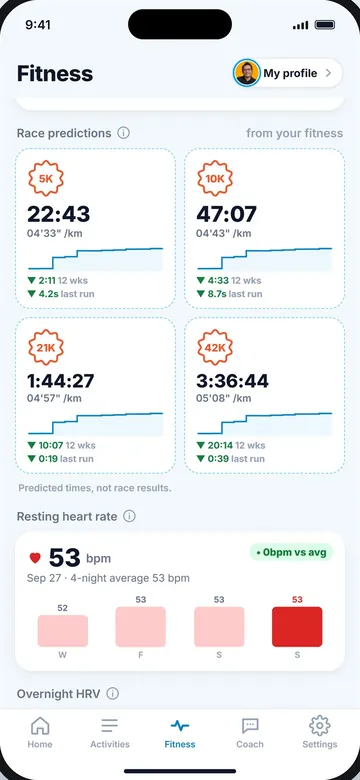
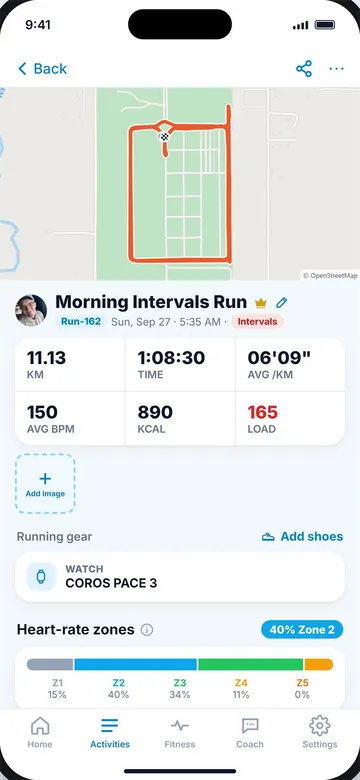
Race predictions (left) and pace on a run (right).
Key takeaways
- A good pace depends on the purpose of the run and your current fitness.
- Many recreational runners race a 5K at about 5:00 to 8:00 per km.
- Easy runs should be conversational, often 1 to 2 minutes per km slower than 5K pace.
- Threshold pace is only about 15 seconds per km slower than 5K pace.
- Spread your paces: slow easy runs, faster workouts, and update them every 6 to 8 weeks.
Frequently asked questions
What is a good running pace for a beginner?
Any pace you can keep while talking is a good beginner pace. For many new runners that is 7:00 to 9:00 per km, or a mix of running and walking.
Is a 6 minute per km pace good?
For an easy run it is a solid pace for many recreational runners. As a 5K race pace it gives a 30:00 finish, which is a common goal for newer runners.
Is 5:00 per km a good pace?
Yes. Running a 5K at 5:00 per km means a 25-minute finish, which is faster than many recreational runners.
What is a good pace per mile?
Many recreational runners race a 5K at about 8:00 to 13:00 per mile. Easy runs are usually 1.5 to 3 minutes per mile slower than 5K pace.
How do I know my easy pace?
Run at a pace where you can talk in full sentences. If you have a recent 5K time, the table above gives a range.

Keep reading
 TrainingHow slow should an easy run be?Four simple ways to find your easy run pace, and why running slowly most days makes you faster.9 min read
 PaceWhat is threshold pace, and how do you find yours?The pace you can hold for about an hour: where it sits next to your race paces, four ways to find it, and how to train with it.10 min read
PacePace vs speed, and a min/km to min/mile chartThe difference between pace and speed, a conversion chart with km/h and mph, and easy formulas for any pace.8 min read