"How many calories did I burn?" is one of the first things many new runners look at after a run. Watches give an exact-looking number, but behind it is a fairly simple idea: moving your body a certain distance takes a certain amount of energy.
The short answer
Running burns roughly 1 calorie (kcal) per kilogram of body weight per kilometre, so a 70 kg runner burns about 70 to 80 kcal per km, or 350 to 400 kcal for 5 km; heavier runners burn more, and pace makes surprisingly little difference.
In miles, that is about 0.75 kcal per pound per mile. A 160 lb runner burns roughly 120 kcal per mile.
The simple formula
Calories ≈ weight (kg) × distance (km) × 1.0 to 1.1
Example: 65 kg × 8 km × 1.05 ≈ 546 kcal. The lower number (1.0) is close to the extra energy running costs; the higher one (1.1) also includes what your body would have burned anyway while resting.
Research on the energy cost of running has found it is fairly constant across a wide range of speeds: roughly 1 kcal per kg per km above resting for most adults. That is why distance matters much more than speed. Running 5 km fast or slowly costs about the same; the fast run just takes less time.
Calories per km and per run
| Weight | Per km | Per mile | 5K | 10K | Half marathon |
|---|---|---|---|---|---|
| 55 kg (121 lb) | 61 | 98 | 305 | 610 | 1,288 |
| 65 kg (143 lb) | 72 | 116 | 361 | 722 | 1,522 |
| 75 kg (165 lb) | 83 | 134 | 416 | 833 | 1,756 |
| 85 kg (187 lb) | 94 | 152 | 472 | 944 | 1,991 |
| 95 kg (209 lb) | 105 | 170 | 527 | 1,055 | 2,225 |
What changes the number
Calories per hour
Pace does matter for calories per hour, simply because you cover more distance in the same time. A 70 kg runner at 7:00 per km covers about 8.6 km an hour, burning roughly 660 kcal. At 5:00 per km they cover 12 km and burn about 920 kcal. Per kilometre, both are similar. So if you have a fixed time to exercise, running faster burns more; if you have a fixed distance, it barely matters.
What about the afterburn?
After exercise, your body keeps using a little more oxygen than normal while it recovers. Scientists call this excess post-exercise oxygen consumption (EPOC), often called the afterburn. After an easy run it is small, typically a few percent of the calories burned during the run. After hard intervals it is larger, but still usually tens of calories rather than hundreds. It is a nice bonus, not a reason to choose one workout over another. The run itself is where nearly all the energy goes.
Where the energy comes from
During a run your body burns a mix of fat and carbohydrate. At easy paces, a larger share comes from fat; as you speed up, carbohydrate takes over. This does not change the total much, but it explains why long runs need fuel: your carbohydrate stores last roughly 90 minutes to 2 hours of hard running. That is why runners take gels or sports drink in longer races.
Running vs walking
Walking costs roughly half as much energy per kilometre as running, around 0.5 to 0.6 kcal per kg per km at a normal pace, because you do not lift your whole body off the ground with each step. Running burns about twice as many calories for the same distance, and about three times as many per hour. More in Running vs walking.
How accurate is your watch?
Watches estimate calories from your weight, age, sex, heart rate and speed. Studies testing popular wrist devices have found that heart rate is usually measured well, but energy (calorie) estimates are often off by 20% or more for individual people. Use your watch's number to compare your own runs, not as an exact count.
- Keep your weight up to date in your watch and app settings; it is the biggest input.
- Gross vs net: some devices count all calories during the run (including resting), others only the extra. This explains many differences between apps.
- Heart-rate glitches push calorie numbers up or down. A run with a bad heart rate trace will have a wrong calorie number too.
Calories and weight loss
Running is a great tool for weight loss, but the numbers need patience. A common rough figure is that a kilogram of body fat stores about 7,700 kcal. A runner burning 400 kcal on four runs a week burns about 1,600 kcal, roughly 0.2 kg of fat, if nothing else changes. Many runners also get hungrier, so food matters as much as running. Read Running for weight loss for a full plan, and what to eat after a run to recover without overeating.
How to estimate your own calories, step by step
- Weigh yourself in kilograms (pounds ÷ 2.2).
- Multiply by the distance in kilometres.
- Multiply by 1.0 for the extra energy from running, or about 1.1 for the total during the run.
- Add about 10% for a clearly hilly route.
Want to burn more without getting hurt? Read How to run longer without getting tired and Is it OK to run every day?
Calories in Windlace
- Runs from your watch use the calories your watch calculated.
- Runs recorded on your phone or added by hand get an estimate of about 1.11 kcal per kg per km, using the body weight in your profile.
- Open a run to see its calories next to distance, pace and training load.
- Share a run: the share image can include calories too.
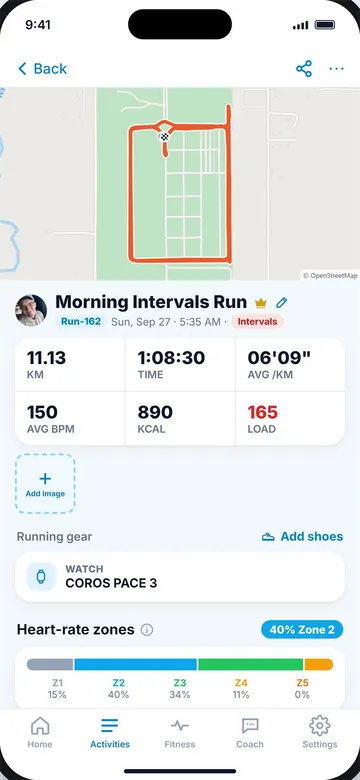
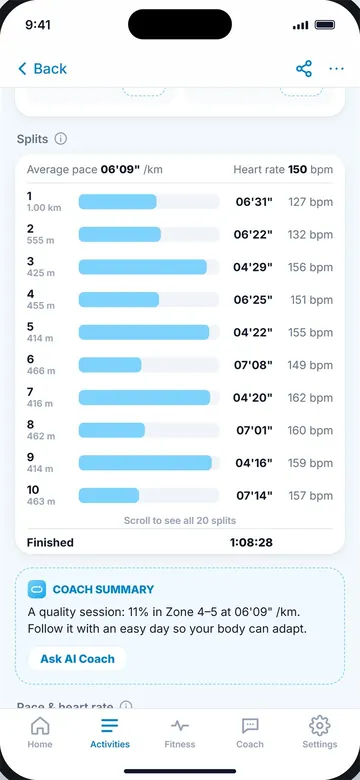
A run summary (left) and its details (right).
Key takeaways
- Running burns roughly 1 to 1.1 kcal per kg of body weight per km.
- A 70 kg runner burns about 350 to 400 kcal over 5 km.
- Distance and weight matter most; pace changes calories per km only a little.
- Walking burns about half as much per km as running.
- Watch calorie numbers can be 20% or more off; use them to compare your own runs.
Frequently asked questions
How many calories does a 5K run burn?
Roughly 300 to 530 kcal depending on body weight: about 1 to 1.1 kcal per kg per km. A 70 kg runner burns about 350 to 390 kcal.
Does running faster burn more calories?
Per kilometre, only a little. Per hour, yes, because you cover more distance.
How many calories does running burn per mile?
About 0.75 kcal per pound per mile, so roughly 100 kcal per mile for a 135 lb runner and 150 kcal for a 200 lb runner.
Is the calorie number on my watch accurate?
It is an estimate. Studies show wrist devices can be 20% or more off for individuals, though they are useful for comparing your own runs.
Does running burn more calories than walking?
Yes, about twice as many per kilometre and about three times as many per hour.

Keep reading
TrainingHow long should your long run be?Simple long run rules by race distance and weekly mileage, the right pace, and how fast to build up.9 min read
TrainingInterval training for runners: a simple guideWhat intervals are, the right pace and rest, six classic workouts and how often to do them safely.10 min read
TrainingWhat is a tempo run, and how do you do one?The right tempo pace, how it differs from threshold runs, five tempo workouts and how often to do them.9 min read