Run streaks are popular: some runners have run every day for decades. At the same time, many coaches recommend rest days for everyone. Both can be right. Running every day is not good or bad on its own. What matters is the total load, how much of it is easy, and whether your body has adapted to it.
The short answer
Running every day can be OK for experienced, healthy runners if most runs are short and easy, there are no more than two hard days a week and they take easier weeks; beginners and runners prone to injury usually do better with 3 to 5 runs and at least one or two rest days a week.
The benefits of daily running
A large study of over 55,000 adults (Lee and colleagues, 2014) found that runners had a lower risk of death from any cause than non-runners, even when they ran only 5 to 10 minutes a day at slow speeds. You do not have to run a lot to get the health benefits.
The risks
- Overuse injuries: running is repetitive, and bones and tendons need time to recover.
- Fatigue that builds up when daily runs are not truly easy.
- Burnout: running because of a streak, not because you want to.
- Running through warning signs to keep a streak alive.
Who it suits, and who it does not
| Runner | Daily running? |
|---|---|
| Beginner (first 6 to 12 months) | Usually not. 3 to 4 runs a week with rest days is safer. |
| Experienced, injury-free runner | Can work well with mostly easy days |
| Runner returning from injury | Not until fully back to normal training |
| High-mileage or marathon runner | Common, often with some very short recovery runs |
| Older runner | Possible, but many prefer an extra easy or rest day |
How to run every day safely
- Build up first: run 5 days a week comfortably for a few months before adding a sixth and seventh day.
- Keep most runs easy: a conversational pace, about 80% of your total time.
- No more than two hard days a week, with easy days around them.
- Use short recovery runs: 20 to 30 minutes, very easy, the day after hard sessions. See What is a recovery run?
- Take easier weeks every 3 to 4 weeks.
- Rotate shoes and surfaces to vary the load on your legs.
- Have a minimum: some streak runners count 1 mile (1.6 km) as a run, so a busy or tired day can be a gentle 10-minute jog.
Thinking about a run streak?
Run streaks can be fun and motivating, and many people do a short streak, such as every day in December or a 30-day challenge. If you try one, set a small daily minimum, keep most days very easy, and decide in advance that you will stop the streak if you feel pain, fever or exhaustion. Health always beats the streak.
Signs daily running is too much
- Easy runs feel harder every week.
- Resting heart rate is up and overnight HRV is down for several days.
- Niggles keep coming back in the same place.
- You dread the next run.
If several apply, take 2 or 3 days off and read Signs of overtraining. A rest day is not a failure; see Rest days for runners.
Example: from 5 days to 7
Lee has run 5 days a week for two years, about 40 km a week, injury-free. Lee wants to try daily running. Instead of adding two full runs, Lee adds two 20-minute recovery jogs on the days after the workout and the long run, keeping the weekly total at about 45 km. The hard days stay the same. After a month, Lee feels fresher, not more tired, because the extra runs are short and very easy. Only then does Lee slowly lengthen some easy runs.
Daily running for weight loss
Short daily runs can help with weight loss, because consistency matters more than any single long session. But running more makes you hungrier, and eating too little while running every day raises the risk of injury and fatigue. Pair daily easy runs with regular, balanced meals, and judge progress over months, not days.
The middle ground
If you love moving every day but your legs do not love running every day, try 4 to 5 runs plus 2 days of low-impact activity: cycling, swimming, walking or yoga. You keep the daily habit and the fitness, with less pounding on bones and tendons.
Run daily with Windlace
- Check your recovery after each run: Fresh, Good, Tired or Exhausted, with hours until recovered.
- Watch training load: it compares this week with your usual 4 weeks, so you can see creeping overload.
- Keep easy days easy by checking the heart rate zones on each run.
- Look at weekly mileage on the Activities tab to see your total, not just the streak.
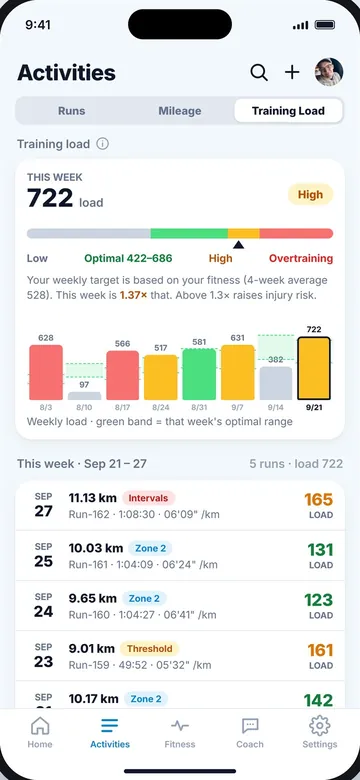
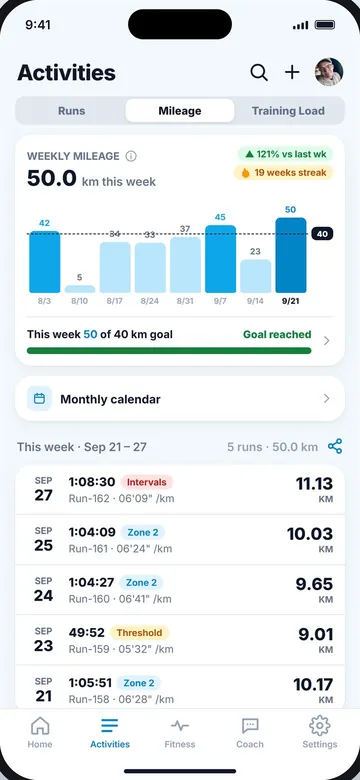
Training load (left) and weekly mileage (right).
Key takeaways
- Running every day can work for experienced, healthy runners if most runs are easy.
- Beginners and injury-prone runners usually do better with 3 to 5 runs a week.
- Keep no more than two hard days a week and use short recovery runs.
- Even 5 to 10 minutes of running a day has been linked to health benefits.
- Stop a streak for pain, fever or exhaustion; health beats the streak.
Frequently asked questions
Is it bad to run every day?
Not for experienced runners who keep most runs easy and short. Beginners should take rest days.
How many days a week should I run?
Most recreational runners do well with 3 to 5. Experienced runners may run 6 or 7.
Can I run every day to lose weight?
Daily easy runs can help, alongside a healthy diet. Build up gradually to avoid injury.
How long should a daily run be?
Many daily runners do 20 to 45 minutes most days, with one longer run a week.
What is a run streak?
Running at least a minimum distance, often 1 mile, every day for as long as possible.

Keep reading
 RecoveryRest days for runners: how many do you need?How many rest days you need by level, what to do on them, and the signs you need a day off.9 min read
 RecoveryWhat is a recovery run, and do you need one?The right recovery run pace and length, when to run one instead of resting, and when to take the day off.9 min read
RecoverySigns of overtraining in runners (and what to do)The early warning signs, how to check your data for them, how to recover and how to avoid it.10 min read