Almost every new runner hits the same wall: a few minutes in, breathing gets hard, legs feel heavy, and stopping feels like the only option. It is easy to think you are just "not a runner". In fact, this usually has a simple cause and a simple fix.
The short answer
To run longer without getting tired, slow down to a pace where you can talk, use run-walk intervals if needed, add a few minutes to one run each week, and run 3 to 4 times a week so your aerobic endurance can grow; most runners can double their run time in 6 to 8 weeks.
Why you get tired so quickly
The most common reason is pace. When you run faster than your aerobic system can supply, your body leans more on fast, short-lived energy, breathing becomes ragged and fatigue builds quickly. At a slower, conversational pace, you can keep going for much longer. Many beginners are surprised by how slow that pace is: often only a little faster than a brisk walk.
Ten ways to run longer
- Slow down. Run at a pace where you can speak in full sentences. This alone often doubles how long you can run.
- Use run-walk. For example, run 4 minutes and walk 1. Walk breaks let you cover more distance with less fatigue.
- Add time slowly. Add 2 to 5 minutes to one run each week, not to every run.
- Run more often. Three to four short runs a week build endurance faster than one long, hard one.
- Breathe from your belly. Relaxed, deep breaths through mouth and nose. Many runners like breathing in for 3 steps and out for 2 or 3.
- Relax your body. Loose shoulders, soft hands, short light steps.
- Pick flat routes while you build. Hills raise the effort quickly.
- Fuel well. Eat a light snack 1 to 2 hours before if you run after work.
- Sleep and recover. Tired legs on day one become heavy legs on day two.
- Distract your mind. Music, a podcast or a running partner makes the minutes pass faster.
The science: Zone 2 builds endurance
Easy running in heart rate Zone 2 trains your body to deliver and use oxygen better. Over weeks, you grow more capillaries and mitochondria, your heart pumps more blood with each beat, and you get better at burning fat for fuel. The result: the same pace feels easier and you can keep it up for longer. Read Zone 2 running for how it works and how to find your zone.
A 6-week plan to double your run time
| Week | Run 1 | Run 2 | Longer run |
|---|---|---|---|
| 1 | 15 min | 15 min | 18 min |
| 2 | 15 min | 18 min | 21 min |
| 3 | 18 min | 18 min | 24 min |
| 4 (easier) | 15 min | 18 min | 20 min |
| 5 | 20 min | 20 min | 27 min |
| 6 | 20 min | 22 min | 30 min |
Use walk breaks whenever you need them. The aim is time on your feet, not running every step.
"I cannot breathe when I run"
Feeling out of breath early is the clearest sign you are going too fast. Try this: run so slowly that you could hum a song. If even that is too hard, walk briskly and add 30-second jogs. Your breathing will settle as your aerobic fitness grows. If you have asthma or breathlessness that seems unusual, talk to a doctor.
When your legs, not your lungs, give up
Sometimes breathing is fine but the legs feel heavy. Muscles and tendons take longer to adapt than heart and lungs. Keep building slowly, add two short strength sessions a week (squats, lunges, calf raises), and make sure your shoes are comfortable and not worn out. Heavy legs every run can also mean you need an extra rest day.
Common mistakes
- Trying to run every run faster than the last.
- Adding distance to every run in the same week.
- Skipping walk breaks out of pride. Walk breaks build endurance too.
- Running on an empty stomach late in the day.
- Comparing your pace with other runners' easy pace.
Heat makes everything harder
On hot, humid days, your heart rate rises at the same pace, and you will tire sooner. Run in the cooler early morning or evening, slow down even more and take water. See Why is my heart rate so high when running? for more on heat and heart rate.
Build endurance with Windlace
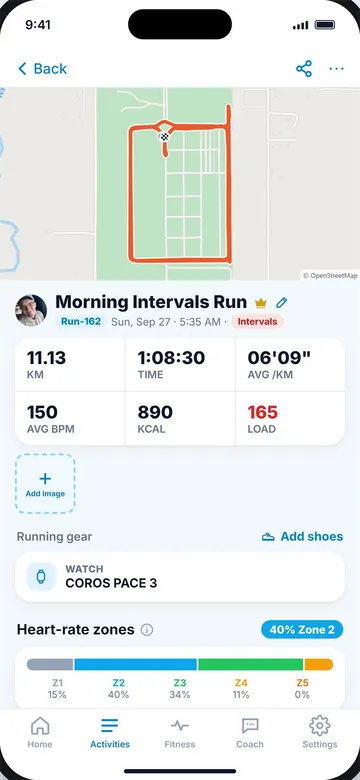
- Open each run to see the time in each heart rate zone. Easy runs should be mostly Zones 1 and 2.
- Watch your weekly running time and distance grow on the Activities tab.
- Check your average Zone 2 pace on the Fitness tab: when it gets faster at the same heart rate, your endurance is growing.
- Use pace effort on hilly routes to see your effort as if the course were flat.
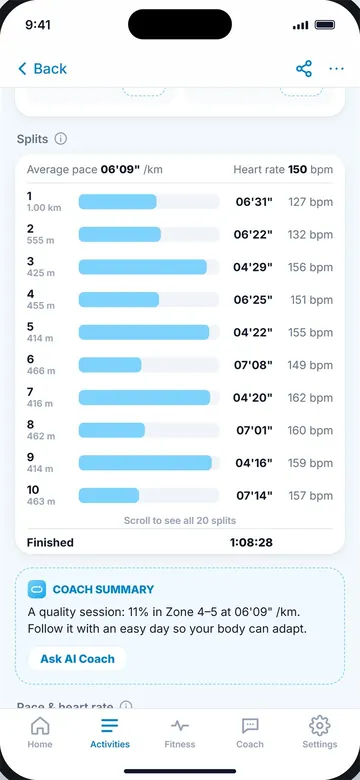
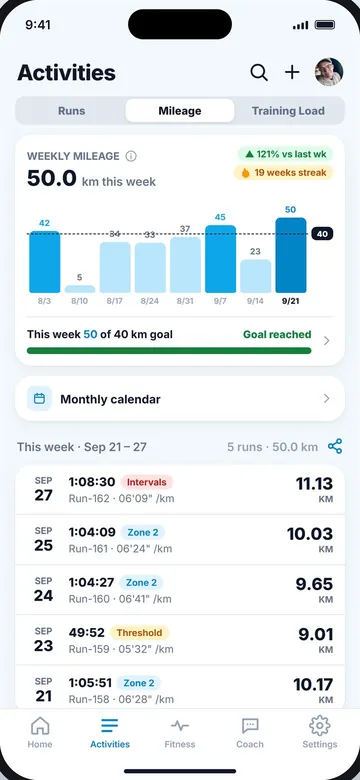
Heart rate zones on a run (left) and weekly mileage (right).
Key takeaways
- The main reason runners tire quickly is running too fast.
- Run at a pace where you can talk, and use walk breaks as needed.
- Add 2 to 5 minutes to one run each week and run 3 to 4 times a week.
- Easy Zone 2 running builds the aerobic engine that lets you run longer.
- Most runners can double their run time in 6 to 8 weeks.
Frequently asked questions
Why do I get tired so fast when running?
Usually because the pace is too fast for your current aerobic fitness. Slow down until you can talk.
How can I increase my running stamina fast?
Run 3 to 4 times a week at an easy pace, add a few minutes to one run each week, and be patient for 6 to 8 weeks.
Is it OK to walk during a run?
Yes. Run-walk is a proven way to build endurance and run longer.
How should I breathe when running?
Relaxed, deep breaths through mouth and nose. If you cannot talk, slow down.
Should I run faster to build stamina?
No. Stamina for longer runs comes mostly from easy running. Faster sessions help later, once you have a base.
How long until I can run 30 minutes?
Most beginners get there in 6 to 10 weeks of regular run-walk training.

Keep reading
Heart rateWhat is Zone 2 running, and why does everyone talk about it?Why slow running makes you faster, how to find your Zone 2 heart rate and pace, and how to use it every week.10 min read
TrainingHow slow should an easy run be?Four simple ways to find your easy run pace, and why running slowly most days makes you faster.9 min read
 BeginnersCouch to 5K: a 9-week plan for complete beginnersA 9-week run-walk plan that takes complete beginners to running 5 km or 30 minutes non-stop.10 min read