Breaking two hours in the half marathon is a goal shared by hundreds of thousands of runners every year. It is a real challenge, but for most healthy runners who train consistently it is very achievable. This guide covers the numbers, the training and the race-day plan.
The short answer
A sub-2 hour half marathon needs an average pace just under 5:41 per km (9:09 per mile), which matches a Daniels fitness level (VDOT) of about 36.5, or roughly a 26-minute 5K and a 54-minute 10K; most runners get there with 4 runs a week and long runs of 16 to 21 km over 10 to 16 weeks.
How fit do you need to be?
| Distance | Equivalent time |
|---|---|
| 5K | about 26:04 |
| 10K | about 54:07 |
| Marathon (fully trained) | about 4:07:45 |
If your recent 10K is around 54 minutes or faster, you likely have the speed for sub-2. The half marathon then becomes a test of endurance, which long runs and steady weekly running build. To check any race result against your goal, see How to set a realistic race goal time.
Your training paces
| Run | Pace per km | Used for |
|---|---|---|
| Easy | 6:18 to 7:31 | Most runs and long runs |
| Half marathon pace | 5:35 to 5:41 | Race-pace blocks in long runs |
| Threshold | about 5:29 | Tempo runs and cruise intervals |
| Intervals | about 5:02 | Short VO2max reps |
Long runs: the heart of half marathon training
Long runs build the endurance that holds 5:41 per km after 15 km, where most sub-2 attempts are won or lost. Build your long run gradually, adding 1 to 2 km a week, to 16 to 18 km at an easy pace. Many runners also go to 19 to 21 km once or twice, 3 to 5 weeks before race day. In the last month, add a block at goal pace inside the long run, such as 6 to 8 km at 5:40 in the second half. See How long should your long run be?
Key sessions
- Tempo: 20 to 30 minutes at about 5:29 per km, or 3 × 10 minutes with 2 minutes jog.
- Goal-pace blocks: 2 × 5 km at 5:38 with 3 minutes jog, later 8 to 10 km continuous.
- Long run: 16 to 21 km easy, with goal-pace finishes in the last month.
- Strides or short reps: 6 × 20 seconds after easy runs, or 6 × 800 m at about 5:02 every few weeks.
A sample week (4 runs, about 35 to 45 km)
| Day | Run |
|---|---|
| Tuesday | Warm-up, 3 × 10 min at 5:29 with 2 min jog, cool-down |
| Wednesday | 40 min easy plus strides |
| Friday | 45 min easy |
| Sunday | Long run: 16 to 18 km easy, last 5 km at 5:40 |
Runners with time for a fifth run can add another easy 30 to 40 minutes. For a full week-by-week plan, read Half marathon training plan.
How long will it take?
Fuel and water
Two hours is long enough that fuel matters. Eat a familiar breakfast 2 to 3 hours before the start. Many runners take one energy gel at about 7 to 8 km and another at 14 to 15 km, with water. Practise this in long runs first, so your stomach is used to it. In warm weather, drink at most aid stations.
Race-day plan
- Km 1 to 2: 5:45 to 5:48. Crowded starts make it easy to waste energy weaving.
- Km 3 to 15: settle at 5:38 to 5:40. It should feel comfortably hard and steady.
- Km 15 to 18: the hardest part. Hold pace; focus on the runner ahead.
- Km 18 to finish: push gradually and empty the tank in the last kilometre.
- GPS: watches often read 200 to 400 m long over a half. Aim for about 5:35 to 5:38 on your watch.
- Pacers: many races have a 2:00 pacer. Start with them, or just behind.
Signs you are ready
- You have run 18 to 21 km comfortably in training.
- 8 to 10 km at 5:38 to 5:40 feels controlled inside a long run.
- A 30-minute tempo at about 5:29 feels strong.
- Your app's half marathon prediction is under 2 hours.
Common mistakes
- Long runs too fast: they should be conversational, about 6:20 to 7:30 per km.
- No practice with gels before race day.
- Skipping the taper: cut distance by about a third in the last 10 to 14 days.
- Choosing a hilly or hot race for a time goal.
Chase sub-2 with Windlace
- Check your half marathon prediction on the Fitness tab, and how it has moved in the last 12 weeks.
- Set 1:59:59 as your target in Break the PR. Windlace rates it as Realistic, Ambitious or Very hard and builds a plan around your weekly schedule.
- Use your pace zones for easy runs, tempo and goal-pace blocks.
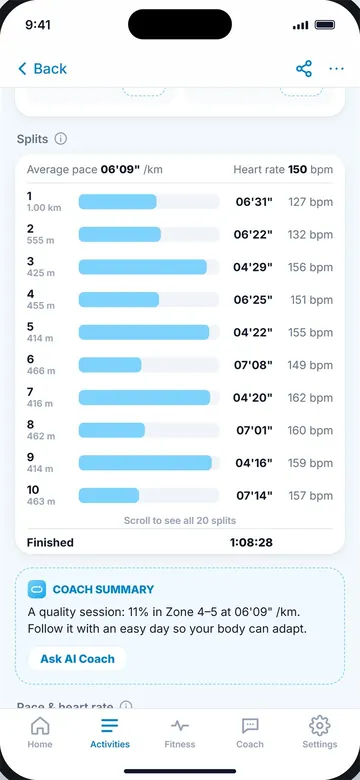
- Check your splits after the race to see how evenly you paced each kilometre.
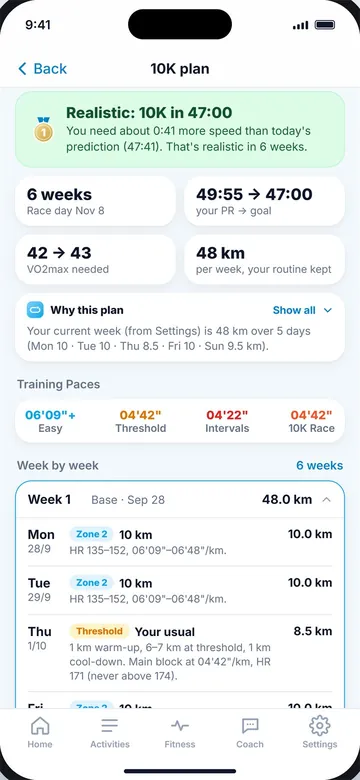
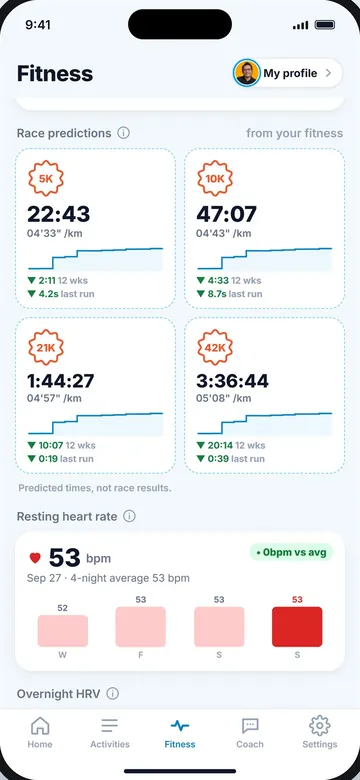
A sub-2 plan (left) and race predictions (right).
Key takeaways
- Sub-2 means just under 5:41 per km (9:09 per mile) for 21.1 km.
- It matches about a 26-minute 5K and a 54-minute 10K in Daniels' tables.
- Build long runs to 16 to 21 km and add goal-pace blocks in the last month.
- Start at 5:45 to 5:48, settle at 5:38 to 5:40 and push in the last 3 km.
- Practise gels in training and aim for 5:35 to 5:38 on your watch to allow for GPS.
Frequently asked questions
What pace is a 2 hour half marathon?
About 5:41 per km or 9:09 per mile.
Is a sub-2 half marathon good?
Yes. It is faster than the average half marathon finish time and a classic goal.
What 10K time do I need for a sub-2 half?
About 54 minutes or faster, according to Daniels' tables.
How long should my longest run be for a sub-2 half?
16 to 21 km. Many runners do one or two runs of 19 to 21 km.
Do I need gels for a half marathon?
Many runners benefit from one or two gels in a 2-hour race. Practise them in training first.

Keep reading
Training plansHalf marathon training plan: 12 weeks, week by weekA 12-week, 4-runs-a-week half marathon plan: long runs, tempo runs and easy days, week by week.11 min read
 TrainingHow long should your long run be?Simple long run rules by race distance and weekly mileage, the right pace, and how fast to build up.9 min read
RacingHow to set a realistic race goal timeUse a recent race and proven formulas, adjust for training and conditions, and test your goal in workouts.10 min read