Here is the puzzle every runner faces: training makes you fitter, but it also makes you tired. The week after your biggest training block, you are the fittest you have ever been, and also too tired to run your best. Racing well means getting the timing right. A simple model, used by coaches for decades, shows you how.
The fitness-fatigue model
In the 1970s, sports scientist Eric Banister described performance as the result of two effects from every training session:
How ready you are to perform is your fitness minus your fatigue. Coaches call this number form, freshness, or training stress balance (TSB).
Form = fitness (6-week load) − fatigue (1-week load)
Example: your 6-week average is 70 a day and your last week averaged 85 a day. Form = 70 − 85 = −15: fit, but tired from a big week.
What your form number means
| Form | What it means |
|---|---|
| Below about −30 | Very tired. Risk of overreaching. Ease off. |
| About −30 to −10 | Productive training. Tired, but building fitness. |
| About −10 to +5 | Neutral. Normal training, fairly fresh. |
| About +5 to +25 | Fresh. Good for racing. |
| Above about +25 | Very fresh, but fitness may start to fade if it lasts. |
Negative form during training is normal and even good: it means you are working. The goal is to turn it positive just in time for the race.
How a taper works
Because fatigue fades in days but fitness fades over weeks, you can cut training before a race and lose tiredness much faster than fitness. That is a taper. Research reviews (for example by Bosquet and colleagues, 2007) found that a taper of about two weeks, cutting volume by roughly 40 to 60% while keeping some intensity, improves performance.
| Race | Taper length | Volume in the last week |
|---|---|---|
| 5K | About 5 to 7 days | About 70% of normal |
| 10K | About 7 to 10 days | About 60 to 70% |
| Half marathon | About 10 to 14 days | About 50 to 60% |
| Marathon | About 2 to 3 weeks | About 40 to 50% |
How to taper, step by step
- Cut distance, not speed. Run shorter, but keep a few short efforts at race pace so your legs stay sharp.
- Keep your usual days. Same number of runs, each a bit shorter. Big changes can leave you feeling flat.
- Do the last hard session 7 to 10 days out for a half or marathon, about 4 to 5 days out for a 5K or 10K.
- Rest more, sleep more. The taper is when your body turns training into fitness.
- Do not cram. No workout in the last week can make you fitter for race day, but one can make you tired.
The limits of the model
- It only sees training. Poor sleep, work stress and illness add fatigue that the numbers miss.
- The 6-week and 1-week windows are averages. Some runners recover faster or slower.
- It needs good load data. Missing runs or bad heart-rate readings make it less accurate.
Use it as a guide, and check it against how you feel, your resting heart rate and your HRV.
How to get race-ready with Windlace
- Watch your training load. The Fitness tab compares this week with your usual 4 weeks. Staying in the optimal range builds fitness safely.
- Check your recovery. Fresh (95 to 100%) on race morning is what you are aiming for.
- Set a PR goal. Pick one distance and target time; the Break the PR plan builds your weeks around your schedule, with lighter weeks before race day.
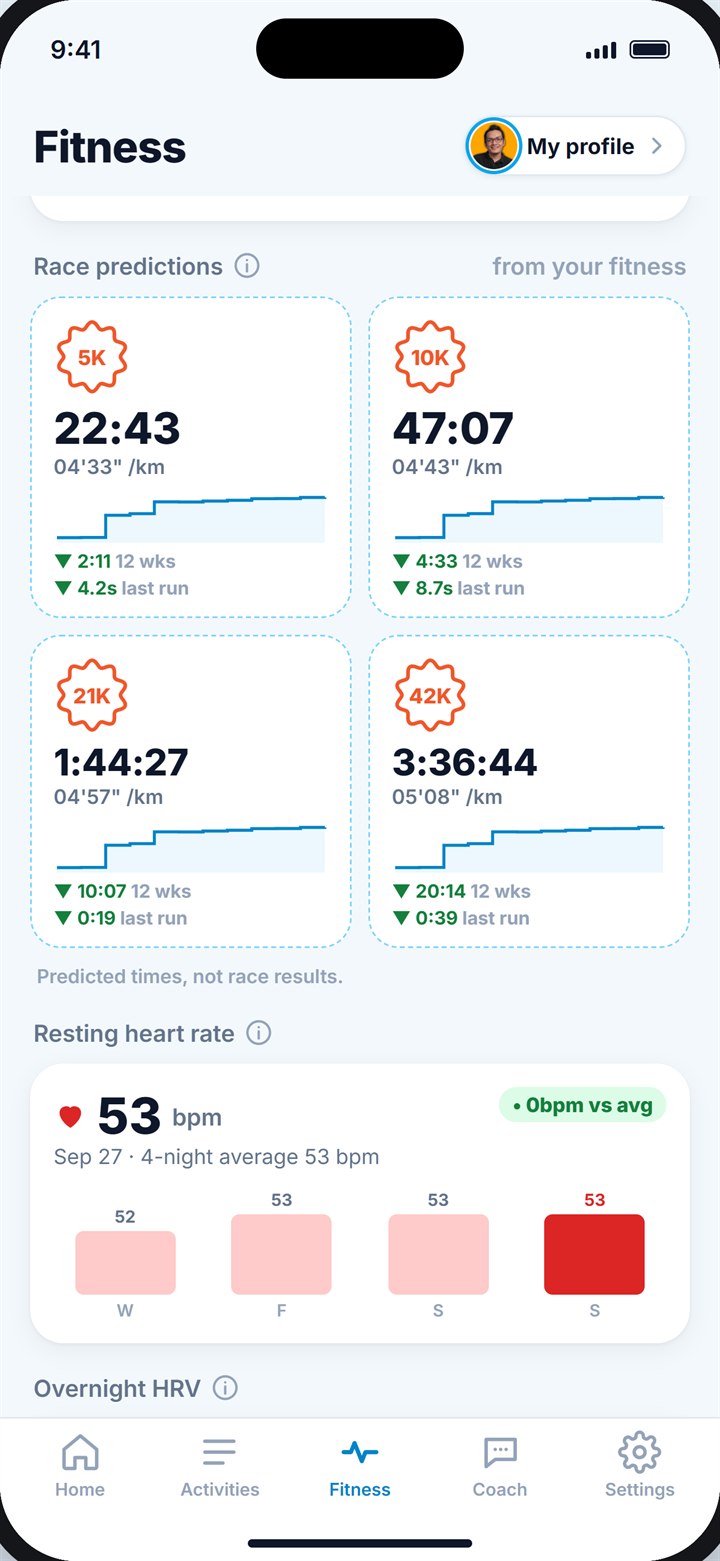
- Check your race prediction to set a realistic target pace.
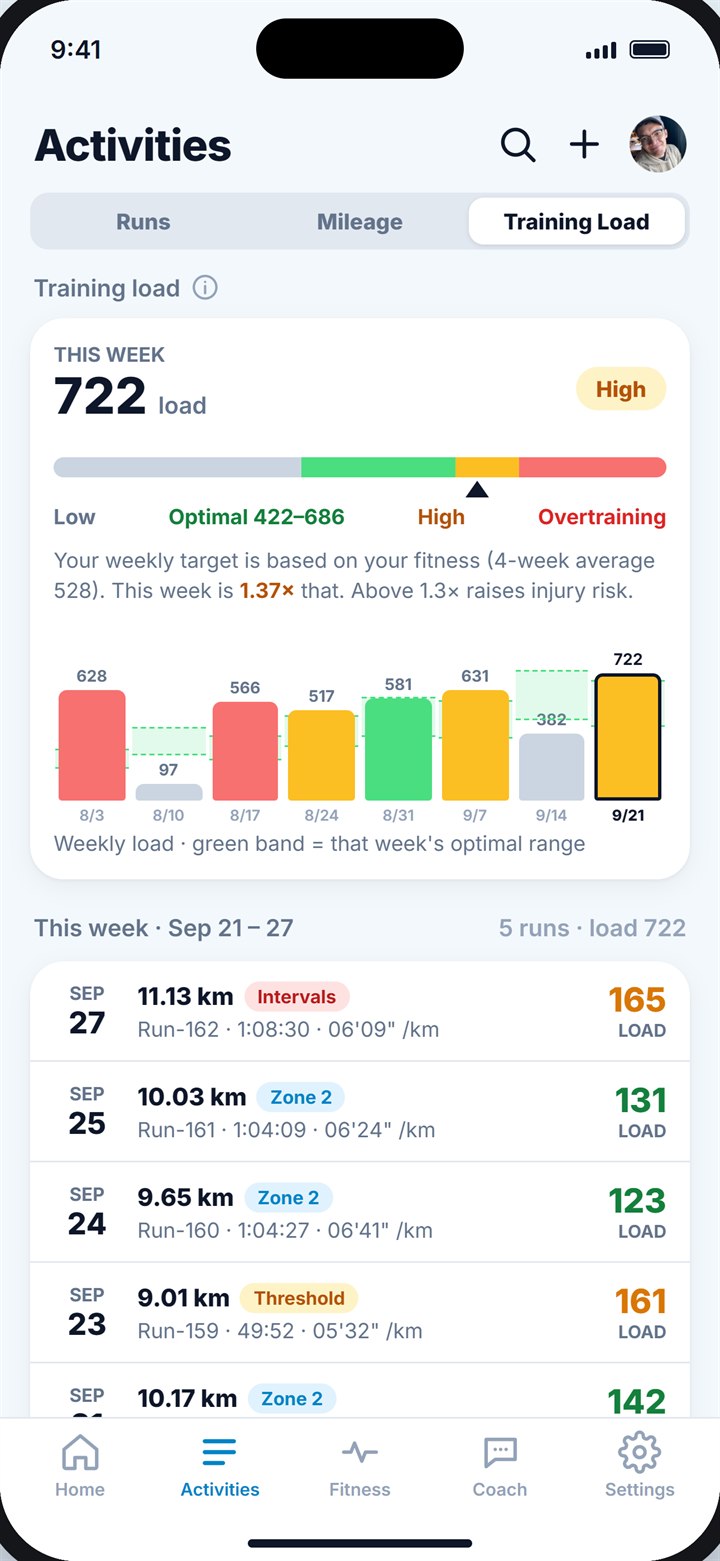
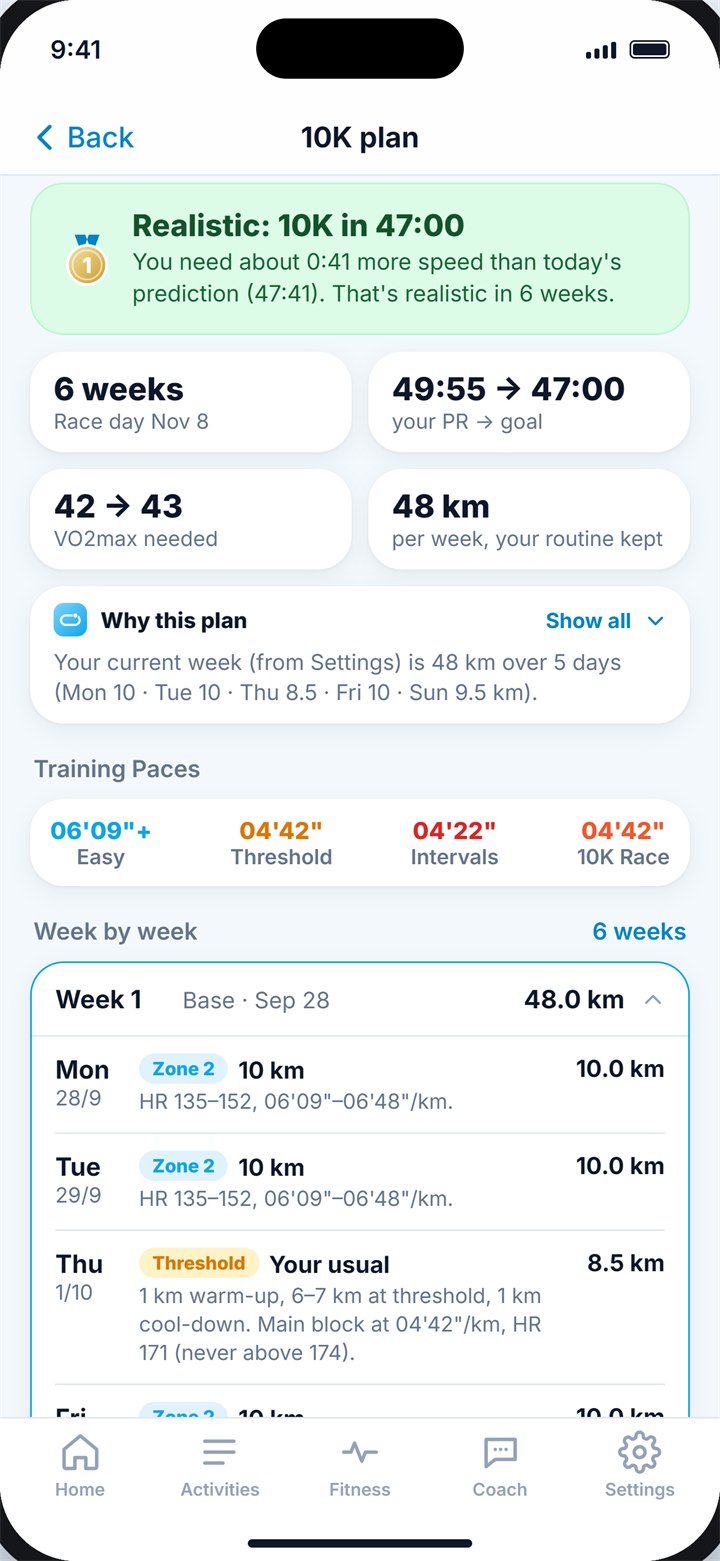
Training load (left) and the Break the PR plan (right).
Key takeaways
- Every run adds fitness (slow to build, slow to fade) and fatigue (fast to build, fast to fade).
- Form = fitness minus fatigue. Negative in hard training is normal; positive is fresh.
- A taper cuts volume by about 40 to 60% but keeps some intensity, so fatigue drops faster than fitness.
- Taper about a week for 5K and 10K, about 2 weeks for a half, 2 to 3 weeks for a marathon.
- The model only sees training: check sleep, stress, heart rate and how you feel too.
Frequently asked questions
What is a good form (TSB) for race day?
Many coaches aim for slightly positive form, roughly +5 to +25, on race day. Exact numbers differ between apps, so look for the trend turning positive in your taper.
What do CTL and ATL mean?
CTL (chronic training load) is fitness, your average load over about 6 weeks. ATL (acute training load) is fatigue, your average load over about 1 week. Form is CTL minus ATL.
Will I lose fitness during a taper?
Very little. Fitness fades over weeks, while a taper lasts one to three weeks and keeps some intensity. You lose far more fatigue than fitness.
Why do I feel bad during my taper?
It is common to feel sluggish or restless as your body repairs and your routine changes. Most runners feel much better by race day.
Should I run the day before a race?
Many runners do a short, easy 15 to 20 minute jog with a few strides. It keeps your legs loose without adding fatigue.

Keep reading
TrainingWhat is training load, and how much is too much?How hard your running really was: how training load is worked out, your optimal range, and how to build up safely.10 min read
RecoveryHow long should you recover after a run?Typical recovery times after easy runs, hard sessions and races, the signs you need more rest, and how to recover faster.9 min read
 RacingHow accurate are race time predictions?How predictors work, why the marathon number is often too fast, and how to turn a prediction into a smart race plan.9 min read