Whether you just finished your first parkrun or have been running for years, it is natural to wonder how your 5K compares. The good news: there is no single "right" time, and almost every finish time is faster than someone else's. Still, some numbers help you see where you stand and what a realistic next goal looks like.
The short answer
Most recreational runners finish a 5K in roughly 25 to 40 minutes; large race datasets put average finish times for men at around 30 to 35 minutes and for women at around 35 to 40 minutes, while a "good" time depends on age and sex, such as about 23 to 25 minutes for men and 26 to 29 minutes for women aged 20 to 49.
Average 5K times
Average times vary a lot depending on which races are counted. Fun runs with many walkers have slower averages; club races and timed parkruns are faster. As a broad guide:
| Runner | Typical 5K time | Pace per km |
|---|---|---|
| Run-walk beginner | 35 to 45 min | 7:00 to 9:00 |
| New runner, running all the way | 30 to 38 min | 6:00 to 7:36 |
| Regular recreational runner | 24 to 32 min | 4:48 to 6:24 |
| Strong club runner | 18 to 23 min | 3:36 to 4:36 |
| Elite | about 13 to 16 min | about 2:36 to 3:12 |
What is a good 5K time by age?
A fairer way to judge a time is to compare it with your age group. The table below shows 5K times that match a "Good" VO2max level for each age group, using the same fitness norms Windlace uses and Jack Daniels' race equivalents. These are not averages; they are a solid, fit level for a recreational runner.
| Age | Men | Women |
|---|---|---|
| 20 to 29 | 23:08 | 26:21 |
| 30 to 39 | 24:06 | 27:38 |
| 40 to 49 | 25:10 | 29:05 |
| 50 to 59 | 26:59 | 31:33 |
| 60+ | 29:05 | 34:31 |
If you run around these times, you are fitter than most people your age. If you are slower, that is normal for many runners, and a great starting point. See the VO2max chart by age for the fitness levels behind this table.
Why age and sex matter
Maximum heart rate and VO2max fall slowly with age, typically by around 1% a year after the 30s in people who do not train, and less in those who stay active. Men on average have higher VO2max values than women, mainly because of differences in body composition and the amount of haemoglobin in the blood. That is why fair comparisons use age groups and separate tables for men and women.
Age grading: the fairest comparison
Age grading compares your time with the best possible time for your age and sex, as a percentage. Many parkruns and race results show it. Roughly: 50 to 60% is a typical recreational level, 60 to 70% is a good club level, 70 to 80% is regional level, and 80%+ is national class. A 60-year-old running 29 minutes can have a higher age grade than a 30-year-old running 25.
Average 5K time for beginners
For a first 5K, finishing is the goal. Many beginners following a couch-to-5K style plan run their first 5K in 30 to 40 minutes, and that is a fantastic achievement. With 3 runs a week for a few months, most new runners take several minutes off that first time. Read Couch to 5K if you are just starting.
5K time to pace
| 5K time | Pace per km | Pace per mile |
|---|---|---|
| 20:00 | 4:00 | 6:26 |
| 25:00 | 5:00 | 8:03 |
| 30:00 | 6:00 | 9:39 |
| 35:00 | 7:00 | 11:16 |
| 40:00 | 8:00 | 12:52 |
For every goal time in between, see the running pace chart.
What affects your 5K time?
How to improve your 5K time
- Run 3 to 4 times a week, mostly at an easy, conversational pace.
- Add one faster session a week, such as 6 × 400 m or 5 × 1 km at 5K effort.
- Do one longer run of 45 to 75 minutes.
- Pace evenly: start a little slower than you think and finish strong.
- Race every 4 to 6 weeks to see progress.
For a full guide, read How to run a faster 5K.
Popular 5K goals
- Finish without walking: the first big milestone.
- Sub-30 (6:00 per km): a common goal in the first year.
- Sub-25 (5:00 per km): read How to run a sub-25 minute 5K.
- Sub-20 (4:00 per km): a strong club-level time.
See where you stand in Windlace
- Check your VO2max level on the Fitness tab, compared with runners of your age and gender.
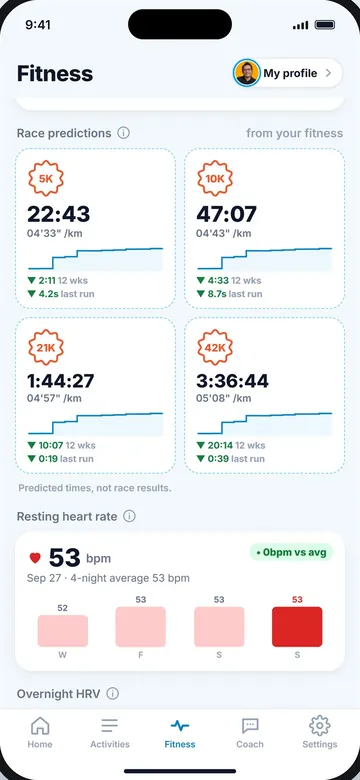
- See your 5K prediction: what you could run today on a flat course, from your runs.
- Find your 5K record: Windlace finds your fastest 5K inside any run, with gold, silver and bronze medals.
- Set a target with Break the PR and get a plan to beat it.
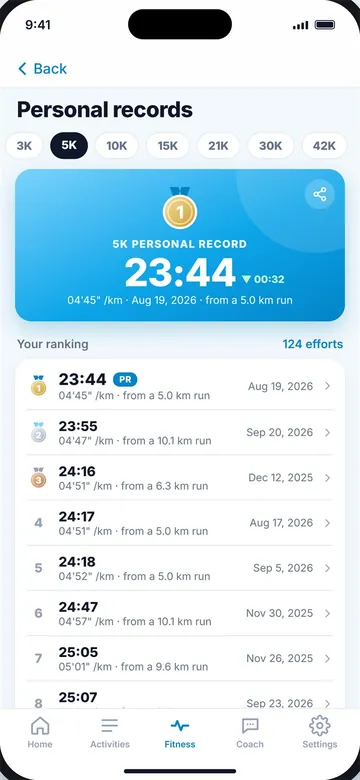
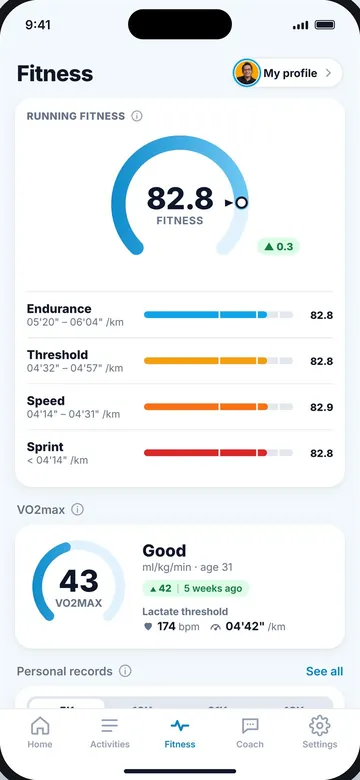
Personal records (left) and fitness level (right).
Key takeaways
- Most recreational runners finish a 5K in roughly 25 to 40 minutes.
- Average race times are roughly 30 to 35 minutes for men and 35 to 40 for women.
- A "good" time depends on age and sex, such as about 24 minutes for men and 28 for women in their 30s.
- Age grading is the fairest way to compare runners of different ages.
- The best comparison is your own time a few months ago.
Frequently asked questions
What is a good 5K time for a beginner?
Finishing is the first goal. Many beginners run 30 to 40 minutes, and sub-30 is a great target for the first year.
Is a 30 minute 5K good?
Yes. It means running at 6:00 per km and is a solid time for many recreational runners.
What is the average 5K time for women?
Large race datasets suggest roughly 35 to 40 minutes, with many regular runners between 27 and 35.
What is the average 5K time for men?
Roughly 30 to 35 minutes in large datasets, with many regular runners between 23 and 30.
What is a good 5K time for a 40 year old?
About 25 minutes for men and 29 minutes for women matches a good fitness level for the 40s.

Keep reading
 RacingHow to run a faster 5KThe four workouts that matter most, an 8-week plan outline, race pacing and how much faster you can get.10 min read
RacingHow to run a sub-25 minute 5KThe pace you need, the fitness it takes, matching training paces, key sessions and race-day pacing.9 min read
FitnessVO2max chart by age and sexVO2max levels for men and women by age, from Poor to Powerful, and what a good VO2max is for you.7 min read