Running is one of the simplest ways to get fitter, clear your head and feel better. It costs very little, you can do it almost anywhere, and you can start today. The biggest mistake new runners make is doing too much, too soon. Start small and the habit grows by itself.
The short answer
To start running, run-walk 3 times a week for 20 to 30 minutes (for example 1 minute running, 2 minutes walking), at a pace where you can still talk, and slowly increase the running parts over 8 to 10 weeks until you can run 30 minutes without stopping.
Your first week
- Walk briskly for 5 minutes to warm up.
- Run gently for 1 minute, then walk for 2 minutes.
- Repeat 6 to 8 times.
- Walk for 5 minutes to cool down.
- Rest a day before the next session.
That is it. It may feel almost too easy, which is perfect. Your heart and lungs adapt in weeks, but your bones, tendons and joints need months.
How fast should you run?
Slower than you think. Beginners should run at a pace where they can talk in full sentences, sometimes called "conversational pace". If you are gasping, slow down or walk. There is no such thing as too slow when you are starting out. Read How slow should an easy run be? for more on easy effort.
How often and how much?
| Stage | Sessions per week | Session length |
|---|---|---|
| Weeks 1 to 4 | 3, with rest days between | 20 to 30 min run-walk |
| Weeks 5 to 10 | 3 | Building to 30 min running |
| Months 3 to 6 | 3 to 4 | 30 to 45 min, one longer run |
A structured plan helps. Our Couch to 5K guide takes you from zero to running 5 km in about 9 weeks.
What you need
For women, a good sports bra makes a big difference. You do not need expensive gear to start.
When to run
The best time to run is the time you will actually do it. Morning runners often find it easier to stay consistent, because the day has not got busy yet. Evening runners often feel looser and faster. In hot climates, run early in the morning or after sunset, and avoid the midday heat. Eat a light snack 1 to 2 hours before if you run after work, and avoid big meals just before a run.
Where to run
Choose a safe, flat route at first: a park, a quiet road, a track or a treadmill. Soft surfaces like grass and trails are kind to your legs but can be uneven. Variety is good. Running with a friend or a beginner group makes it more fun and easier to stick with.
How to avoid injury
- Increase slowly: small steps each week, and repeat a week if it felt hard.
- Rest between runs: at least one day off between sessions at first.
- Listen to pain: mild muscle soreness is normal; sharp or one-sided pain is not.
- Add simple strength work: squats, lunges and calf raises twice a week.
Breathing and form
Breathe through your mouth and nose, whatever feels natural. If you cannot catch your breath, you are going too fast. For form: stand tall, relax your shoulders, keep your arms swinging forward and back, and take short, light steps. Do not worry about your foot strike; most runners settle into a natural pattern.
How to keep going
- Schedule your runs like appointments, on the same days each week.
- Set a small goal, like running 20 minutes non-stop or a 5K in 3 months.
- Track your progress: seeing your weeks add up is very motivating.
- Expect bad days: everyone has runs that feel heavy. One bad run means nothing.
- Celebrate milestones: first 5K, first 10 km week, first month.
What progress looks like
In the first month, the main change is that running starts to feel less hard. By month two or three, most beginners can run 20 to 30 minutes without walking, and their easy pace gets a little faster at the same effort. Weight loss, better sleep and more energy often follow. Progress is rarely a straight line: some weeks feel great, others heavy. Look at the trend over months, not days.
Common beginner mistakes
- Running too fast, so every run feels terrible.
- Running every day in the first weeks.
- Comparing yourself with experienced runners online.
- Stopping after a week off: just start again where you were.
Track your first runs with Windlace
- Record a run with your phone on the Record tab, or link your watch so runs import on their own.
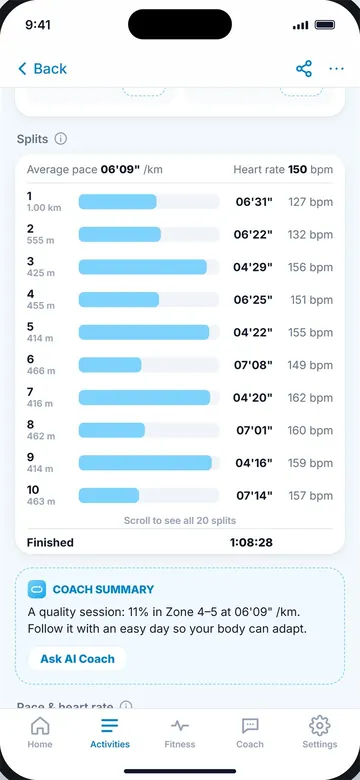
- See every run: distance, time, pace, map and splits.
- Watch your weekly mileage grow on the Activities tab, and set a weekly goal.
- Celebrate your first records: your first 1 km, mile and 5K show up automatically.
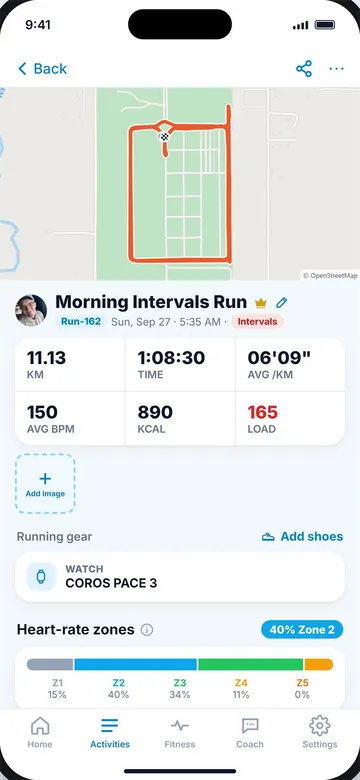
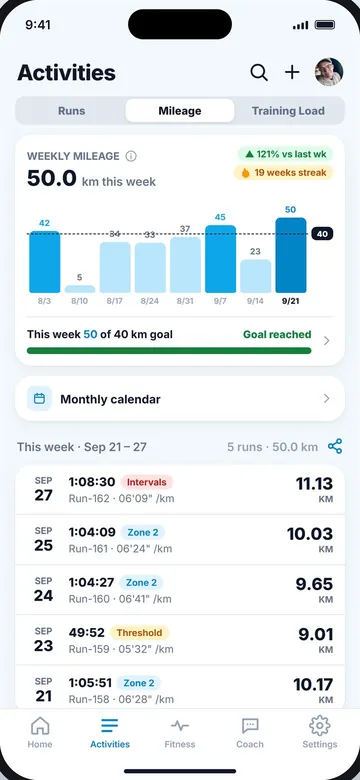
A recorded run (left) and weekly mileage (right).
Key takeaways
- Start with run-walk sessions, 3 times a week, for 20 to 30 minutes.
- Run slowly enough to talk in full sentences.
- Build the running parts over 8 to 10 weeks until you can run 30 minutes.
- Rest between runs and increase slowly; bones and tendons adapt more slowly than lungs.
- Track your runs and set a small goal to keep going.
Frequently asked questions
How should a beginner start running?
Run-walk 3 times a week, such as 1 minute running and 2 minutes walking, for 20 to 30 minutes.
How far should a beginner run?
Focus on time, not distance. 20 to 30 minutes of run-walk is a good start, often 2 to 3 km.
Is it OK to walk when running?
Yes. Walk breaks are a smart way to build up, and many experienced runners use them too.
How long until running gets easier?
Most beginners notice it getting easier within 3 to 4 weeks of regular running.
What should I eat before running?
A light snack like a banana or toast 1 to 2 hours before is enough. Avoid big meals right before a run.
Should I run every day as a beginner?
No. Three days a week, with rest days between, is best at the start.

Keep reading
BeginnersCouch to 5K: a 9-week plan for complete beginnersA 9-week run-walk plan that takes complete beginners to running 5 km or 30 minutes non-stop.10 min read
 TrainingHow slow should an easy run be?Four simple ways to find your easy run pace, and why running slowly most days makes you faster.9 min read
BeginnersHow to run longer without getting tiredSlow down, use run-walk, build time gradually, breathe better, fuel well and build endurance with easy running.9 min read