Not every speed session needs a track, a stopwatch and a plan written to the second. Fartlek, developed in Sweden in the 1930s and 1940s, is speed training at its most natural: you run faster for a while, then slower, mixing it up as you go. It is fun, flexible and surprisingly effective.
What fartlek is
Fartlek (Swedish for "speed play") is a continuous run that mixes faster surges with easier running, usually by time or by landmarks rather than exact distances, so you keep moving the whole way and never fully stop.
The idea is credited to Swedish coach Gösta Holmér, who used it to help Swedish runners compete with the Finnish distance runners of the time. Runners would surge to a tree, a lamp post or the top of a hill, then ease off and recover while still running.
Why fartlek works
Fartlek vs intervals
| Fartlek | Intervals | |
|---|---|---|
| Structure | Loose, by time or landmarks | Exact distances or times |
| Recovery | Easy running, never stopping | Jog, walk or stand |
| Pace | By feel | Target paces |
| Where | Anywhere | Track, measured road or treadmill |
| Best for | Variety, beginners, race surges | Precise VO2max and speed work |
Both have a place. Many runners do fartlek in the early weeks of a training block, then move to more precise interval training closer to race day.
Six fartlek workouts
Each one starts with 10 to 15 minutes of easy running and ends with 10 minutes easy.
| Workout | Main set | Level |
|---|---|---|
| Lamp-post fartlek | Surge to the next lamp post or tree, ease off for two, repeat for 15 minutes | Beginner |
| 1 on, 1 off | 8 to 10 × (1 min fast, 1 min easy) | Beginner to intermediate |
| Pyramid | 1-2-3-2-1 min fast, with half the time easy between | Intermediate |
| Mona fartlek | 2 × 90 s, 4 × 60 s, 4 × 30 s, 4 × 15 s fast, each with equal time easy (20 min) | Intermediate to advanced |
| Hill fartlek | Push every uphill on a rolling route, cruise the flats and downhills | All levels |
| Long-run fartlek | 6 × 3 min at marathon pace inside a 70 to 90 min easy run | Advanced |
The Mona fartlek is named after Australian marathoner Steve Moneghetti. Because the "easy" parts are steady running rather than jogging, it is harder than it looks.
How fast should the fast parts be?
- Surges of 15 to 60 seconds: about 5K effort or a bit faster, effort 8 out of 10. Fast and relaxed, not a sprint.
- Surges of 2 to 3 minutes: about 10K effort, effort 7 out of 10.
- Longer surges: threshold to marathon effort, effort 6 to 7 out of 10.
- Easy parts: your normal easy pace, or a little slower. Keep moving.
How to run your first fartlek, step by step
- Choose a route with few traffic lights: a park loop, a quiet road or a trail.
- Warm up 10 to 15 minutes at an easy pace.
- Do 6 surges of 1 minute at a strong but controlled effort, with 2 minutes of easy running between.
- Keep the surges even. The last one should feel as good as the first.
- Cool down 10 minutes easy. Next week, try 8 surges or shorten the easy parts to 90 seconds.
How often to do fartlek
Once a week, in place of another hard session, is enough. Treat it as a workout: an easy day before and after. In a busy week, a short fartlek inside an easy run (for example 6 × 20 seconds of quick running) adds a little speed without much fatigue. Fartlek also works well in the last week before a race, when you want to stay sharp without long, tiring reps.
Fartlek on trails and hills
Fartlek was born on Swedish forest trails, and it still works best on varied ground. On a rolling route, let the terrain decide: push the uphills, recover on the flat and run the downhills relaxed and quick. This "hill fartlek" builds strength as well as speed, and it is a gentle step towards structured hill repeats. On trails, judge everything by effort, because pace means little on roots, mud and climbs.
Using fartlek to prepare for races
As a race gets closer, make your fartlek surges match the race. For a 5K, surges of 1 to 3 minutes at 5K effort. For a 10K or half marathon, longer surges of 3 to 5 minutes at 10K to half marathon effort, with shorter easy parts between. For a marathon, include surges at marathon pace inside long runs. The structure stays relaxed, but the effort becomes more specific. If you want even steadier race-pace practice, a tempo run is the next step.
Fartlek with friends
Fartlek is a great group workout because runners of different speeds can do it together. One idea: run in a line, and the runner at the back surges to the front, then everyone settles. Or take turns choosing the next landmark. Since nobody has to hit a set pace, slower and faster runners can share the same route and finish together.
Fartlek in Windlace
- Record the run on your phone or watch, pressing lap at each surge if you want clean splits.
- Open the run and look at the pace and heart rate along the run: each surge shows as a peak.
- Check your pace zones: surges should reach your Threshold or Speed zone, and the easy parts your Endurance zone.
- Look at the training load to see how big the session was compared with your normal runs.
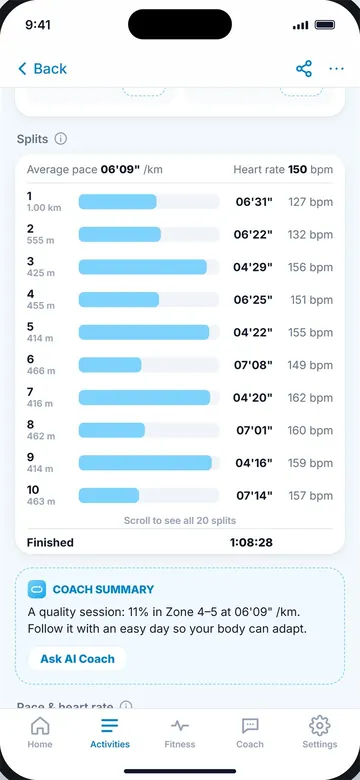
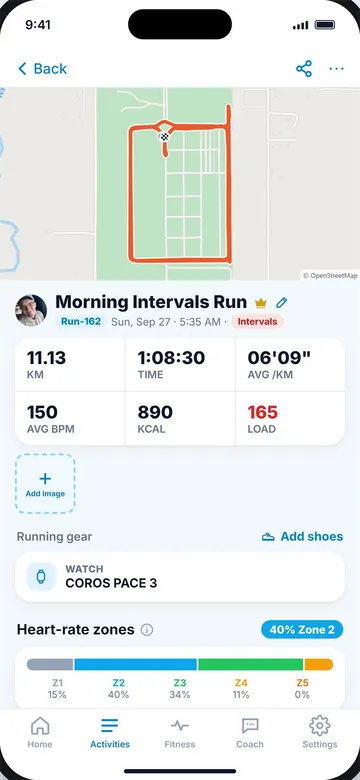
Splits and zones (left) and the run summary (right).
Key takeaways
- Fartlek ("speed play") mixes faster surges with easy running, without stopping.
- It is loose and by feel, using time or landmarks instead of exact distances.
- Start with 6 × 1 minute fast and 2 minutes easy inside an easy run.
- Fast parts should be strong and controlled, not sprints.
- Once a week is enough; it is a great bridge to structured intervals.
Frequently asked questions
What does fartlek mean?
It is Swedish for "speed play": a run that mixes faster and slower running.
Is fartlek good for beginners?
Yes. It is one of the best first speed sessions because there are no exact paces to hit.
How long should a fartlek run be?
Usually 30 to 50 minutes in total, including a 10 to 15 minute warm-up and a 10 minute cool-down.
What is the difference between fartlek and intervals?
Intervals use exact distances or times with set rest; fartlek is looser and you keep running easily between surges.
How fast should fartlek surges be?
For 15 to 60 second surges, around 5K effort or a little faster. Longer surges should be closer to 10K or threshold effort.

Keep reading
TrainingInterval training for runners: a simple guideWhat intervals are, the right pace and rest, six classic workouts and how often to do them safely.10 min read
TrainingWhat is a tempo run, and how do you do one?The right tempo pace, how it differs from threshold runs, five tempo workouts and how often to do them.9 min read
TrainingHill repeats: the workout that makes you strong and fastWhy hill repeats build strength and speed, how steep and long, five hill workouts and good uphill form.9 min read